
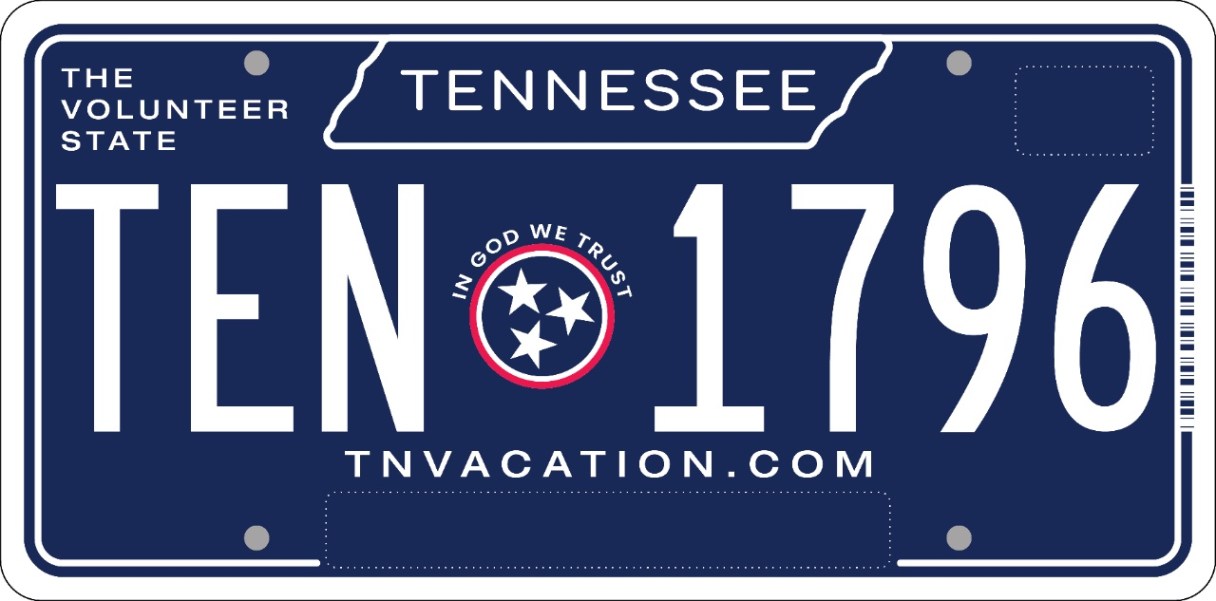
NASHVILLE – When announcing the state’s new license plate last fall following an online contest, Gov. Bill Lee proudly predicted the winning design would “take its place in Tennessee history.”
It may yet. But perhaps not in the way the governor envisioned.
Lee administration officials are examining concerns that Tennessee’s plate design or perhaps the printing process or other issues such as camera quality are producing nighttime photo images that are blurry or downright invisible for infrared license plate readers. The readers are used by police and others to identify suspects and aid in Amber and Silver alerts.
“Both the Department of Safety and Home Security and the Department of Revenue are evaluating claims regarding how [the] new plates interact with license plate readers at night,” Tennessee Department of Revenue spokesperson Kelly Cortesi said in a statement Monday. “Until this evaluation is complete, there will be no changes to the production or renewal process.”
The plates feature a navy blue background with white lettering and numbers plus the state’s “tri-star” emblem. They began being issued in January with 400,000 plates issued so far. The state expects to replace 5.5 million plates by year’s end.
Safety Department spokesperson Wesley Moster stated in a text to the Times Free Press that the agency “is offering assistance to the Tennessee Department of Revenue to find a solution with license plate readers and the newly issued tri-star license plate. It’s premature to say what steps will be taken until all concerns are fully investigated.”
Concerns were first reported by WKRN-TV in Nashville.
By Monday afternoon, the Revenue Department tweeted a statement dismissing a report the state is halting production of the plates.
“Drivers should continue to renew their registration and receive their new plate in the month of renewal,” the statement said.
In a Times Free Press phone interview Sunday, Joe Patty, a retired Memphis Police Department officer who was the department’s video surveillance manager for eight years and now operates his own security firm, said, “There is definitely some vendors out there that have a pretty large footprint in the state of Tennessee, and they’re having some real issues seeing these tags, especially at night. So there’s nothing to give the background contrast compared to the foreground, so the letters don’t pop out.
“It just kind of blurs in, the whole tag,” said Patty, who now also works as a consultant for SkyCop, a national firm that provides audio and video surveillance systems for law enforcement and businesses. SkyCop systems have not had issues, Patty said, noting that in his view the problem “boils down to the optics of the camera.”
He said “manufacturers that have specialized lenses, specialized readers, they’re not having an issue with this tag as much as the people who are just trying to do this with a lower-end camera. … That’s where the real issue’s coming in.”
SkyCop’s Tennessee customers include the affluent city of Belle Meade in Davidson County, and Metro Nashville recently approved use of license plate readers.
“I’m careful not to blame anyone, I just want to make sure that’s clear,” Patty said.
Tim Holman, an electrical engineer in Nashville, told the Times Free Press in a phone interview Saturday he created his own license plate reader and has used it to identify vehicles of people engaged in criminal activity in his neighborhood, sometimes generating arrests.
He said he noticed problems not long after the new plates came out while checking his reader after multiple vehicles were broken into in his neighborhood.
“There was a car full of guys going down my street and smashing windows … to get into vehicles. … I looked and I see the car go by, but [the plate] didn’t record on my [readers]. And it’s like, ‘This is interesting. Oh, you can’t see the letters on that plate.’ It’s just basically a kind of a white rectangle, and you can just barely see the markings on it. I looked at it a little more closely and I said, ‘This is the brand new tags that they’re pushing out to everybody now.'”
After checking his reader records on other tags, Holman said, he saw “they’re all doing the same thing. You can’t see the infrared.”
“It’s not blurry, it’s lack of contrast,” Holman said. “Whenever you image a license plate at night, you have to basically make it so that it reflects in such a way that the letters and the background of the plate are distinct from each other. You got to have high contrast, so it’s got to be dark on light or light on dark, otherwise you can’t read it.”
The problem, he believes, is that the new plate’s “blue background looks great in the daytime. You got the white letters on the blue background. But under infrared light, the blue looks white along with the letters. So it’s very very hard to read the letters. You can just barely make them out, and that’s under the best of conditions.”
It’s even worse if there is moisture present, he added.
Both the Hamilton County Sheriff’s Office and the Chattanooga Police Department say they aren’t aware of any problems yet with their license plate reader operations since the new state tags began going out.
“I spoke to our traffic unit lieutenant, and neither he nor I am aware of any concerns we’ve incurred with the new license plates,” said sheriff’s spokesperson Matt Lea in Friday text to the Times Free Press.
Chattanooga police spokesperson Sgt. Jeremy Eames stated in a Monday email to the Times Free Press that the department is looking into the issue but is not aware of any problems.
The department has 10 readers now in service but is “hoping to add to that soon,” Eames said. Noting the department in the next few months is switching to a new vendor, Motorola-owned Vigilant, Eames said, “We expect a more efficient product than what we currently use.”
Contact Andy Sher at asher@timesfreepress.com or 615-255-0550. Follow him on Twitter @AndySher1.