
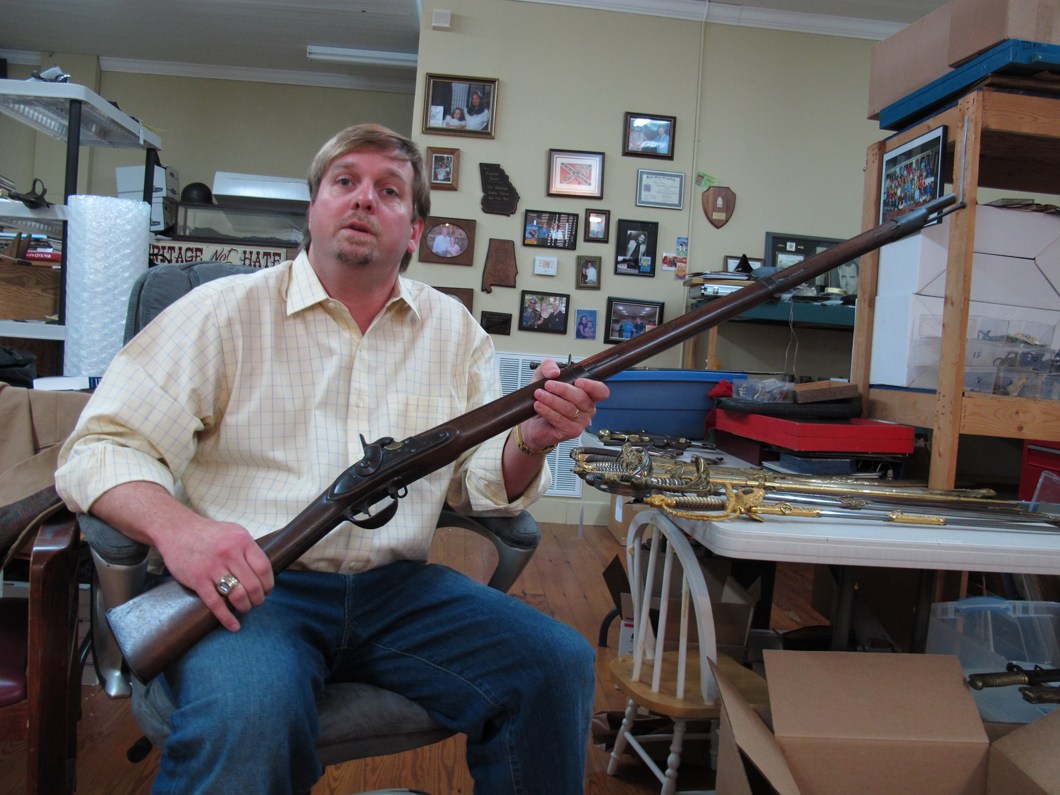
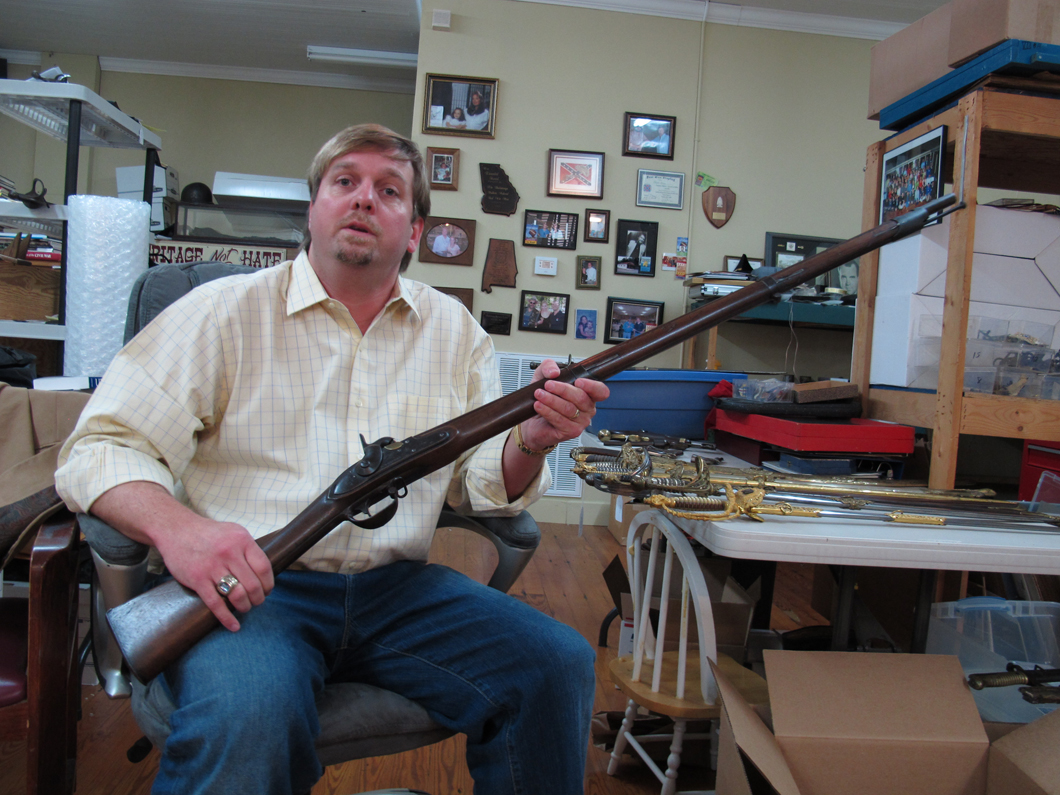
 Civil War relics collector Rafael Eledge poses in Savannah, Tenn., with a musket made in 1831. Eledge says artifacts connect him with meaningful events and people of the past.
SHILOH, Tenn. — Every Civil War bullet, every sword and every musket tells a story.
There’s the .69-caliber musket made in 1831 by a company founded by cotton gin inventor Eli Whitney, the leaden bullet found at bloody Shiloh, the intricately crafted soldier’s sword made by Tiffany and Co.
Since the end of the Civil War, countless artifacts from soldiers’ uniforms to heavy cannons have been found on battlefields, in antique stores and in attics and basements of relatives of Union and Confederate soldiers who fought at Gettysburg, Vicksburg and the other big battlefields of the past. These are the relics left behind that recall individual and collective stories of struggle between North and South.
Some relics ended up in museums. Others ended up with collectors, who set up display booths at collectors’ shows and now use the Internet to show and sell artifacts to Civil War buffs from Tennessee to Tokyo.
Collector Rafael Eledge has some rare relics from the pivotal April 1862 Battle of Shiloh in Tennessee. He says artifacts connect him with meaningful events and people of the past.
“It makes you wonder: What happened to the soldier that lost this?” said Eledge, who appears on “Antiques Roadshow” on PBS. “Did he ever get to see his family? Those guys never knew if they were going to be back.”
On an overcast March day, visitors walked among soldiers’ graves at the riverfront National Cemetery, while others drove around the park and stopped to read markers designating the key battles. Light-blue cannons mark important battle positions such as the Hornet’s Nest, where the Union Army held off the Confederacy amid flying bullets.
Visiting battlefields is a good way to relive Civil War conflicts. Collecting the relics is another way.
The Shiloh National Military Park, with its National Cemetery, is a somber reminder of the fierce fight over a chunk of land some 150 miles southwest of Nashville. Shiloh’s proximity to the Tennessee River and to vital railroad lines made this swath of farmland, woods and open fields a strategic necessity for Union Gen. Ulysses S. Grant on his incursion into the South.
About 45,000 Confederate soldiers attacked on April 6, and what ensued was a battle filled with musket and cannon fire. The Union narrowly escaped with a victory, but it suffered 13,000 casualties. Confederate forces had about 10,700 dead or wounded, and the North eventually took Corinth.
The state of Tennessee plans several events through April 7 to commemorate the battle. More than 5,000 re-enactors are expected to descend on Shiloh; a historic locomotive will carry them to the battlefield in passenger cars, stopping in Kansas City, Jefferson City, Mo., St. Louis and Memphis on the way.
Besides the re-enactors, there are the relic collectors. They began their trade in Civil War gear when relatives of war veterans began selling or giving away items that veterans either kept after surviving the war or that were sent home after the soldier had died. Some items began showing up in antique stores.
Eledge’s collection includes belt buckles, buttons, swords, pistols, muskets — even a Confederate hat. He has about 4 million photos of items in his collection at one time or another, though his inventory is currently about 2,000.
His collection began with a Confederate sword, bought with $60 his father lent him. He took the sword to the Nashville Civil War show, and got $1,450 in cash and trade in return.
Some collectors pay several thousand dollars for cannons. At about $2 dollars, bullets are probably the cheapest items available.
But Eledge says fakes and mistakes with Civil War relics can be a problem. He urges buyers to consult appraisers, veteran collectors and reference books to ensure the authenticity of the items in question.
Nowadays with the advent of the Internet, relic hunters can peruse Web pages and place orders within minutes, rather than waiting for a once-a-year-show or ordering from a clunky catalog.