
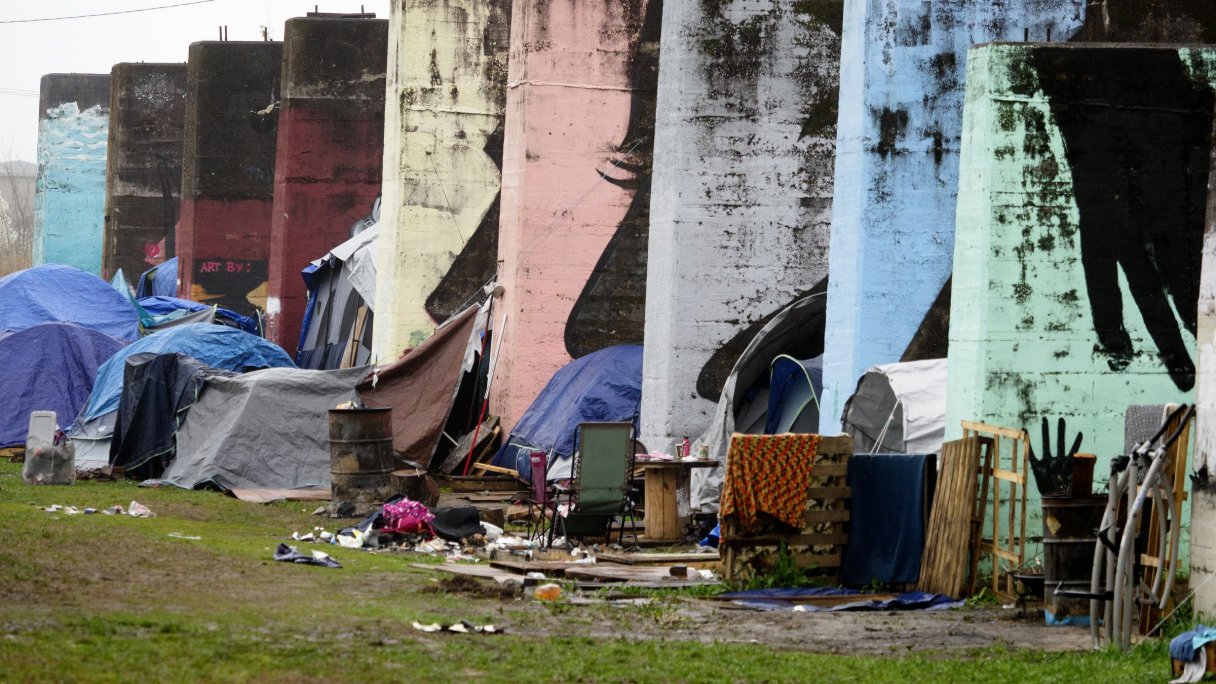
A local advisory board of young people with direct experience with homelessness will help steer federal dollars coming to the Chattanooga region to address youth homelessness.
The Young Adult Advocacy Board is helping advise the Chattanooga Regional Homeless Coalition about issues involving youth homelessness. The coalition recently received a $2.2 million grant from the U.S. Department of Housing and Urban Development to address the problem.
Jas Snell, chair of the advocacy board, said the group has an opportunity to help people in ways members of the board were helped when they were experiencing homelessness.
“To now have the ability to structure, fund and implement those acts as a programming and policy will be a gift to those who may be in need now and those who are at risk of experiencing homelessness,” Snell said. “So this is just a fabulous opportunity to continue our boots on the ground with a lot of support from the community and a financial aspect.”
The Chattanooga Regional Homeless Coalition and the advocacy board are working to end youth homelessness in the area using a plan scheduled to be released in the spring. Wendy Winters, executive director of the coalition, said the $2.2 million grant will be used to fund projects that meet that goal and address priorities outlined in the plan.
“The priorities that are set for the projects that will be funded will also be set by youth with lived experience, who will be providing that voice and informing us on the things that need to be addressed with these funds,” Winters said.
Many youths who are at risk or who meet the definition of being homeless do not realize the severity or the fragility of their situation, said Dallas Williams, a member of the advocacy board.
“It’s not that far of a leap from being couch surfing into being, for instance, one of the people we have on the street that are chronically homeless,” he said. “And there’s that mindset of, well, there’s other people that have it worse off than me.”
On a single day in January, local workers counted 69 people ages 18 to 24 who were homeless, a jump from previous years, when the count tallied 46 in 2020 and 27 in 2019. Across the region, there was a sharp increase in homelessness in 2020, with many pointing to the COVID-19 pandemic as a cause.
Because young people may be staying with friends, moving from house to house or even living in their cars, they may not classify themselves as homeless or be accessing services in the same way older people do. Williams said most of the young people he has encountered as an outreach worker are living in their cars and do not go to 11th Street, where services such as the free health clinic or the Community Kitchen operate.
Snell said the board is looking to raise awareness about services through social media and partnerships with local schools, such as Chattanooga State Community College.
Snell said the advocacy board is a different approach than other experiences she has had working in the service field.
“Nothing should be developed for any population if it’s not coming from them or made in partnership with them. And this is an opportunity to truly lay the foundation for how we serve populations, in this case, young adults experiencing homelessness,” Snell said. “But that can extend to a lot of other populations. It’s more than having a seat at the table. It’s truly understanding circumstances, what’s being assessed in decision making, having a hand in the development of decisions and then still being around to see the results and alter things as needed.”
Contact Wyatt Massey at wmassey@timesfreepress.com or 423-757-6249. Follow him on Twitter @news4mass.