
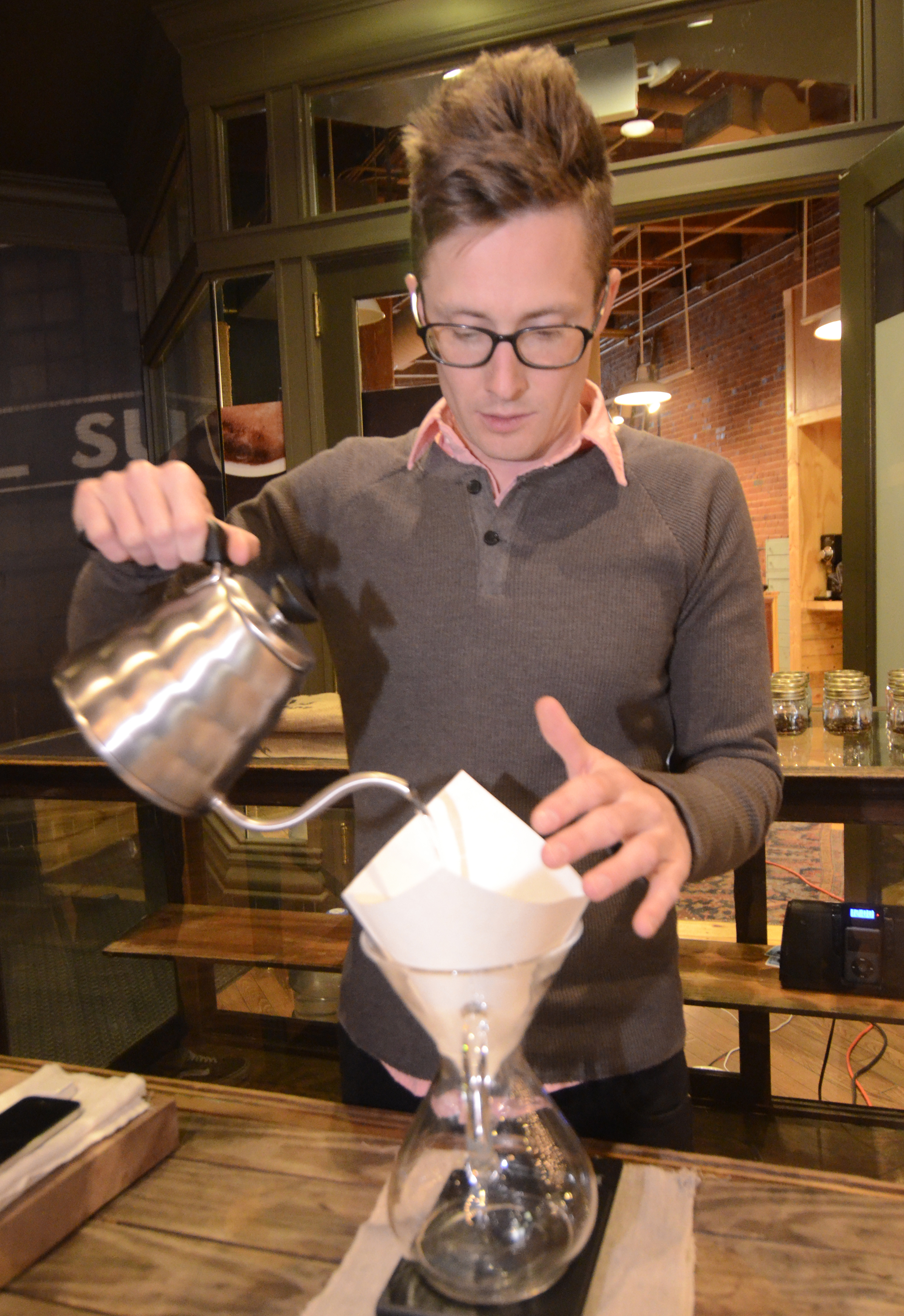
 Local barista Matt Ludwikowski, who owns Brash, a new coffee shop in Warehouse Row, hand-brews each cup
of coffee he serves. To begin the three-minutes process, he warms and rinses the coffee filter before adding
fresh-ground beans.
HAND-POURED COFFEE BASICSIngredientsFresh-roasted coffee (0.5-0.7 ounces per fluid ounce of water)Hot water (195-205 degrees)GrinderBrew basket or conePaper or metallic fiber filterMeasuring spoon or scaleCup(s) and/or thermal carafeDIRECTIONS* Place paper or metallic fiber filter into brew basket. Use a small amount of hot water to pre-wet paper filters (to avoid paper taste). Dispose of water used for pre-wetting.* Place brew basket above cup, carafe, or pitcher.* Measure and grind coffee; final grind size should be about the size of granulated table salt. Burr grinders generally offer better performance, but if using a blade grinder, grind in short bursts and give the grinder a few firm shakes between grinds.* Add ground coffee to filter. Use 0.5-0.7 ounces of freshly ground coffee per fluid ounce of water.* Heat and add water.* With a gentle pour, saturate the grounds with water, allowing the coffee to “bloom.” Try to add only enough water to saturate the grounds; stop before coffee starts to flow from bottom of filter.* Carefully pour remaining water and control brewing time (3-4 minutes total) by slowing or stopping the pour as needed. keeping the water level in the cone between ½ and ¾ full in the cone is recommended for optimum brewing.* Brewing is complete when the drip becomes irregular, instead of a steady flow, within recommended time parameters.* Serve immediately.Source: counterculturecoffee.com
COFFEE STATSAND FACTS* Almost 112 million tons of coffee beans were imported around the world in 2013.* The U.S. imported almost 27 million tons in 2013, and Americans drink 400 million cups of coffee a day.* It is believed coffee trees originated in the Ethiopian province of Kaffay, and the fruit itself was first tried by a goat herder who noticedhow it pepped up his herd when they ate it.* It became an international commodity around the 15th century and is today considered one of the world’s most important products.* Around 1668, coffee houses popped up in larger American cities like Philadelphia, Boston and New York.* Both the New York Stock Exchange and the Bank of New York began in coffee houses.Source: International Coffee Organization and National Coffee Association
There is a good chance that you’re drinking a cup of coffee as you read this, but how much thought did you put into where it came from, how it was harvested, ground, roasted and brewed, or if the water temperature was in the recommended 195- to 205-degree range?
Serious coffee crafters and drinkers are pondering all that and more. Like cigars a decade ago and craft beers more recently, people are discovering there is more to having a good cup of coffee than choosing a favorite brand or a sugary additive.
This new wave of coffee lovers doesn’t begrudge anyone who wants a little pumpkin spice or cream and sugar in their mug, mind you, but they believe a really good cup has very little added to it. For them, it’s all about how you get from bean on the bush to coffee in the cup.