
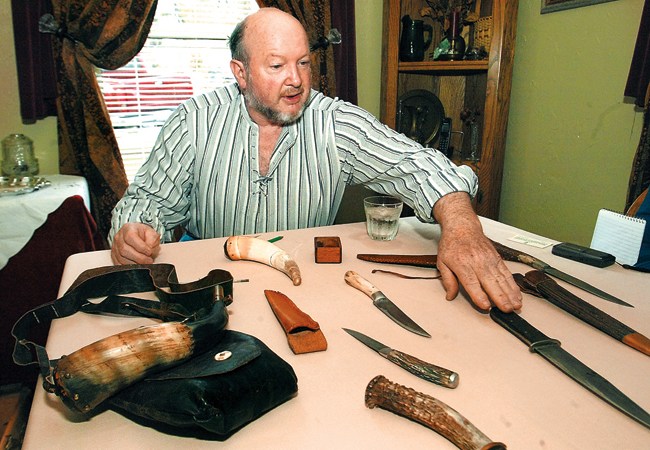
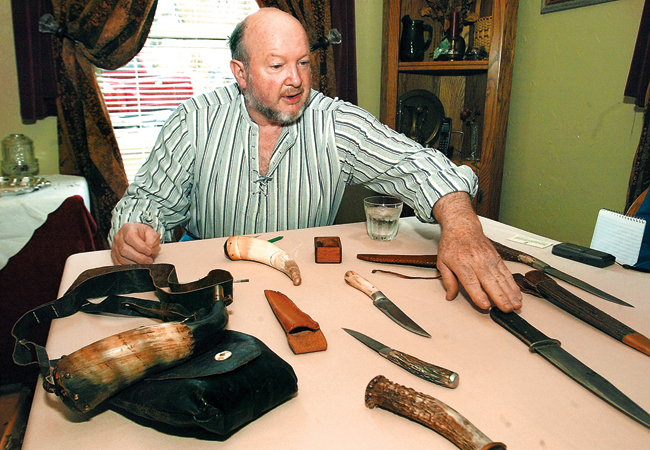
 Lonnie McMillan displays some of the hunting knives he makes as he talks about the tools of life from the 1700s and 1800s, in Marysville, Tenn. Years ago, when he couldn’t afford period attire for his duties as a re-enactor, he began making weapons as a hobby. “I came to the conclusion that it was cheaper to make the weapons myself,” McMillan said.
AP Photo/The Daily Times, Tom Sherlin
MARYVILLE, Tenn.-Years ago when Lonnie McMillan couldn’t afford all the period attire for his duties as a re-enactor, another hobby was set into motion that has long since taken over as his favorite challenge.
“I came to the conclusion that it was cheaper to make the weapons myself,” McMillan said as he laid some of his recent creations on the dining room table. “I was raising a family and couldn’t afford to buy it.”
That was back in the 1980s. McMillan got some experts to teach him the metallurgy part of making the hunting knives, and others showed him how to take the deer and elk horns, bones and wood to carve out the handles. To make sure the weapons he was making were correct to the period he wanted to imitate – namely the 1700s and 1800s – he also used Madison Grant as a teacher. A picture book by Grant was the pattern he adopted.
McMillan reached down and chose one of his knives with a history behind it. This one happens to be a replica of a famous Revolutionary War veteran, he explained. Isaac Shelby was a veteran of that war who then became the first governor of Kentucky. A man in North Carolina has Shelby’s hunting knife and McMillan has made his own copies of it.
Then there’s the bowie knife, named for Jim Bowie. No one really knows what Bowie’s personal hunting knife looked like, but they know the maker was James Black. “This one is a replica of one of James Black’s knives now in the Arkansas State Museum,” McMillan said.