
Monday, November 16, 2026Nov 16

Norway leader joins ‘napalm girl’ protest against Facebook

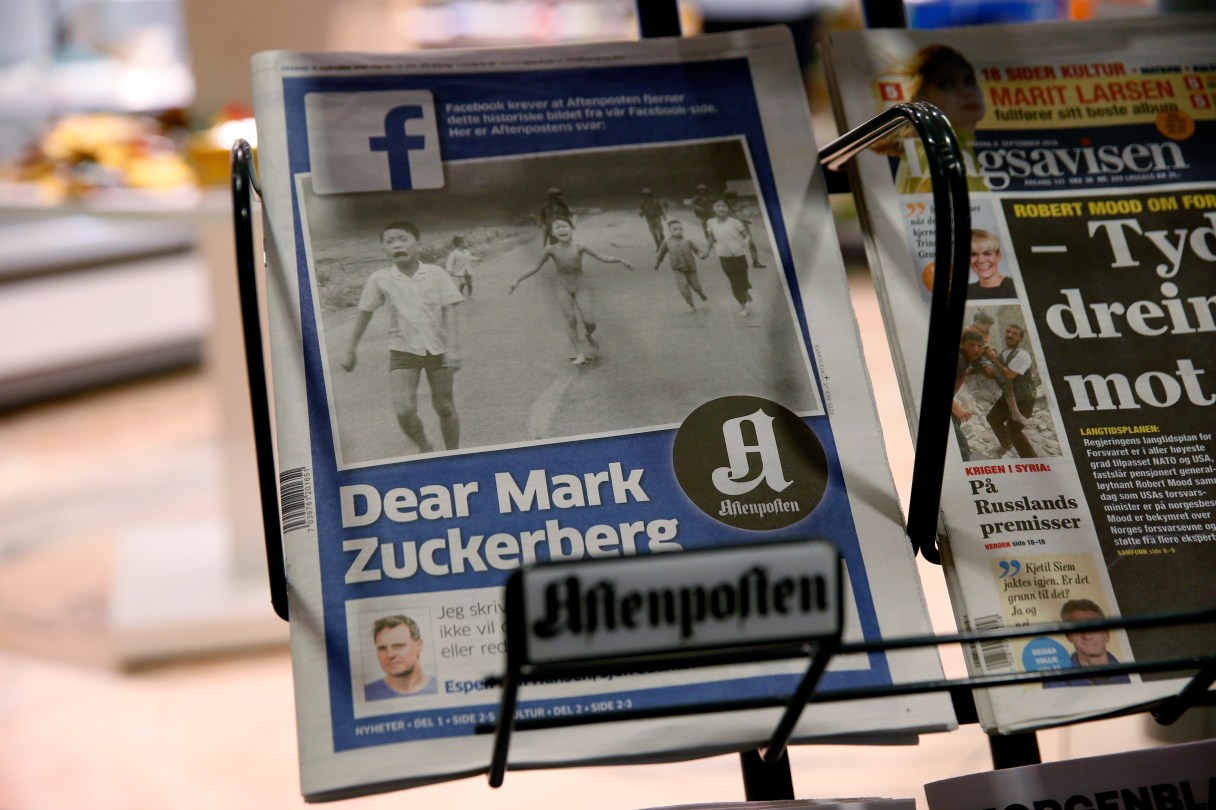
The cover to Norway's largest circulation newspaper, Aftenposten, displayed in Oslo Friday Sept. 9, 2016. Editor-in-chief and CEO, Espen Egil Hansen, wrote an open letter to founder and CEO of Facebook, Mark Zuckerberg, accusing him of threatening the freedom of speech and abusing power after deleting the iconic picture from the Vietnam war, taken by Associated Press photographer  Nick Ut, of a young girl running from a napalm attack. The Pulitzer Prize-winning image by Nick Ut is at the center of a heated debate about freedom of speech in Norway after Facebook deleted it from a Norwegian author's page. (Cornelius Poppe, NTB scanpix via AP)
The cover to Norway's largest circulation newspaper, Aftenposten, displayed in Oslo Friday Sept. 9, 2016. Editor-in-chief and CEO, Espen Egil Hansen, wrote an open letter to founder and CEO of Facebook, Mark Zuckerberg, accusing him of threatening the freedom of speech and abusing power after deleting the iconic picture from the Vietnam war, taken by Associated Press photographer Nick Ut, of a young girl running from a napalm attack. The Pulitzer Prize-winning image by Nick Ut is at the center of a heated debate about freedom of speech in Norway after Facebook deleted it from a Norwegian author's page. (Cornelius Poppe, NTB scanpix via AP)

COPENHAGEN, Denmark (AP) – Norway’s prime minister on Friday challenged Facebook’s restrictions on nude photos by posting an iconic 1972 image of a naked, screaming girl running from a napalm attack in Vietnam. Facebook quickly deleted it.

The Pulitzer Prize-winning image by Associated Press photographer Nick Ut is at the center of a heated debate about freedom of speech in Norway after Facebook deleted it from a Norwegian author’s page last month.

Many Norwegians have since posted the photo on Facebook in protest, and Prime Minister Erna Solberg joined them on Friday. Facebook removed her post within hours, said Sigbjorn Aanes, one of Solberg’s aides.

“What they do by removing images of this kind, whatever (the) good intentions, is to edit our common history,” Solberg told the Norwegian news agency NTB.

Facebook, in a statement from its European headquarters in London, responded that “it’s difficult to create a distinction between allowing a photograph of a nude child in one instance and not others.”