
Happy New Year, and happy new beginning.
It’s fitting, of course, that today, Jan. 1, a day that has long been synonymous with college football bowl games, is the launching point for the first college football playoff among the power conferences in the NCAA.
Today, when No. 2 Oregon faces No. 3 Florida State in the Rose Bowl around 5 p.m. in the first semifinal, the drive to be crowned the first multigame postseason national champion among the sport’s elite begins.
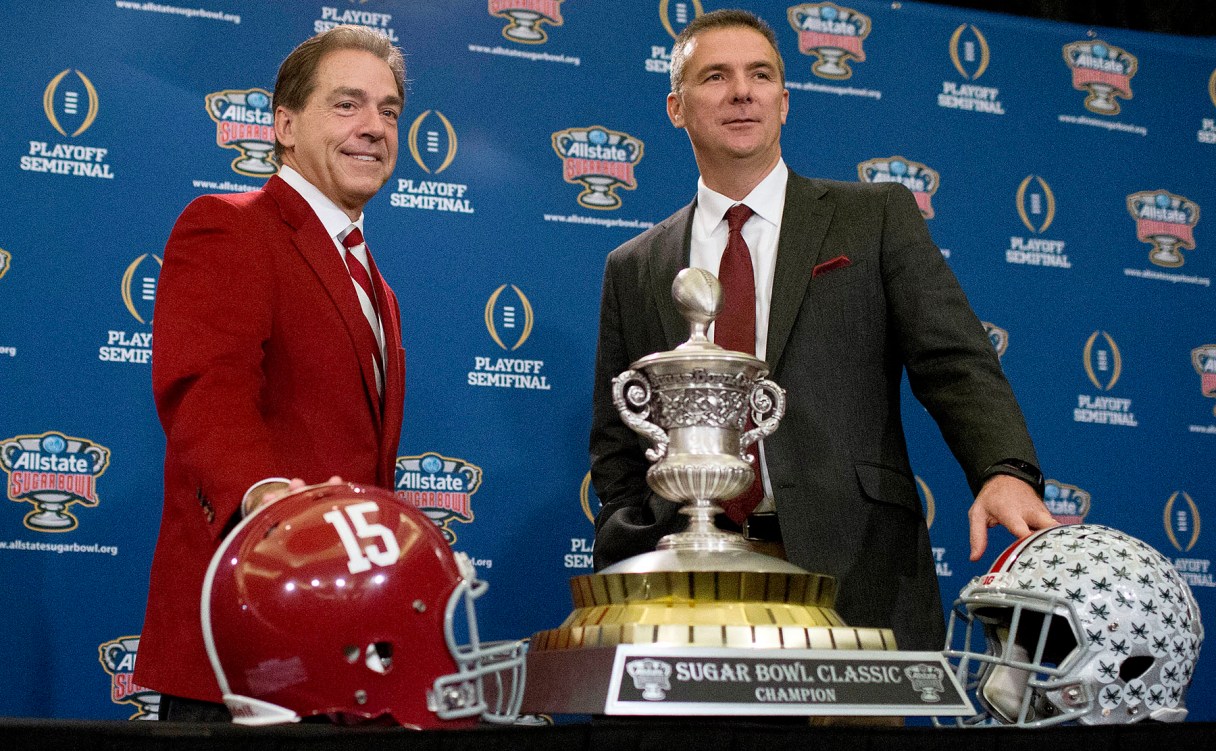
“We’re really proud of our team for the opportunity that they created for themselves to be here, to play against a very good Ohio State team,” Alabama coach Nick Saban told reporters at a news conference this week. His top-ranked Crimson Tide will face No. 4 Ohio State in the Sugar Bowl in the other semifinal around 8:30 tonight.
BOWLS OF ENTERTAINMENT
There are a number of quality bowl match-ups today, highlighted by the first semifinals of the college football playoff. Here is today’s television schedule of college football games:Outback Bowl — Auburn vs. Wisconsin, noon, ESPN2Cotton Bowl — Michigan State vs. Baylor, 12:30 p.m., ESPNCitrus Bowl — Missouri vs. Minnesota, 1 p.m., ABC* Rose Bowl — Oregon vs. Florida State, 5 p.m., ESPN* Sugar Bowl — Alabama vs. Ohio State, 8:30 p.m., ESPN* College football semifinal
“We’re certainly pleased and proud of the progress our team worked to make this entire season, so they created a great opportunity for themselves to be a part of the first sort of college football playoff.”
The path to a true postseason has been long and filled with controversy and resistance for the biggest sport in big-time college athletics.
From the early days of the game, when Heisman was a coach rather than a trophy and “Win one for the Gipper” was a Notre Dame pregame slogan rather than a rallying cliche, college football has awarded its championship rather than deciding it in a postseason tournament. The first champions actually were crowned before the bowl games were played in a given year, leading to dubious national-title claims and debate that carried through the offseason.
The debate of champions and which team is the best was there from the very beginning, dating to the game’s inception in the late 1800s. The first poll was published by the New York Sun in 1901, but the discussion about best teams was regionalized and divisive, something that still rings true in today’s debates about college football.
A mathematical equation founded by University of Illinois professor Frank Dickinson that rewarded teams for playing tougher schedules — another contentious point that is debated today — was used to determine the first widely recognized national champions, which started with Stanford in 1926. The debate and bickering soon followed, as then-Notre Dame coach Knute Rockne pushed to have the previous two seasons awarded championships in Dickinson’s system, meaning Rockne’s Irish were declared champions in 1924 and Dartmouth was crowned for the ’25 season.
Roughly a decade later, sportswriter Alan J. Gould created The Associated Press poll and asked sportswriters who they thought was the best team. That led to Minnesota being named the AP national champ in 1936. The now-defunct United Press decided to poll coaches starting in 1950, leading to the two main polls that are still around today.
Multiple polls also meant the potential of multiple champions, and the possibility of more than one champion seems foreign to every other sport and every other sports fan. It was part of the original design of the father of the AP poll.
“It was a case of thinking up ideas to develop interest and controversy. Papers wanted material to fill space between games,” said Gould, who was The Associated Press sports editor from 1922-38, in the 2001 book “Tales from College Football’s Sidelines.”
“That’s all I had in mind, something to keep the pot boiling. Sports was then living off controversy, opinion, whatever. This was just another exercise in hoopla.”
That exercise was part of the fabric of college football for almost all of the 20th century, as the AP and the coaches’ poll disagreed on the nation’s best team 11 times total and 10 times from 1950 to 1998, when the Bowl Championship Series was born.
With Roy Kramer as its architect, the BCS tried to get the two best teams in the country on the field to decide the national champion in a bowl game by blending computer-minded pollsters with poll-minded computers. It worked for the most part, but controversy occasionally remained, highlighted by the 2004 season when unbeaten and third-ranked Auburn was left out of the BCS title game.
The new system was not without some controversy this year, too. TCU and Baylor shared the Big 12 title and were left out of the four despite spending some time in the committee’s top-four weekly rankings during the season. The weekly rankings drew some ire, and even the BCS forefather knows there’s no perfect system.
“The only thing that matters is that you pick the four teams, and then you seed them when the season is over,” Kramer told the Times Free Press in December before the field was announced. “I could see Florida State getting seeded fourth, and I don’t know if we’ve ever had a team that’s had a season like Florida State is having. Every year it seems like there is another wrinkle.”
So, a decade from the biggest drama in the history of the BCS, and almost 80 years after Gould tried to “keep the pot boiling,” four of college football’s biggest names will play semifinal games tonight to see which two teams will survive and advance.
Three of the four rank among the game’s true blue bloods, each with a glorious history — Alabama claims 15 national titles, including a share of the 1925 title with Dartmouth; Ohio State claims seven national titles; and Florida State is the defending champ.
Yet this is a chance to claim a true part of history. It’s the chance to be the first major college football playoff champion.
“Guys, it’s a new era in college football,” ESPN television announcer Rece Davis said to the head coaches of the four semifinal teams last month during the college football awards television show. “You’ve got seven national championships among you (coaches), but this is the first time that you’ll have the playoff.”
New beginning indeed.
Contact Jay Greeson at jgreeson@timesfreepress.com and 423-757-6273. Follow him on Twitter at @jgreesontfp.