
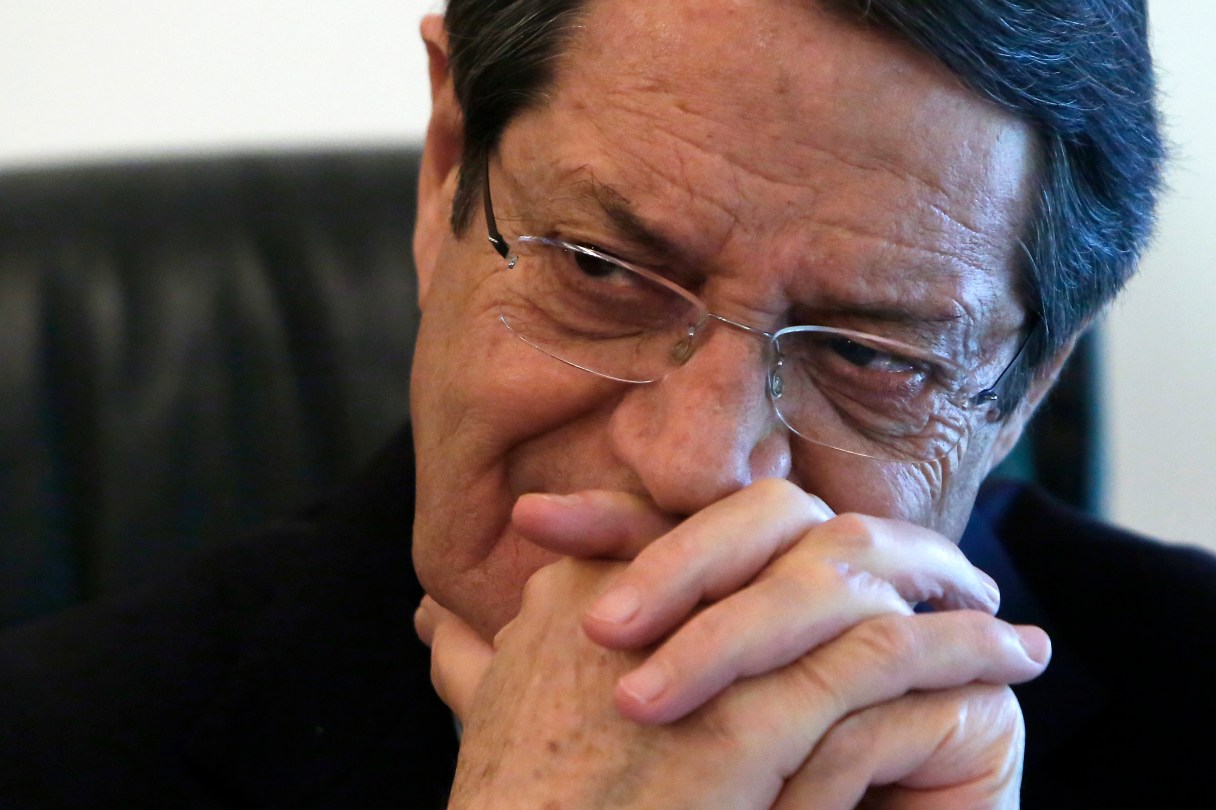
NICOSIA, Cyprus (AP) – Cyprus’ president on Tuesday sought to tone down what he called “excessive optimism” that ongoing talks aimed at reunifying the ethnically divided Mediterranean island are on the verge of a breakthrough.
President Nicos Anastasiades said an accord is possible this year but warned against undue haste and a “climate of euphoria” being whipped up, saying time is still needed to overcome remaining difficulties.
“To paint a picture that we’re just shy of an overall settlement is a mistake,” Anastasiades told The Associated Press in an interview.
He said recent statements by foreign officials, including United Nations envoy Espen Barth Eide, that raised expectations of a speedy deal may have been intended to bolster momentum to carry forward the talks that have been billed as the best chance at peace in decades.
“There are many details left that must be discussed and agreed on,” he said. “We mustn’t leave any constructive ambiguities or unresolved issued that touch on the core aspects of a settlement.”
Anastasiades said he would brief U.N. chief Ban Ki-moon on the talks at a meeting in Davos, Switzerland next week.
Failure has marked numerous rounds of talks since 1974 when the island was split after Turkey invaded in response to a coup aimed at union with Greece.
The Cypriot president said significant progress has been made with Mustafa Akinci, a moderate elected last April as leader of the breakaway Turkish Cypriots, whom he credited with a “genuine wish” to reach a settlement.
But Anastasiades said Akinci is expressing what he called “positions that reflect concerns of the past.” One such issue is an insistence that Turkish Cypriots remain the majority in terms of population and ownership of private property inside a constituent state they will govern as part of an envisioned federation.
Most property in the island’s north, where the Turkish Cypriot constituent state would be established, belongs to Greek Cypriots, prompting Turkish Cypriot fears they would be swamped. Anastasiades said any such limitations would be in breach of a person’s right to choose where they live.
The Cypriot president said Turkish Cypriot fears may be assuaged by an accord that entrenches their right to run their own affairs, irrespective of how many Greek Cypriots reside in their zone.
Anastasiades said the cost of reunification will be high and donations from other countries in combination with low-interest loans will be needed to finance peace.
But he added that a Cyprus peace deal would allow Turkey to fulfill its vision of becoming a key conveyor of natural gas to Europe.