
From smart TVs to drones, technology continues to revolutionize the way we live. The medical community is often on the forefront of using technology to improve care. One such instance is robotic surgery. While the name may conjure images of shiny, silver robots with scalpels, this type of surgery is actually performed by highly trained human surgeons, not machines. The term “robotic-assisted surgery” is preferred by doctors since it more accurately portrays what’s happening in the operating room. The surgeons with University Surgical Associates offer robotic-assisted surgery as another innovative tool for quality patient care.
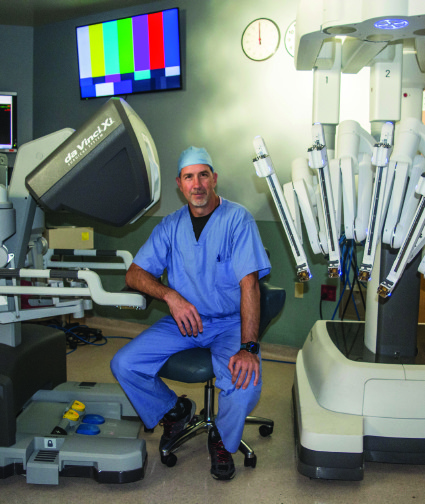 USA pediatric surgeon Dr. Curt Koontz pictured with the robotic surgery console and
arms in the operating room. Photo by Janda White
“Robotic-assisted surgery is another minimally invasive approach that we use,” says Dr. Benjamin Dart, general surgeon with University Surgical Associates (USA). Minimally invasive simply means that procedures are performed through small incisions instead of one large opening. “Because the incisions are small,” he says, “patients tend to recover more quickly and experience less pain than with traditional, open surgery.”
Many patients are familiar with robotic surgery used in prostate and gynecologic surgeries but they may not be aware it’s available for general and colorectal procedures as well. “We’ve been using the robotic system with substantial success for inguinal hernia repair,” adds Dr. Dart.
How does it work?
“Robotic surgery is an advancement over laparoscopic surgery because the robotic instruments have a range of motion that exceeds that of the human wrist,” says Dr. Jacob Dowden, general and hepatobiliary surgeon with USA. As in laparoscopic surgery, small incisions are used for entry of surgical instruments from outside the body. The robotic system is then attached to the instruments, and the surgeon controls them from a console in the operating room a few feet away from the patient. “The surgeon fully controls the instruments just as in open or laparoscopic surgery,” adds Dr. Dowden, “The robotic system does not act on its own.”