
 Information: 5 need-to-know hockey terms
If you are a beginner fan, here’s a primer on some of the basic terminology of the game:
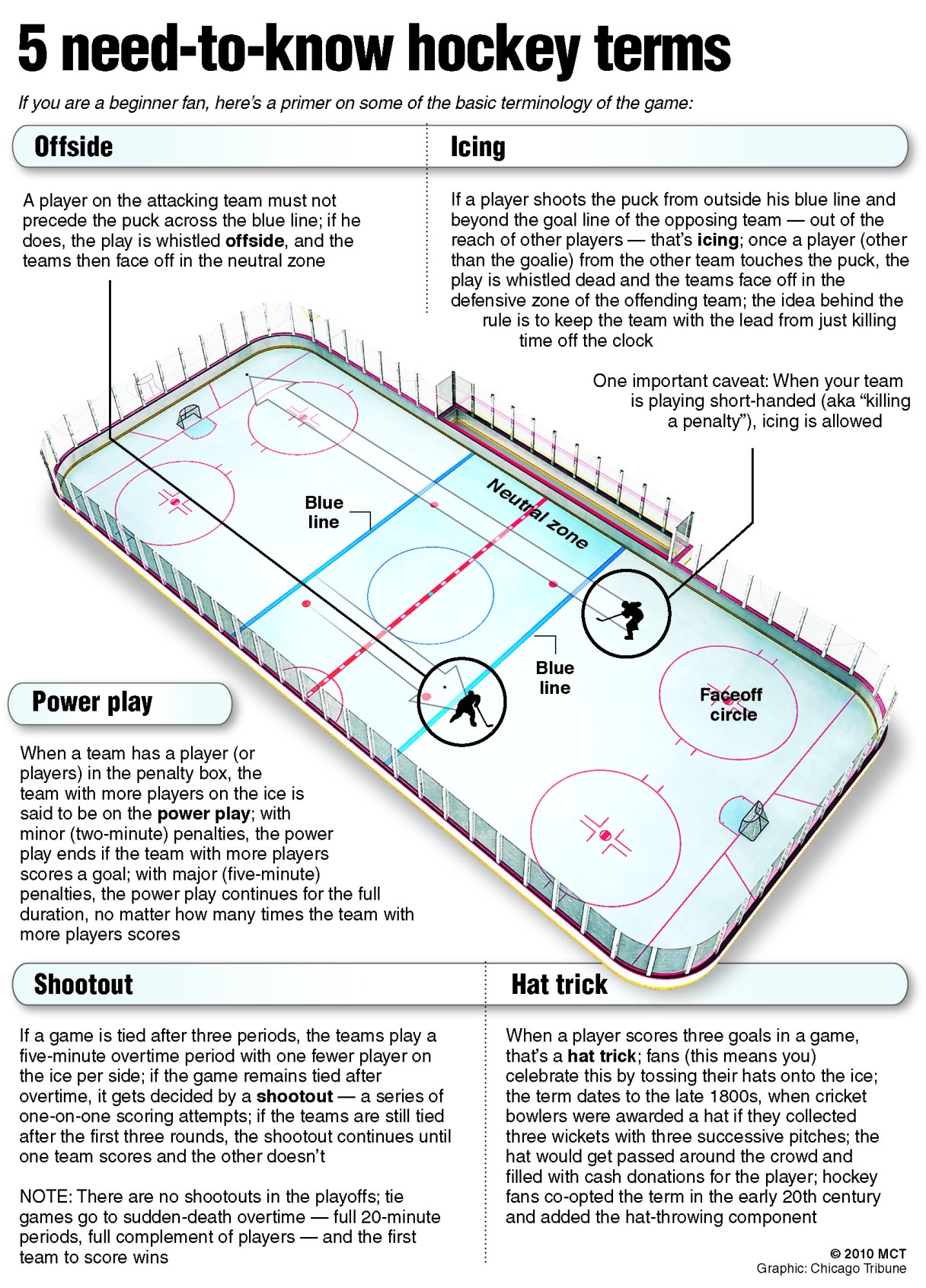
Offside – A player on the attacking team must not precede the puck across the blue line; if he does, the play is whistled offside, and the teams then face off in the neutral zone. Icing – If a player shoots the puck from outside his blue line and beyond the goal line of the opposing team – out of the reach of other players – that’s icing; once a player (other than the goalie) from the other team touches the puck, the play is whistled dead and the teams face off in the defensive zone of the offending team; the idea behind the rule is to keep the team with the lead from just killing time off the clock. One important caveat: When your team is playing short-handed (aka “killing a penalty”), icing is allowed.
Power play – When a team has a player (or players) in the penalty box, the team with more players on the ice is said to be on the power play; with minor (two-minute) penalties, the power play ends if the team with more players scores a goal; with major (five-minute) penalties, the power play continues for the full duration, no matter how many times the team with more players scores.
Shootout – If a game is tied after three periods, the teams play a five-minute overtime period with one fewer player on the ice per side; if the game remains tied after overtime, it gets decided by a shootout – a series of one-on-one scoring attempts; if the teams are still tied after the first three rounds, the shootout continues until one team scores and the other doesn’t NOTE: There are no shootouts in the playoffs; tie games go to sudden-death overtime – full 20-minute periods, full complement of players – and the first team to score wins.
Hat trick – When a player scores three goals in a game, that’s a hat trick; fans (this means you) celebrate this by tossing their hats onto the ice; the term dates to the late 1800s, when cricket bowlers were awarded a hat if they collected three wickets with three successive pitches; the hat would get passed around the crowd and filled with cash donations for the player; hockey fans co-opted the term in the early 20th century and added the hat-throwing component.