

“SOUNDS WILD AND BROKEN: SONIC MARVELS, EVOLUTION’S CREATIVITY AND THE CRISIS OF SENSORY EXTINCTION” by David George Haskell (Viking, 448 pages, $29).
“Sound is ephemeral,” writes David George Haskell, a professor of biology and environmental studies at the University of South, in his preface to “Sounds Wild and Broken: Sonic Marvels, Evolution’s Creativity and the Crisis of Sensory Extinction.” “Yet in its passage, sound links living beings and wakes the latent powers of biological and cultural evolution. These generative powers, acting over hundreds of millions of years, produced the astonishingly diverse sounds of the living Earth.”
Over the next 400-plus pages, Haskell introduces readers to almost all of them, diving deep into the evolutionary physics of natural sound, from bacteria to crickets, dinosaurs to birds, whales to humans and pretty much every creature that ever swam, walked or flew. Beyond the tales he coaxes from widely varied creatures and their noise-making instruments, Haskell devotes much discussion to unnatural sound: the diverse cultural and physical history of human music; the cacophony of noise pollution in cities and oceans; human-wielded banshee saws destroying rain forests, filling their spaces with silence. (In his acknowledgments, the author pledges half of this book’s net profits will go to organizations fighting to ease the “acoustic crises” he documents.)
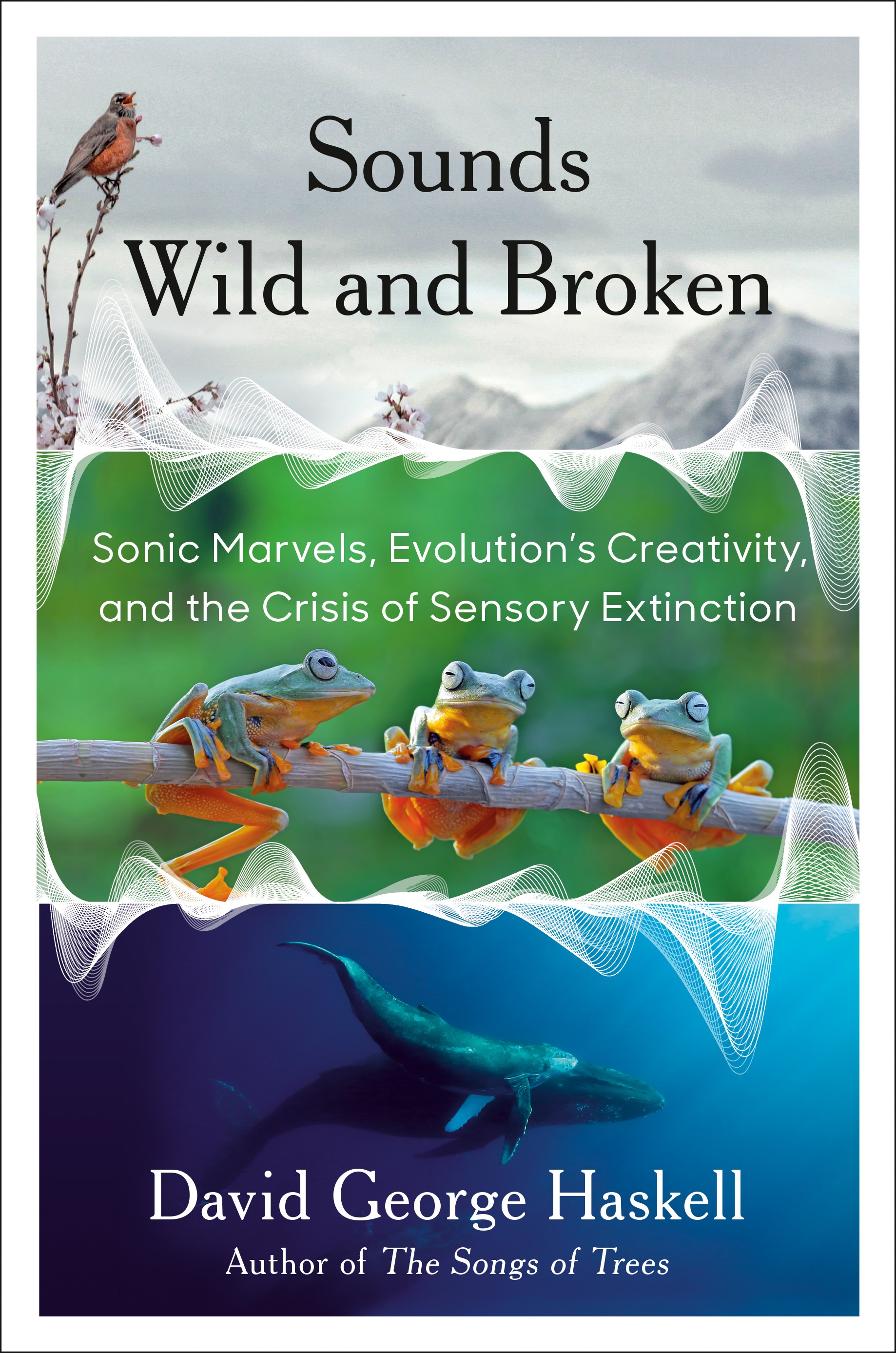 Viking / “Sounds Wild and Broken”
Haskell’s celebrated first book, “The Forest Unseen,” published in 2012 and a finalist for both a Pulitzer Prize and PEN/E.O. Wilson Literary Science Writing Award, focused on a small circle of forest (just over a meter) on the Cumberland Plateau near his home in Sewanee, Tennessee. His second, “The Songs of Trees,” in 2017, circled the globe, each chapter alighting on a specific tree to explain evolution, sounds and the interconnectedness of living things.
The structure of “Sounds Wild and Broken” is more ambitious still, covering nearly all life throughout and beyond the history of Earth, reaching into the Big Bang and harmonic waves of creation rippling through galaxies – a physicist’s rendering of the music of the spheres. All the while, Haskell enumerates global threats civilization imposes on our natural environment and its vanishing soundscape.