
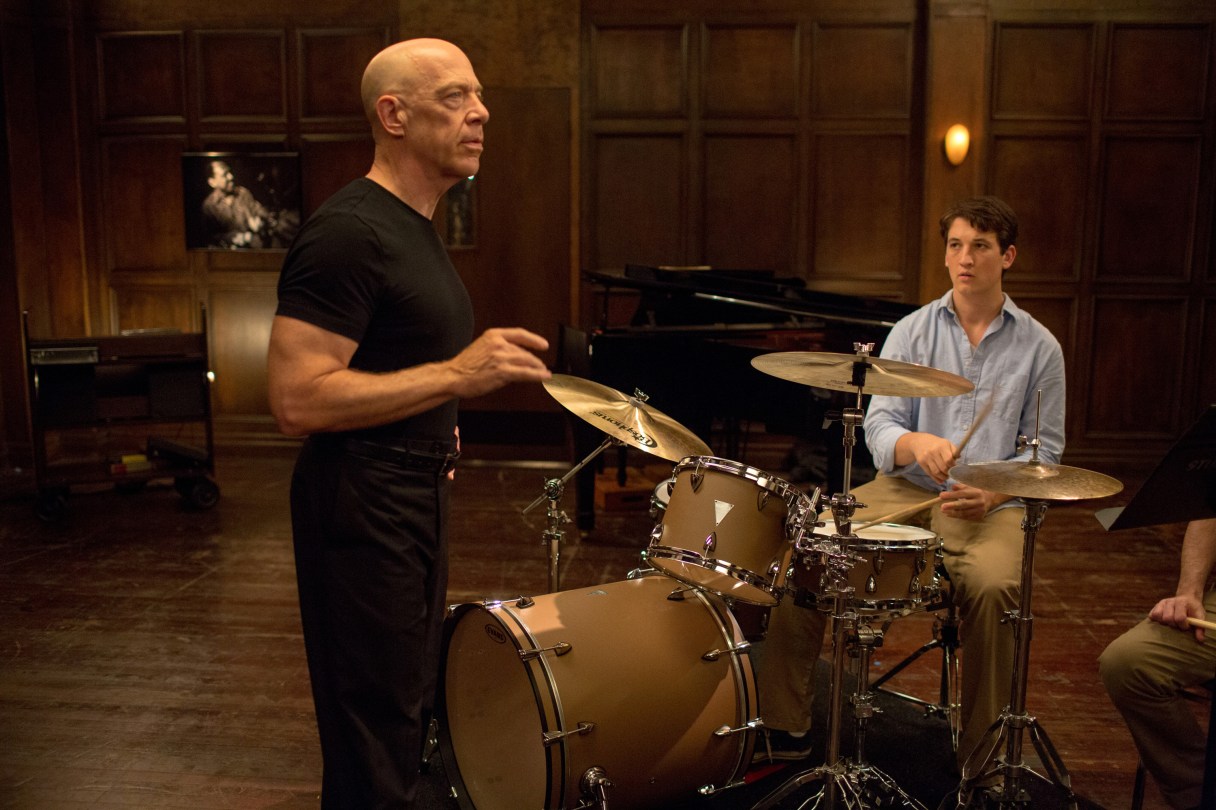
If you’ve ever sat in a jazz club or concert and thought the band was just riffing the night away with nary a care in the world, “Whiplash” should whip that feeling out of you faster than a really up-tempo drum solo.
Rarely has a movie shown so viscerally the utter pain that can accompany the bliss of creating good music. And, in the case of the aspiring jazz drummer at the center of “Whiplash,” played by the fast-rising Miles Teller (“The Spectacular Now,” ”Divergent”), we mean physical pain as well as mental: We’re talking chafed, bleeding fingers leaking droplets onto the cymbals, the blood mixing with sweat, and yes, some tears, too.
The engaging Teller, whose boyish, upbeat demeanor always seems to be suggesting something darker and more desperate underneath, is just one of the reasons “Whiplash” is such an engrossing film. Another is the ingenuity of writer-director Damien Chazelle, who, in only his second full-length film, is clearly working from the heart, having played jazz drums himself in high school.
And the third is the wonderful J.K. Simmons – you’ve seen him in everything from “Spider-Man” to “Juno” to “Burn Before Reading,” but you’ve never seen him burn through the screen like this, savoring the role of a lifetime as a teacher who inspires, terrifies, bullies and downright abuses, in ways that leave you wondering whether you should call 911 from your seat.
It’s a fascinating student-teacher dynamic – though often excruciating to watch – and it allows Chazelle to raise the question not only of how much one should suffer for one’s art, but also what makes us truly learn. Is it encouragement, pressure, or pain? Is it joy, or is it fear?