
Monday, November 16, 2026Nov 16

Sale of Interior Secretary Ryan Zinke’s motor home raises $25,000 question

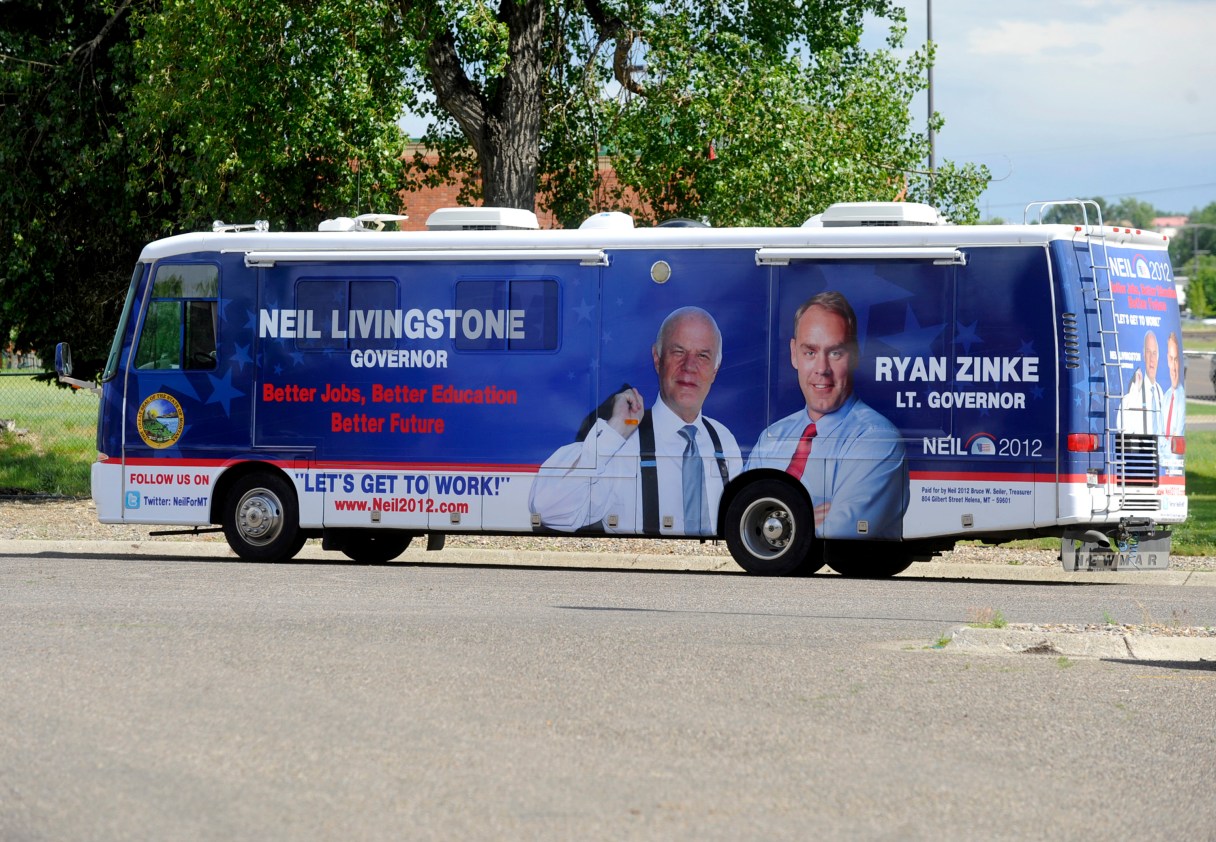
This July 14, 2011 photo shows the campaign bus of Neil Livingstone, candidate for Governor and Ryan Zinke, candidate for Lt. Governor in Great Falls, Mont. A political committee belonging to Interior Secretary Ryan Zinke recently sold the motorhome to a Montana legislator who is up for a top post in the Interior Department, Thursday, Aug. 17, 2017. The sale is prompting curiosity because it was sold for just half of its apparent $50,000 market value. The Federal Election Commission prohibits the sale of political committee assets below fair market value. (Rion Sander/The Great Falls Tribune via AP, File)

HELENA, Mont. (AP) – U.S. Interior Secretary Ryan Zinke’s dormant congressional campaign committee recently sold a 2004 motor home at a steep discount to an old friend in the Montana Legislature.

But a seemingly ordinary transaction between friends, when seen through the optics of stringent campaign finance laws, can raise a bevy of questions – especially when those friends are politically high-powered and well-connected.

After learning about the transaction, campaign finance watchdogs are raising a $25,000 question: Why would Zinke’s campaign committee sell the Kountry Star Freightliner for half the price of its apparent $50,000 market value?

It’s a head-scratcher for Lawrence Noble, a senior director of the Campaign Legal Center, a nonpartisan group of election law experts. “If the asset is worth $50,000, and they sell it to somebody for $25,000. It’s the equivalent of them giving $25,000 to that person,” Noble said.

The Federal Election Commission prohibits political committees to sell assets, including campaign vehicles, below fair market value.