
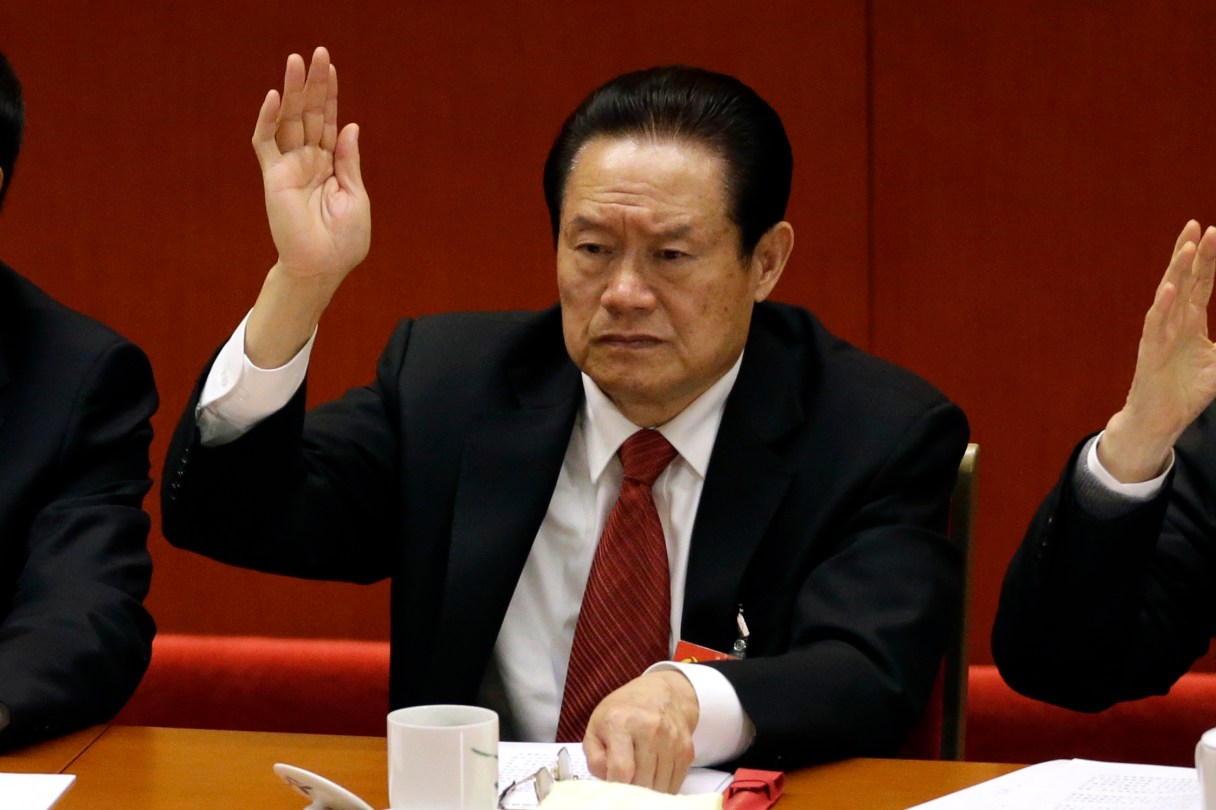
BEIJING (AP) – The investigation into China’s former security chief Zhou Yongkang could pave the way for him to stand trial as the most senior politician ever prosecuted for graft. It’s hard to predict how his case will be handled in the opaque, secretive world of Chinese politics, but here’s how such prosecutions tend to play out, though not necessarily always in this sequence:
ASSOCIATES FALL
The first hints of trouble in past cases have been the disappearances of the politician’s associates. In the months before Tuesday’s announcement of the probe into Zhou, his known allies in his various spheres of influence were rounded up, one after another, in spectacular fashion. They included bigwigs in the southwestern province of Sichuan where he was party boss for a time and senior executives at the state oil company where he was once general manager – and his son. Investigations of peripheral players usually build evidence of bribery that is then used against the main target, who is often seen as being singled out over political rivalries as much as for corruption. Relatives – and mistresses – of the officials often also disappear.
PARTY INVESTIGATES
The party’s anti-graft commission initiates most corruption investigations, using a secretive internal detention system in which suspects are interrogated without access to lawyers or family. Some are done quietly at first, with an announcement being made only after investigators have dug up sufficient evidence. A former top army general, Xu Caihou, had been under investigation since March but his case was announced only last month. In theory, the anti-graft commission reports its findings to China’s Politburo for discussion on how to proceed. However, decisions on high-profile politicians are widely perceived to be the result of tough backroom wrangling among major power brokers. Chinese President Xi Jinping would have had to overcome resistance within the party to publicize an investigation into someone as high-ranking as Zhou, which breaks with a long-standing taboo against targeting topmost leaders.