

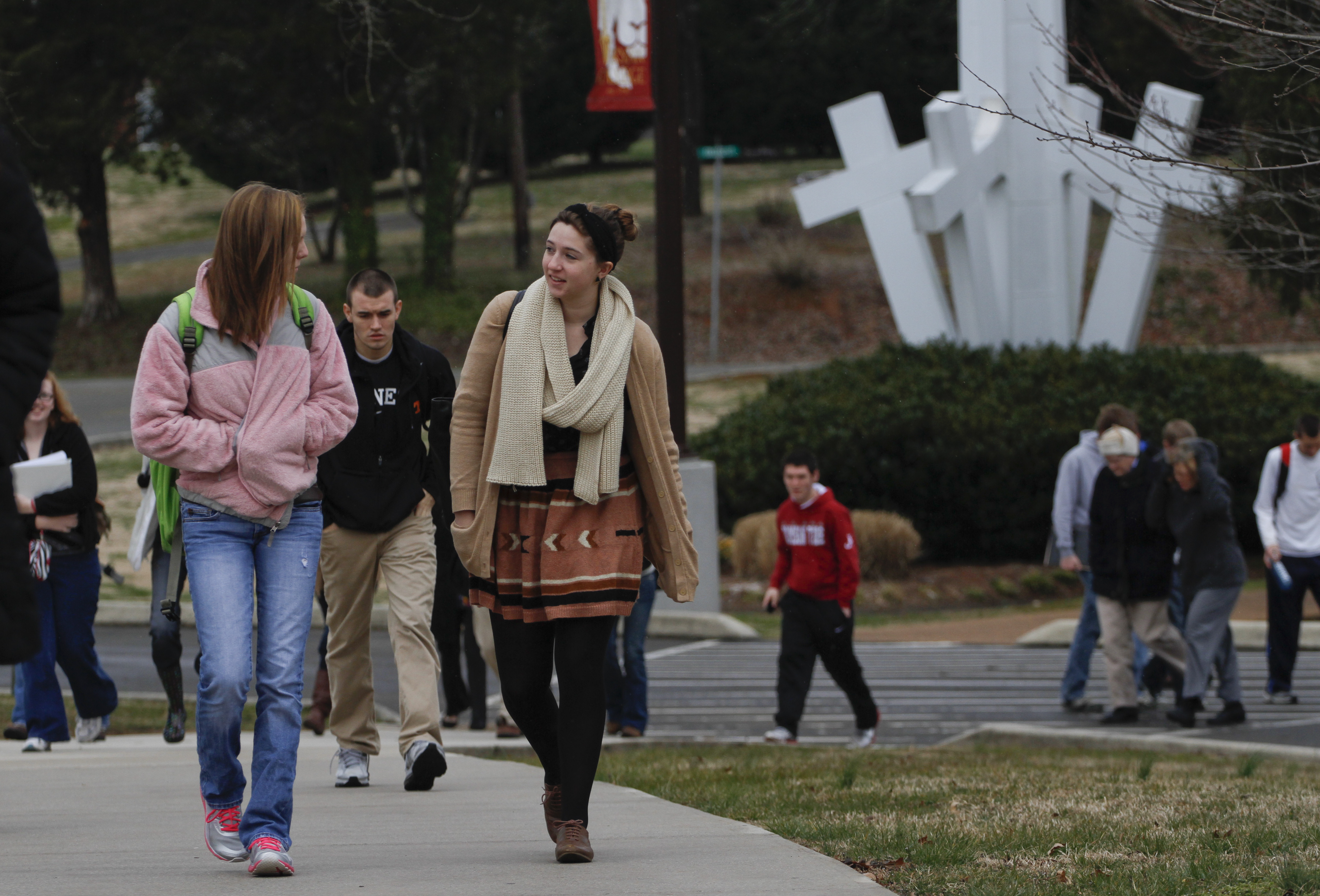
 Bryan College students Sara Beth Crockett,
left, and Amy Bailey leave chapel at the college
in Dayton, Tenn.
THE STORY SO FARBryan College recently moved to clarify a component of its decades-old statement of belief, a set of convictions that faculty, staff and some student leaders must affirm annually. The college is named in honor of William Jennings Bryan, who helped prosecute the 1925 Scopes Trial.For more than 80 years, the college has ascribed to the following view on origins: “that the origin of man was by fiat of God in the act of creation as related in the Book of Genesis; that he was created in the image of God; that he sinned and thereby incurred physical and spiritual death.” The clarification, approved last month by the board of trustees, says that Adam and Eve “are historical persons created by God in a special formative act, and not from previously existing life forms.”That change will potentially force out some faculty members, who have more nuanced views on human origins, those who have reconciled Biblical creationism with natural processes like evolution. Faculty must sign the statement as part of their annual contracts, which are due later this month.The change has sparked student petitions, letters from alumni and a faculty vote of no confidence in Bryan President Stephen Livesay. Many students, instructors and alumni fear the more narrow stance could change Bryan’s campus culture by squelching academic freedom, debate and discovery among students.
In the Rhea County Courthouse in 1925, he famously stood up for biblical creationism and fought against the teaching of evolution in public schools. His victory over John Scopes was viewed as a win for Christianity.
But what many people don’t know is that William Jennings Bryan didn’t necessarily believe in a literal interpretation of Genesis. His descendants say he might not be happy to know that the current administration of the college founded in his name is forcing professors to sign a document embracing a narrow view of how God created mankind.
“I can’t imagine that he would accept this stance at all,” said Kent Owen, a great-grandson of Bryan. “He was very forward-thinking. Some of the things he was putting out there were so far ahead of his time.”
Bryan, called “the Great Commoner,” was a widely known Democratic politician. He served as a congressman, as U.S. secretary of state and launched three failed bids for the White House. He was a deeply religious populist who pushed for women’s suffrage and advocated for the addition of a federal income tax.