
 Clif Cleaveland
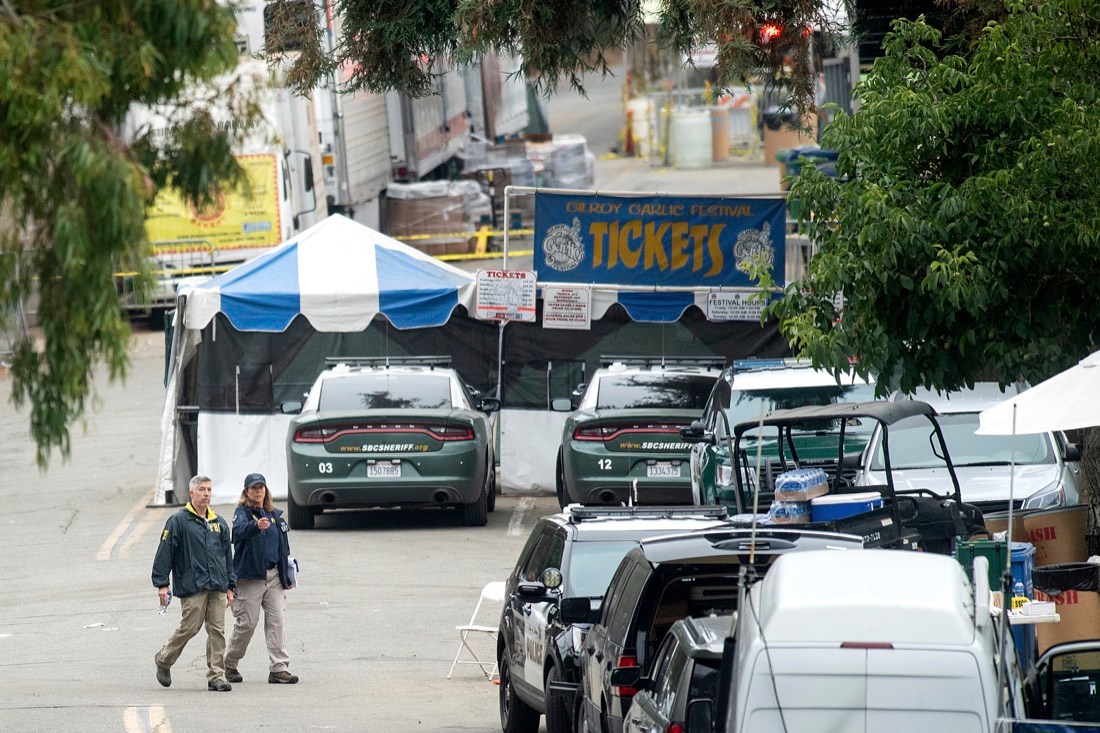
He had completed kindergarten and anticipated first grade. Last Sunday afternoon, he attended the annual Garlic Festival in Gilroy, California.
Stephen’s mother and his grandmother accompanied him to the event and watched as he joyfully played on a bouncy castle. Gunfire erupted. Stephen fell, mortally wounded by a bullet in the back. His mother was struck in the abdomen, his grandmother in her leg. His mother cradled her dying son in her arms.
The 19-year-old gunman had cut through a security fence and began firing his assault weapon, killing Stephen, a second child, and an adult and wounding 12. Purportedly, a musician yelled at the gunman, “Why are you doing this?” The shooter responded, “Because I’m really angry.”
Security personnel at the well-guarded event killed the gunman within a minute of the launch of his attack.
Gun Violence Archive (www.gunviolence.org), a nonprofit organization that tracks gun violence in the U.S., defines a mass shooting as four or more victims, excluding the assailant(s), shot at the same location at the same time. During the first six months of 2019, 196 mass shootings led to 968 victims, of whom 196 died. From July 1-28 of this year, 43 mass shootings resulted in 36 deaths and 217 wounded. Other archives of gun violence exclude the wounded and list only fatalities.
The usual “thoughts and prayers” are offered by local, state, and national officials. Thoughts and prayers do not help Stephen Romero, the other victims and their loved ones.
Let us return to Stephen and imagine the life that he might have had. A photograph shows a boy with a burr haircut and a full, toothsome smile. He wears a black T-shirt with the inscription “Birthday Dude.” Two small medallions depicting smiling animals dangle from chains around his neck. He had a 9-year old sister who remained at home with their father, who was studying for an examination for electricians.
Erase the shooting and imagine this scenario: Stephen enters first grade. A happy, energetic boy, he likes recess and lunch best of all. As he progresses through his grade sequence, he is drawn to mathematics and to science, especially the associated lab exercises. Like his father, he is happiest when working with his hands.
Stephen delights in whatever sport is in season. By seventh grade, his speed and agility lead him to focus on soccer and sprints. In high school, he works his way up the roster of the soccer team, securing a place as a mid-fielder by his junior year.
His report cards include commendations from his teachers on his citizenship, his in-class behavior, and his focus on his academics. Parent-teacher conferences are a pleasure.
Graduation from high school arrives, too soon his parents think, as they witness his walk across the stage to receive his diploma. Stephen enrolls in a community college, uncertain if he will pursue training as an electrician or opt for a career in electrical engineering.
This scenario will never be fulfilled.
Too many lives, too many families, too many dreams are regularly shattered by gun violence.
Why cannot the president and bipartisan leaders of Congress convene a national conference on gun violence with the avowed purpose of radically decreasing all shootings, whether solitary or mass? Invite law enforcement officers, educators, psychiatrists, advocates and opponents of gun ownership, social workers, survivors of gun violence. The conference will not adjourn until its members are ready to report their unified plan to protect the lives of children and adults from wanton, gun-mediated violence.
The alternative is a shrug of the shoulders and more thoughts and prayers upon the occasion of the next mass murder. We must do better than this.
Contact Clif Cleaveland at ccleaveland@timesfreepress.com.