
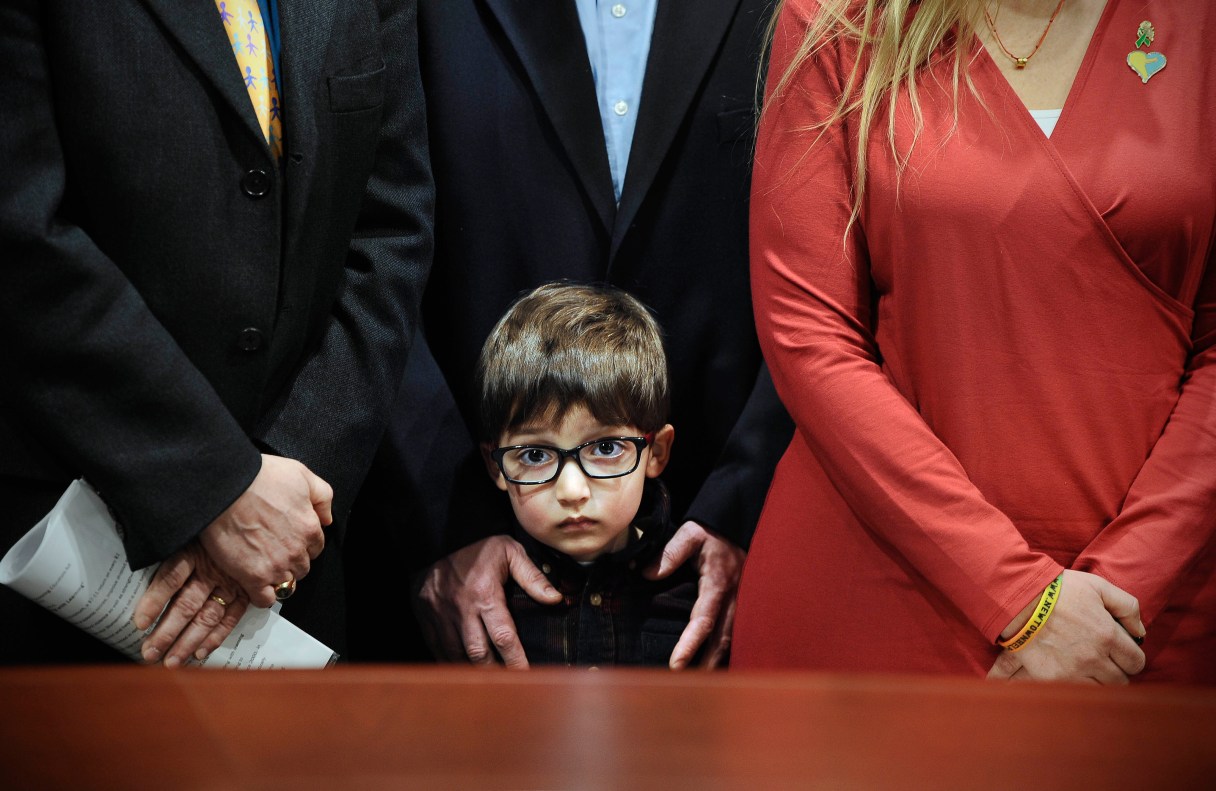
HARTFORD, Conn. (AP) – Days before his death, 6-year-old Jesse Lewis scrawled three words on his mother’s kitchen chalkboard in Connecticut that could now prompt a national change in teacher training.
Those three words – nurturing, healing and love – became the inspiration for a foundation in his name that is focusing on programs and curriculum for children, teachers and parents that encourage peaceful and positive interaction. They’ve also led to new federal legislation, introduced Monday in honor of the late Sandy Hook Elementary School first-grader, setting aside money to train teachers in social and emotional learning.
“If the shooter, in our case, had access to this type of learning before the tragedy at Sandy Hook, it might not have happened,” said Scarlett Lewis, Jesse’s mother and founder of the Jesse Lewis Choose Love Foundation.
Connecticut Sen. Richard Blumenthal, a Democrat, is hoping to amend a federal education bill and set aside part of $2.3 billion earmarked for professional development to train teachers and principals in how to help children learn to recognize and manage their emotions. They would also learn how to demonstrate caring and concern for others, maintain positive relationships, handle interpersonal situations effectively, make good decisions and achieve positive goals. A similar bill has been introduced in the U.S. House of Representatives.
Proponents contend such concepts can ultimately lead to higher grades, less substance abuse, fewer behavioral issues, higher graduation rates and generally happier children.