
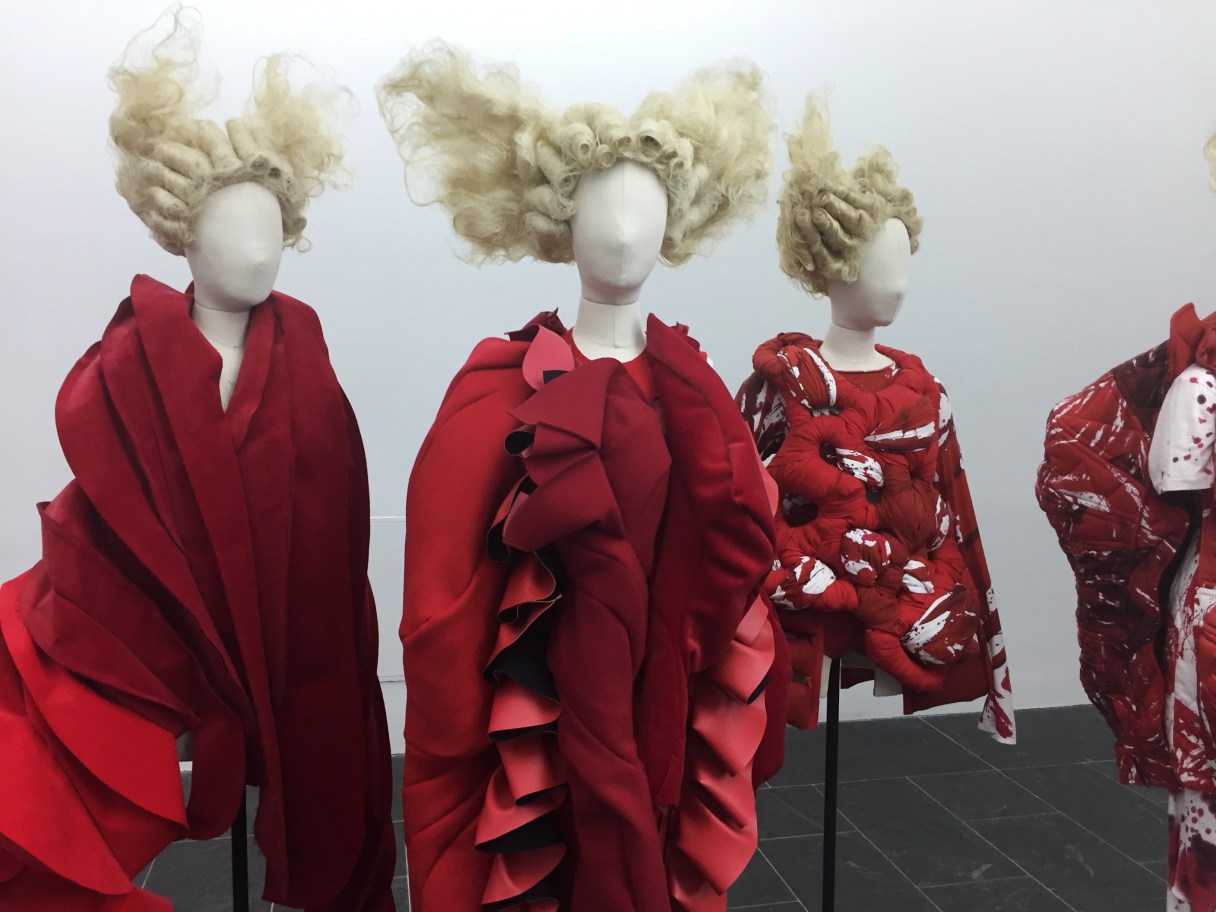
NEW YORK (AP) – If you’re someone who likes a lot of guidance and explanation at the museum, you might want to dramatically recalibrate your expectations before heading into “Rei Kawakubo/Comme des Garcons: Art of the In-Between,” the lavishly presented new show at the Metropolitan Museum of Art’s Costume Institute.
Arriving in a brilliant white space containing a series of geometric structures, you’ll find no one pointing you in the right direction, and no explanatory text next to the garments. That’s because for Kawakubo, the revered Japanese designer who’s been reinventing her clothes for nearly a half-century – to the point that she no longer calls them clothes, but “objects for the body” – there is no right answer.
“I don’t like to explain the clothes,” the Comme des Garcons founder, now 74, was quoted as saying in 2013. “The clothes are just as you see them and feel them.”
There is a bit of guidance available. Andrew Bolton, star curator of this and other blockbuster Met fashion exhibits, has provided paper brochures with maps and context, though he cheerfully welcomes you to ditch them. And even this much explanation for the visitor was a hard-fought compromise with Kawakubo.
“It was a battle,” Kawakubo says in an interview with Bolton. “Are you going to write that we fought?”