
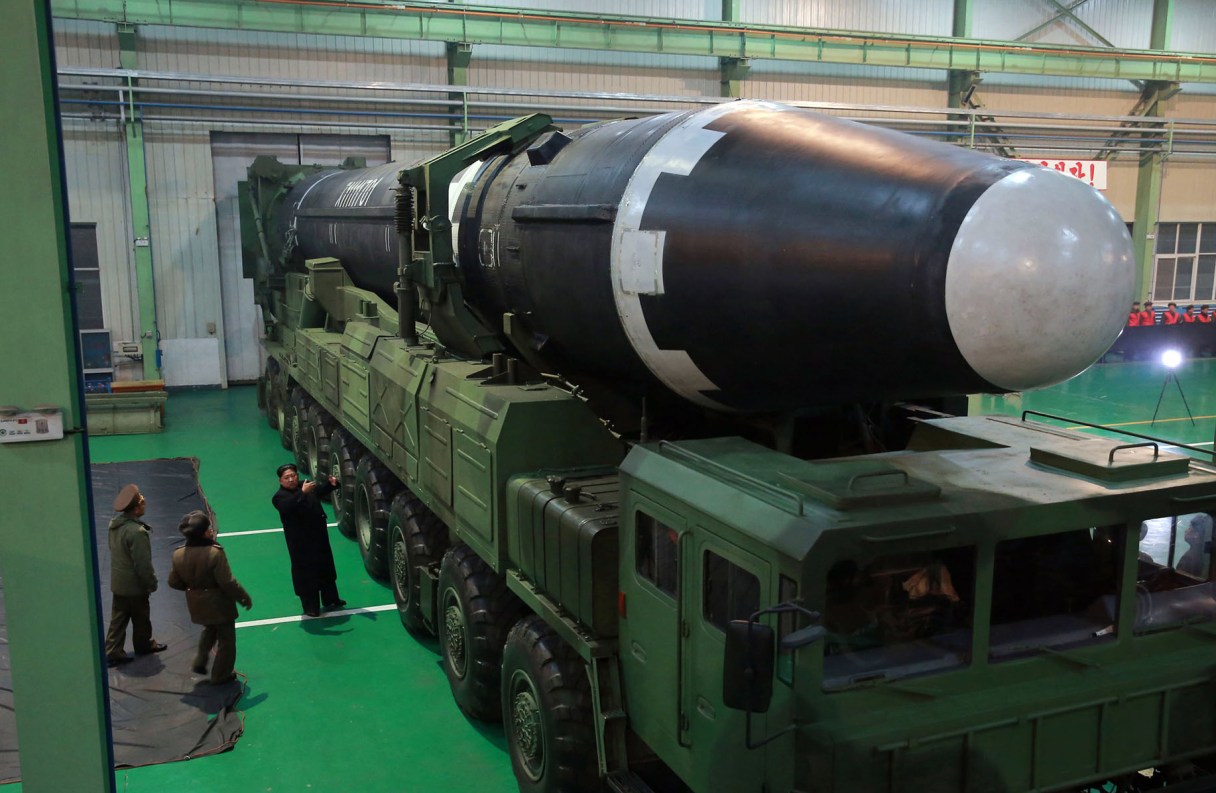
SEOUL, South Korea (AP) – Two days after North Korea test-launched its most powerful missile to date, a clearer picture is emerging of Pyongyang’s impressive technological achievement – and what still remains before it can legitimately threaten the continental United States.
Many questions remain, but there’s broad agreement from government and outside analyses that the huge Hwasong-15 intercontinental ballistic missile represents a significant step forward, putting the North very close to its goal of a viable arsenal of nuclear-tipped long-range missiles – maybe as early as the middle of next year.
The two-stage liquid-fuel missile fired Wednesday is potentially capable of striking targets as far as 13,000 kilometers (8,100 miles), which would put Washington within reach, South Korea’s Defense Ministry said Friday in a report to lawmakers. It’s also considerably larger than North Korea’s previous ICBM, the Hwasong-14, and designed to deliver larger warheads, the ministry said. That would seem to confirm the North’s boast after the launch that the Hwasong-15 can carry “super-large heavy nuclear warheads.”
Michael Elleman, an analyst at the International Institute for Strategic Studies, said it appears that the Hwasong-15 can deliver a 1,000-kilogram (2,200 pound) payload to any point on the U.S. mainland. North Korea, which has so far conducted six nuclear tests, has almost certainly developed a nuclear warhead that weighs less than 700 kilograms (1,543 pounds) , if not one considerably lighter, Elleman wrote Friday on the 38 North website.
North Korea said the missile on Wednesday reached an apogee of 4,475 kilometers (2,780 miles) and flew 950 kilometers (600 miles), splashing down close to Japan after being launched from a site near Pyongyang on a high trajectory to avoid other countries; that flight data was similar to what was announced by South Korea’s military.