
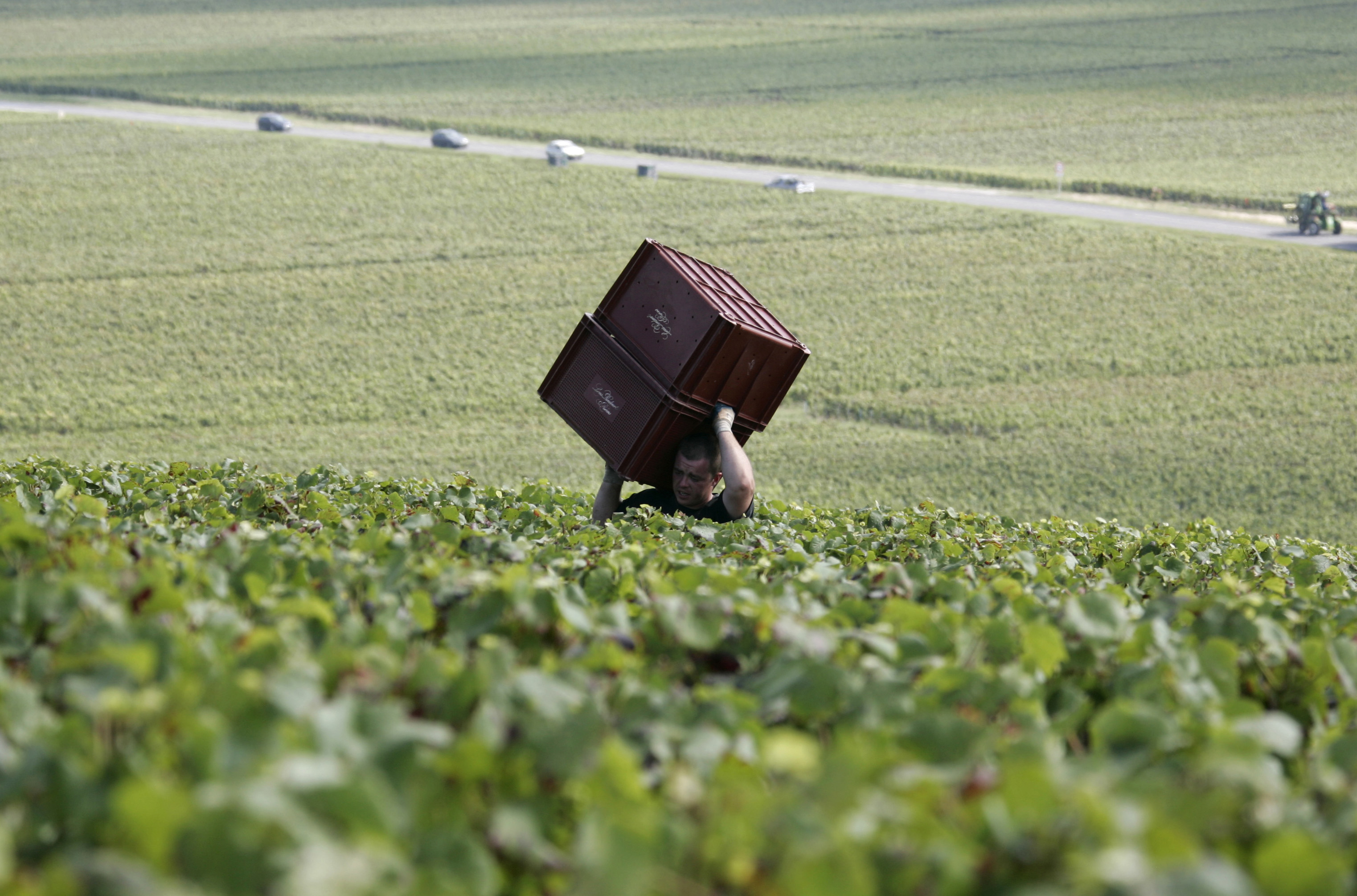
 A worker carries boxes during grape harvest near Epernay in the Champagne region. Europeans are finding fewer reasons to pop open a bottle of Champagne as another year of economic troubles and high unemployment saps the regionís joie de vivre, latest industry figures show. But while a taste for a glass of bubbly might be on the wane in Europe, other markets, particularly Japan and the United States, are developing a growing taste for sparkling luxury with a brand name.
PARIS – Europeans are finding fewer reasons to pop open a bottle of Champagne as another year of economic troubles and high unemployment saps the region’s appetite for the finer things. But while the latest industry figures show that sales might be on the wane in Europe, other markets, particularly Japan and the United States, are developing a taste for a glass of bubbly.
In what is certain to be bad news for the vineyards, France – Champagne’s largest market – is drinking fewer bottles. Sales of Champagne for the country were down 4.9 percent, and 5 percent elsewhere in the 27-country European Union, in the first nine months of 2012 compared with the same period in 2011, according to CIVC, the national association of growers and producers of the wine.
Nineteen months of rising unemployment and growing fears that the worst is yet to come have taken their toll on France – nearly seven in 10 French are worried about their country’s future, according to a recent poll.
“The French are pessimist by nature,” said Antoine Chiquet, whose family has been producing Champagne for three generations and wine for eight. “We had a difficult election, we’re in an economy where Europe’s foundations are being questioned.”
Nonetheless, the country managed to drink 175.7 million bottles of Champagne from Nov. 1 2011 to Oct. 31 2012, according to CIVC – enough for nearly 3 bottles a year for every man, woman and child but about 10 million bottles fewer than the previous year. In contrast, the U.S. consumed enough sparkling wine for about 1.5 bottles per person in 2010, the latest figures available from the California-based Wine Institute.