
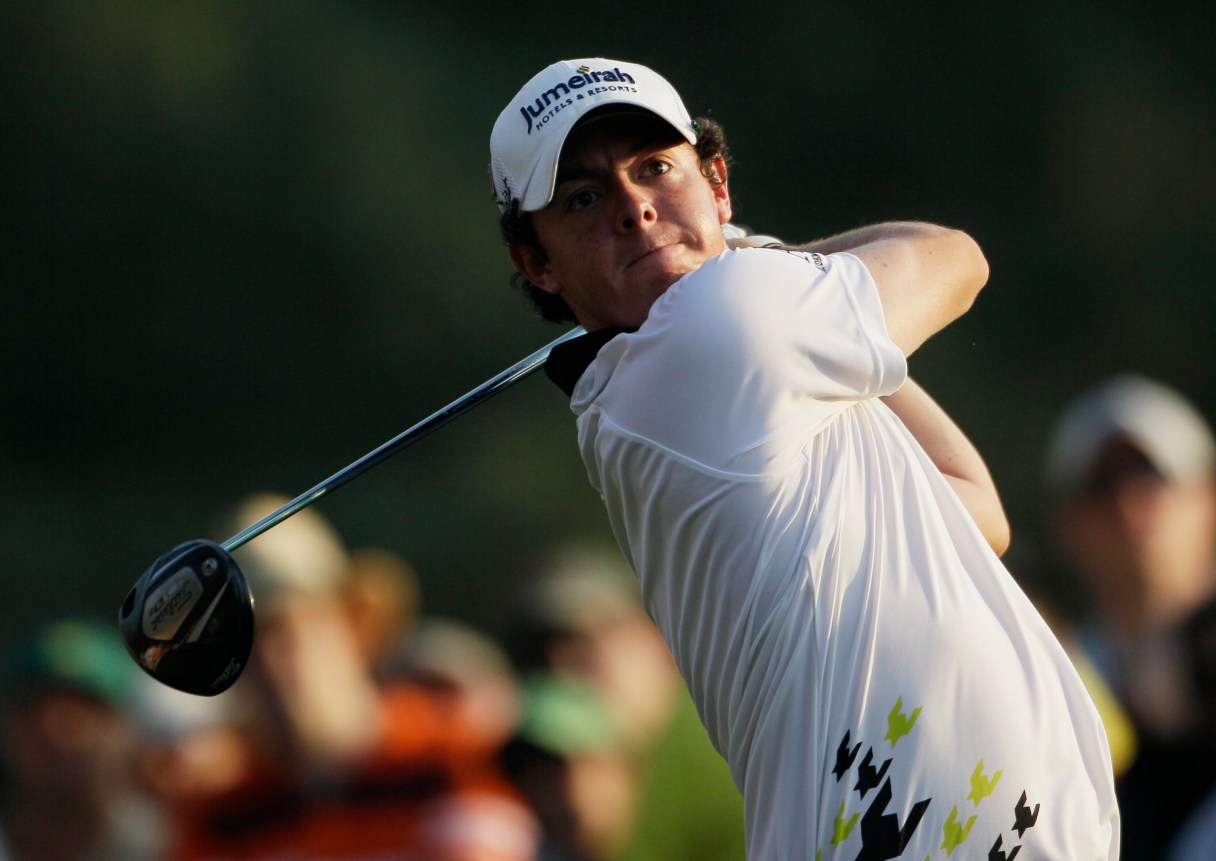
 Rory McIlroy of Northern Ireland hits a drive on the 15th hole during the third round of the Masters golf tournament Saturday, April 9, 2011, in Augusta, Ga. (AP Photo/David J. Phillip)
With curly mop locks and a freckled face, Rory McIlroy is the face of European golf.
And that young face held the lead at the Masters for the first three days last month. But then the Irishman melted down on the final nine holes of his second Masters appearance.
“There’s nothing worse than doing that in public,” his agent Chubby Chandler said. “He has too much talent. He’ll be fine.”
It’s not often a 21-year-old is in that position – first place on Sunday in a major championship event.
Most 21-year-old scratch golfers are playing for American colleges or universities. Very rare are the players who turn pro before they can legally celebrate at the 19th hole.
Europeans are more than dotting college rosters in the United States. At some schools, they’re the majority because only a handful of European universities have athletic scholarships, and there is no competitive system to match the NCAA or even the NAIA.
It’s just different over there. So they come over here.
“It’s set up more for the education, and the sport system isn’t even close,” said University of Tennessee at Chattanooga assistant coach Ben Rickett, who grew up in England before playing for the Mocs. “There are three or four teams in the country that compete against each other, but that’ s not the same category of what it is over here.”
UTC, which learns of its NCAA regional destination Monday, currently has four European players and recently signed Liam Johnston of Scotland.
“I may have played against McIlroy, and if I did he beat me,” Rickett said. “I came over for college before he turned pro.
“Every once in a while you get that one guy – it’s the same with Americans – that one superstar who is better than everyone else.”
Most who have eyes on playing professional golf come across the ocean to play against most of the world’s best amateurs – fellow collegians. Defending U.S. Open champion Graeme McDowell played at Alabama-Birmingham, for instance.
UTC freshman Chris Robb left Scotland for four years in the Scenic City and all of the opportunities opened up by playing in the States.
“It’s always been in my mind that I’d turn pro,” Robb said. “I could see myself staying here and playing on the PGA Tour, but we’ll have to see how the next few years go.
“Nobody is going to pick staying home in Scotland or Britain when they can come over here. Facilites are so much better, the weather is better and the standard of golf is so much better than [United Kingdom] university golf.”
The free education that comes with the golf experience is nice, too, for the future pros – American and European.
“We’re all one swing away from being done with our golf career,” said Vanderbilt graduate Brandt Snedeker, who has two career wins on the PGA Tour. “If you tear up your shoulder or blow out a knee, you’re going to be doing something different, so I greatly value my education.
“I grew up in a family where college was the only option. Plus, I wasn’t that good coming out of high school, so I couldn’t have turned pro.”