
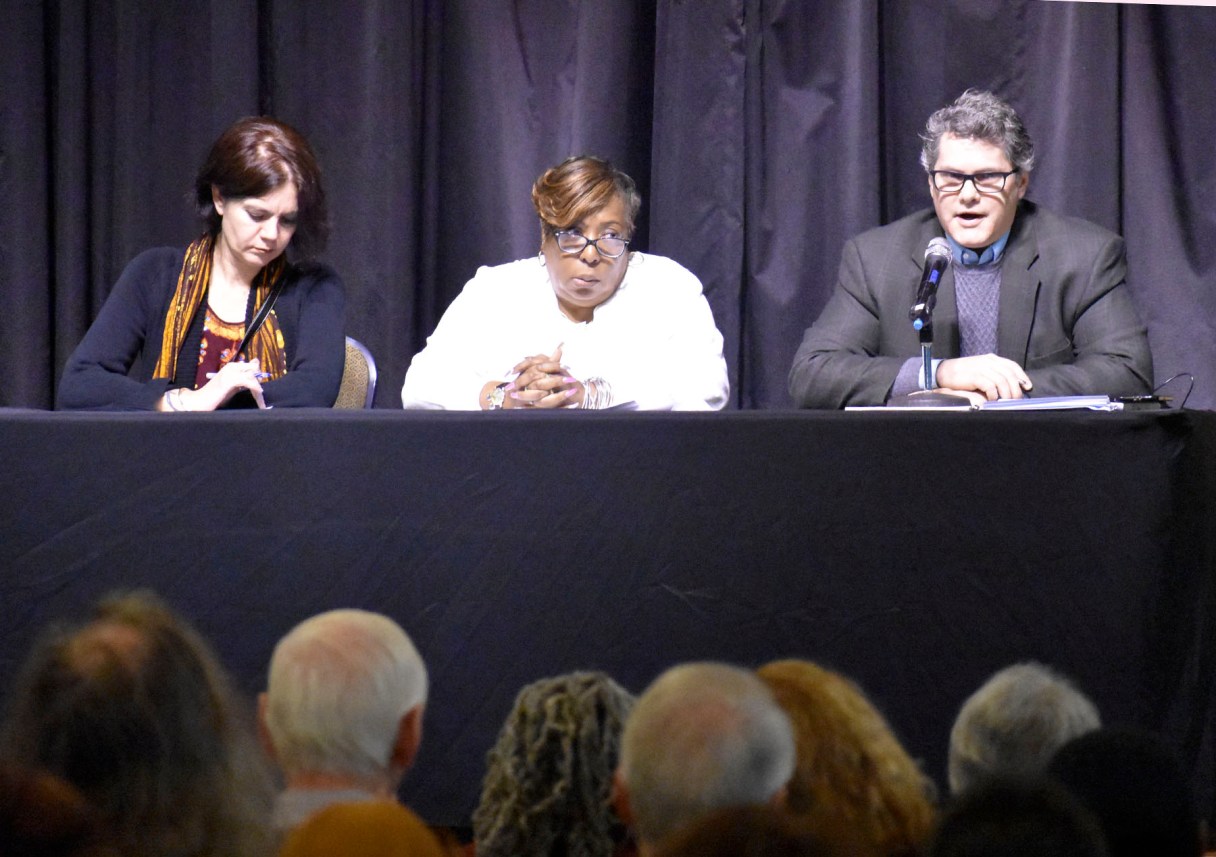
Robert Payne held back tears as he described his time in Tennessee state prisons to the nearly 50 people seated in front of him at the Bessie Smith Cultural Center on Tuesday night.
The crowd had gathered for a forum hosted by the Unity Group to discuss mass incarceration in Tennessee. Payne, 54 and originally from Whitwell, Tenn., said he spent a majority of his life in prison for committing second-degree murder when he was 18. Later diagnosed with post-traumatic stress disorder from trauma endured during childhood, he said he was shuffled from prison to prison until he was 51.
Upon his release, Payne said, the state gave him a check for $35 to restart his life.
“The system is bad,” he said to the crowd. “We need people out here to fight.”
Eric Atkins from Unity Group said the group’s members believe people should be punished for committing violent acts, but that convicted felons are often treated unfairly in prison and after re- entering society. Over the course of the forum, panelists and local residents discussed prison overpopulation in the state, the disproportionate number of black Americans serving time and the lack of rights for convicted felons, such as Payne, after they are released.
Tennessee now prevents people from voting if they have been convicted of a felony, incarcerated, on parole, on probation or not up to date on child support payments or court costs. Hamilton County is working to help certain convicted felons restore their voting rights through an initiative called “Restore My Rights.” Information on the initiative can be found at restoremyrights.com.
Convicted felons also can find it hard to obtain jobs and housing once released, as Payne did. Payne said he was lucky, though, and his current boss let him convert three office spaces into an apartment.
Those who attended the discussion also heard from Tennessee American Civil Liberties Union executive director Hedy Weinberg and panelists the Rev. Jeannie Alexander of No Exceptions Prison Collective, Timothy Dempsey of Chattanooga Endeavors and Jennifer Woods, education chairwoman for the Chattanooga-Hamilton County NAACP.
Retired Signal Mountain resident Linda Pillow was in attendance and said she was most surprised at the statistics all of the speakers provided on incarceration in America and in the state.
“I don’t think most of us know those numbers,” she said.
According to Weinberg, one in four black males will be behind bars in their lifetime. The Bureau of Justice Statistics reports black males born in 2001 have a 32 percent chance of serving time in prison at some point in their lives, Hispanic males have a 17 percent chance and white males have a 6 percent chance.
“Our nation’s criminal justice system is like a maze with many different entrances, which are wider for some people,” Weinberg said. “Once you are inside, it becomes very difficult to make your way out.”
There are more than 30,000 people in Tennessee’s state prison system, said Alexander, who used to be head chaplain at the Riverbend Maximum Security Institution in Nashville where Tennessee’s death row is housed.
“What I met were young adults who ate trauma for breakfast since they were children,” she said. “Hurt people, hurt people.”
Now, Alexander is the director of the No Exceptions Prison Collective, and she focuses on sentencing and parole reform and improving prison conditions. Alexander talked about the for-profit nature of private prison providers in the United States and the state, describing prisoners as being exploited for profit. She urged people to vote, watch legislative bills and reach out to legislators about prison reform initiatives.
Woods, a retired Hamilton County educator, believes the solution is in how we discipline and help children in school, specifically black children. She said the overuse of suspension and expulsion for black students has led to serious civil rights violations, including in Hamilton County Schools.
According to Woods, the local NAACP branch has filed about seven complaints with the U.S. Department of Education and nearly 30 complaints with the state of Tennessee for students whose rights have allegedly been violated.
Woods received several rounds of applause from the audience when discussing the need to improve respect between teachers and black students.
“We have to get back to that mentality of a village raising the children,” she said. “Until those children know there is somebody out there that is looking out for them and has realistic, high expectations … then we will continue to face the problems that we face.”
Contact Allison Shirk at allisonshirk92@gmail.com.