
Thursday, October 29, 2026Oct 29

This story is free to read.

US implicates Saudi crown prince in journalist’s killing

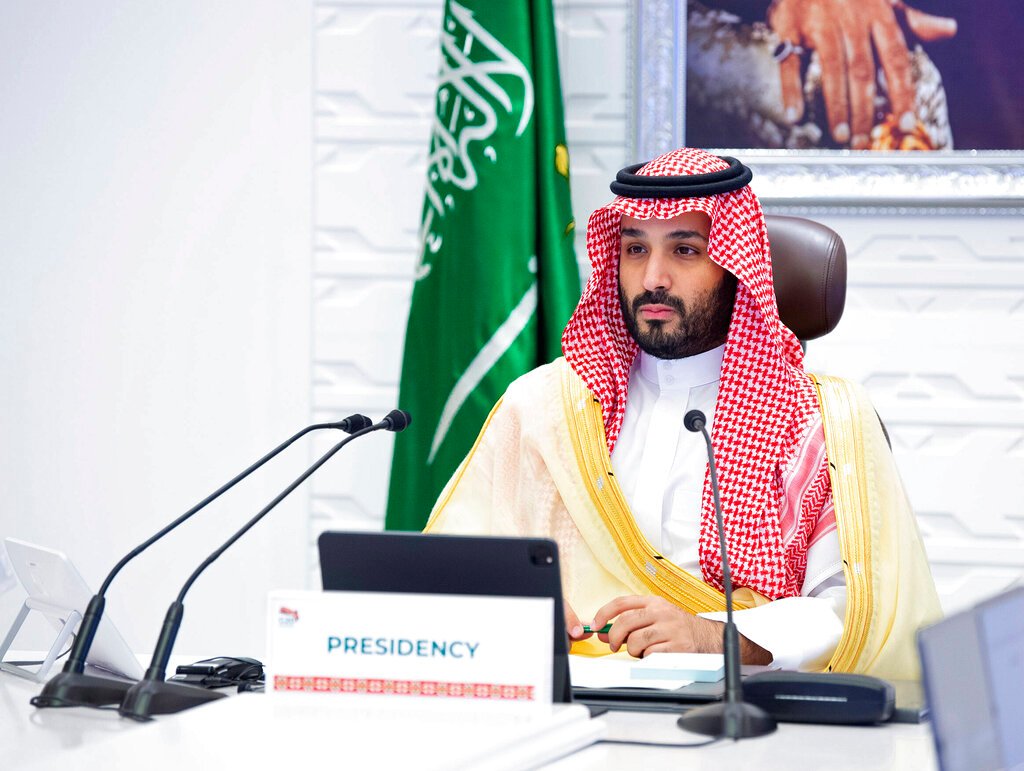
In this Sunday, Nov. 22, 2020, file photo, Saudi Arabia's Crown Prince Mohammed bin Salman attends a virtual G-20 summit held over video conferencing, in Riyadh, Saudi Arabia. Saudi Arabia's royal court says Crown Prince Mohammed bin Salman underwent a "successful surgery" for appendicitis on Wednesday, Feb. 24, 2021, and left the hospital soon after the operation. The 35-year-old Prince Mohammed had laparoscopic surgery at the King Faisal Specialist Hospital in the Saudi capital of Riyadh in the morning. (Bandar Aljaloud/Saudi Royal Palace via AP, File)
In this Sunday, Nov. 22, 2020, file photo, Saudi Arabia's Crown Prince Mohammed bin Salman attends a virtual G-20 summit held over video conferencing, in Riyadh, Saudi Arabia. Saudi Arabia's royal court says Crown Prince Mohammed bin Salman underwent a "successful surgery" for appendicitis on Wednesday, Feb. 24, 2021, and left the hospital soon after the operation. The 35-year-old Prince Mohammed had laparoscopic surgery at the King Faisal Specialist Hospital in the Saudi capital of Riyadh in the morning. (Bandar Aljaloud/Saudi Royal Palace via AP, File) In this Sunday, Nov. 22, 2020, file photo, Saudi Arabia's Crown Prince Mohammed bin Salman attends a virtual G-20 summit held over video conferencing, in Riyadh, Saudi Arabia. Saudi Arabia's royal court says Crown Prince Mohammed bin Salman underwent a "successful surgery" for appendicitis on Wednesday, Feb. 24, 2021, and left the hospital soon after the operation. The 35-year-old Prince Mohammed had laparoscopic surgery at the King Faisal Specialist Hospital in the Saudi capital of Riyadh in the morning. (Bandar Aljaloud/Saudi Royal Palace via AP, File)

WASHINGTON (AP) – Saudi Arabia’s crown prince likely approved the killing of U.S.-based journalist Jamal Khashoggi inside the Saudi consulate in Istanbul, according to a newly declassified U.S. intelligence report released Friday that instantly ratcheted up pressure on the Biden administration to hold the kingdom accountable for a murder that drew worldwide outrage.

The intelligence findings were long known to many U.S. officials and, even as they remained classified, had been reported with varying degrees of precision. But the public rebuke of Crown Prince Mohammed bin Salman is still a touchstone in U.S-Saudi relations. It leaves no doubt that as the prince continues in his powerful role and likely ascends to the throne, Americans will forever associate him with the brutal killing of a journalist who promoted democracy and human rights.

Yet even as the Biden administration released the findings, it appeared determined to preserve the Saudi relationship by avoiding direct punishment of the prince himself despite demands from some congressional Democrats and Khashoggi allies for significant and targeted sanctions.

Questioned by reporters, Secretary of State Antony Blinken defended the approach.

“What we’ve done by the actions we’ve taken is not to rupture the relationship but to recalibrate it to be more in line with our interests and our values,” he said. “I think that we have to understand as well that this is bigger than any one person.”