
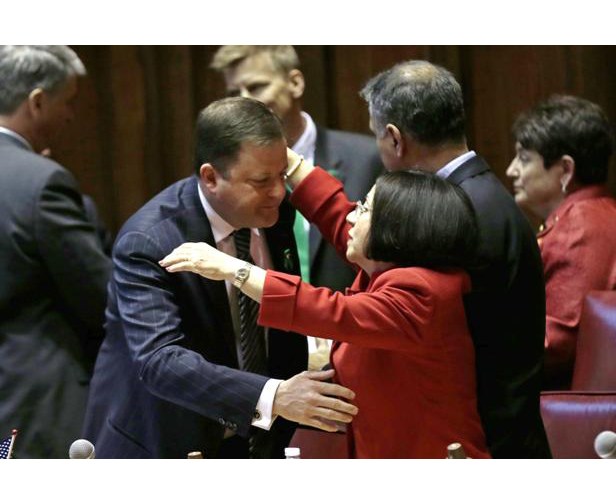
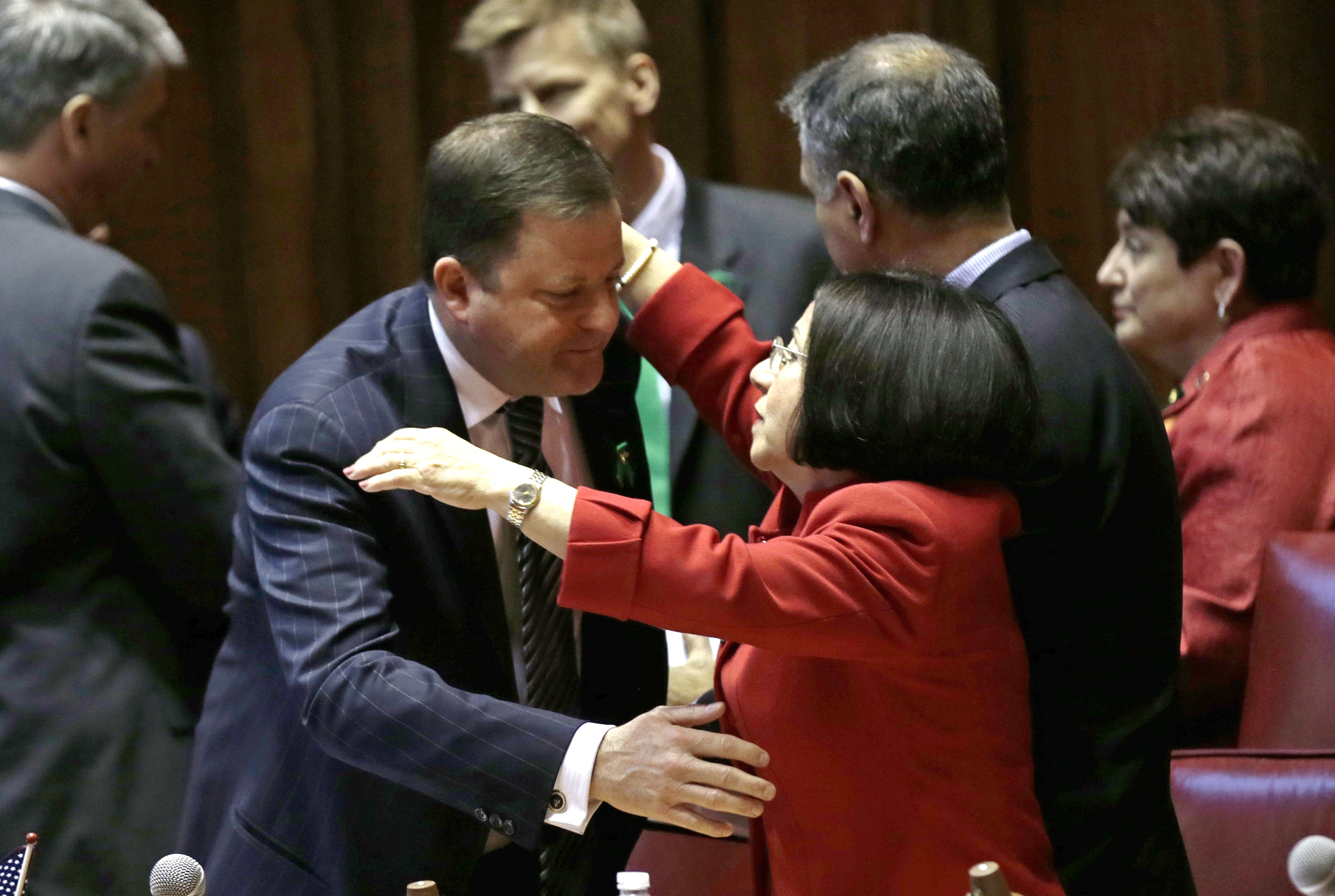
 Connecticut Senate Minority Leader John McKinney, R-Fairfield, who represents Newtown, Conn., left, is embraced by state Sen. Toni Boucher after the passage of a gun-control bill in the Senate chamber at the Capitol in Hartford, Conn., Wednesday. The bill passed the Senate and goes onto the state House for approval. Hundreds of gun rights advocates are gathering at the statehouse in Hartford ahead of a vote in the General Assembly on proposed gun-control legislation.
From Colorado to Connecticut, a handful of very different states have advanced new gun control laws over opposition that has made such legislation a struggle nationally and a non-starter in most legislatures.
How did they do it?
Culture and attitudes regarding guns vary widely from state to state and within their borders, but the limited victories by gun control advocates in the three months since the Newtown school massacre show three factors at work: governors willing to spend significant political capital on the issue; Democratic legislative strength; and heightened public concern raised by proximity to mass shootings.
All three helped drive new gun control measures in New York, Colorado and in Connecticut, where Gov. Dannel P. Malloy pushed for an agreement between majority Democratic lawmakers and Republican counterparts on a series of new laws that were headed for a vote Wednesday. In Maryland, which also has a Democratic governor and legislature, a gun control bill was proceeding through the House of Delegates.
“What makes the difference … is the willingness of the legislators and the governors to take the lead and also, you know, the experience of gun violence in that state, whether it be through a mass shooting or the day-to-day shootings,” said Lindsay Nichols, staff attorney for the Law Center to Prevent Gun Violence, a gun-control advocacy group based in San Francisco.