
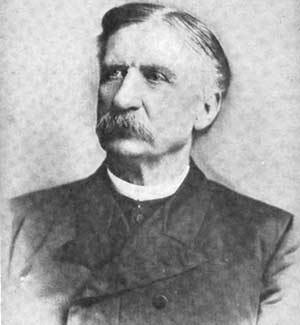
When Dr. Jonathan Waverly Bachman died on Sept. 28, 1924, the Chattanooga newspapers carried the story on their front pages and reported “Chattanooga grieved as never before.” According to an editorial written just four years later, Bachman’s ministry, which began in October 1873, had been a “beacon light to the community.”
A 50-year ministry is certainly exemplary, but how had Bachman become so endeared to the Chattanooga community and to his congregation at First Presbyterian Church? The numbers alone are staggering. In a 1928 Chattanooga Times article, Bachman is identified as having officiated at 1,600 marriages and 2,000 funerals, baptized 884 infants and 390 adults, conducted 2,500 prayer meetings and preached more than 3,000 sermons.
Bachman came to Chattanooga after having served for eight years as a pastor and president of a girls’ college in Rogersville, Tennessee. Perhaps nothing more quickly cemented the city’s affection for him than his actions during the yellow fever epidemic.
In 1878, Chattanooga had rebounded from the Civil War, a financial panic, a series of floods and several waves of illness. While stories of the yellow fever outbreaks in other regions of the South were carried in Chattanooga newspapers, Bachman noted that few in Chattanooga seemed concerned that the epidemic would reach the city because of its higher elevation and its much heralded “mountain air.” Chattanooga newspapers carried stories inviting “refugees” from areas affected by the fever to come to the “Gateway to the South,” and many did.
The summer of 1878 was hot and humid. A friend recalled Bachman saying that he was “apprehensive from the first, as during the war he [a Confederate chaplain] was in the siege of Vicksburg, and had heard tales of the horrors of the disease and he felt the shadow before it fell.” While illness began to spread across Chattanooga, noted as “pernicious” and “malignant,” it was 10 days before the term “yellow fever” was used by physicians.