

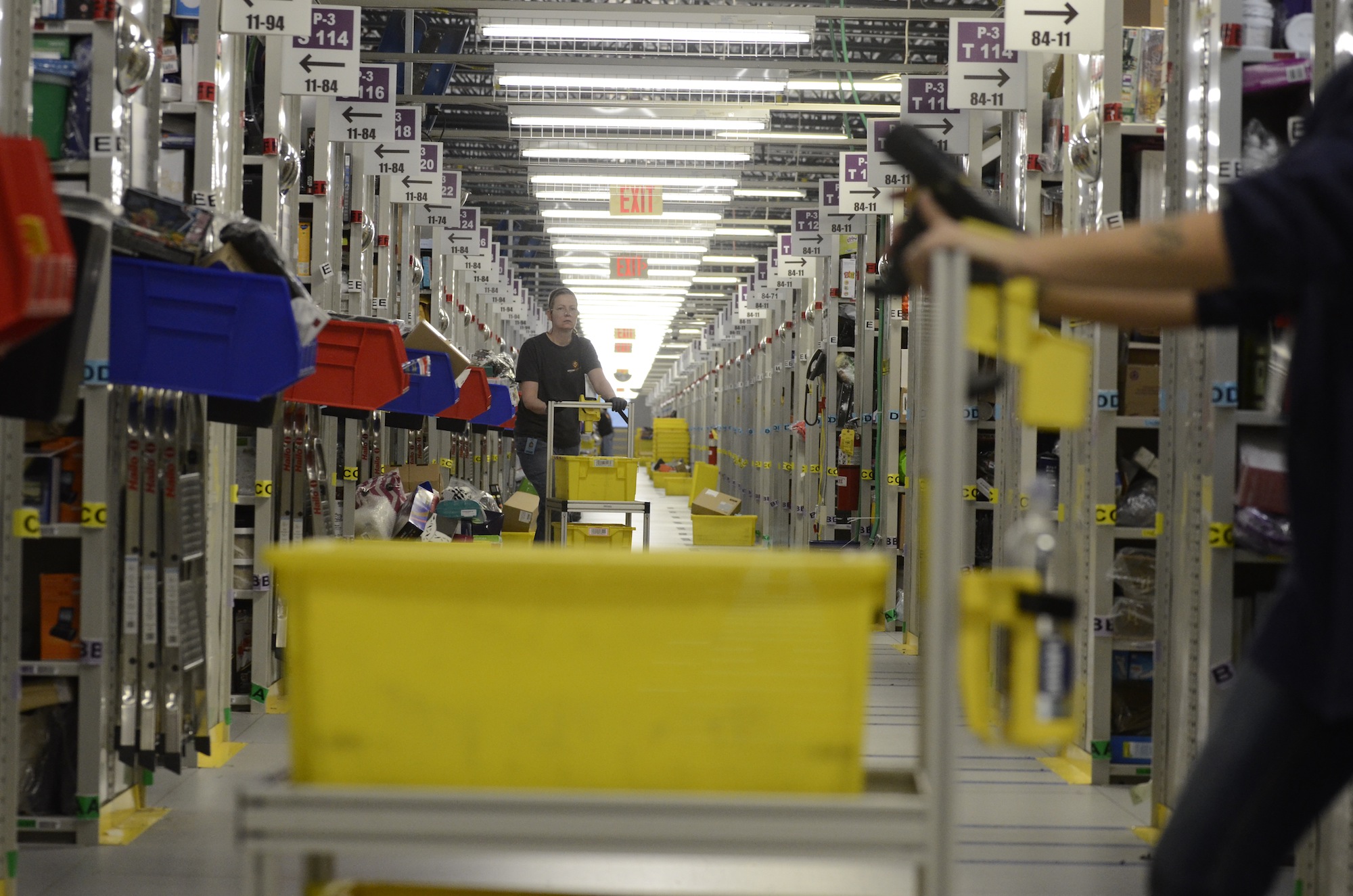
 Staff File Photo by Logan Foll / Pickers, individuals who find and fulfill orders from rows of shelves, dart around the floor on Cyber Monday at the Amazon fulfillment center in the Enterprise South industrial park in Chattanooga in 2014.
A Washington, D.C., nonprofit is sharply critical of local and state government tax incentives awarded for Amazon’s distribution network and cites Chattanooga as one of its case studies.
But while the report by Good Jobs First puts subsidies for Chattanooga’s Amazon distribution center at $36.9 million, including $30 million in property tax rebates from the city of Chattanooga, those figures are disputed locally.
Charles Wood, the Chattanooga Area Chamber of Commerce’s vice president of economic development, put the property tax incentives for Amazon at about $11 million.
Wood defended the 11-year tax incentive agreement given by the city and Hamilton County to Amazon, saying the deal goes back to 2010 when the country was gripped in a recession and joblessness was high.
“The timing of that project – it’s really important,” he said.
In addition, Wood said, Amazon has continued to grow employment at the distribution center and now has more than 3,000 full-time workers when it originally pledged about 1,200 in the tax agreement with the city and county.
Amazon said it also planned to hire as many as 5,000 seasonal workers during the Christmas holiday at its Chattanooga and Charleston, Tenn., fulfillment centers.
Wood said, at the local level, “the incentives were justified and have been a great return on investment.”
The Good Jobs First report, titled “Will Amazon Fool Us Twice?” said Amazon had gained market share in part by avoiding and then minimizing the collection of sales taxes. As the company became less able to avoid doing so, it learned it could sometimes “extract lucrative taxpayer subsidies” for its distribution centers and methodically started doing so in 2010 and 2011, the study said.
Now, Good Jobs First said, Amazon is seeking a new round of favors from taxpayers and, all too often, state and local governments are bowing to the company’s demands for economic development subsidies.
Since the start of 2015 alone, governments in two dozen places have committed at least $241 million in subsidies for Amazon facilities, the study said.
Thomas Cafcas, the report’s prime author, said it’s clear that companies such as Amazon go to communities because the business basics are driving them there.
“The Chattanooga facility is strategically located near major metro areas,” he said. “We think communities shouldn’t pay companies to do what they’d do anyways.”
Amazon spokeswoman Nina Lindsey said the Seattle-based company has invested billions of dollars and created more than 180,000 full-time jobs in more than 70 U.S. cities.
“Whether it’s through the direct creation of great jobs at our fulfillment centers that pay 30 percent higher than traditional retail jobs, supporting local businesses near our sites, or creating hundreds of thousands of additional jobs through our investments across the country, we’re focused on supporting the prosperity of the communities where our employees live and work,” she said.
Cafcas said the $30 million figure the group reported in Chattanooga property tax rebates came from a Nashville press report. But, he said, details of economic development deals are often misreported or misremembered and there’s room for improvement in making such information more readily available.
Helen Burns Sharp, founder of the locally based Accountability for Taxpayer Money citizens group, said her calculations put the Amazon property tax breaks at about $14 million.
She said she’s not convinced the Amazon distribution center was “a catalyst project” such as the Volks- wagen auto assembly plant, which has attracted a number of parts supplier companies.
“[Amazon] would likely have located here anyway because of workforce, proximity to I-75, etc.,” Sharp said. “I believe they were also beneficiaries of several million dollars of site preparation done by the state as part of Enterprise South [industrial park].”
Wood, however, said Amazon has more than fulfilled its part of the deal related to the tax incentive agreement, adding the internet retailer is generating over $100 million in annual payroll.
“Imagine taking more than $100 million out of the local economy,” he said.
Also, Wood said, Amazon paid about $500,000 in county school taxes last year.
“If they weren’t sitting in Hamilton County, we would not be getting a dime,” he said.
Wood added that Amazon wages for full-time workers average more than $30,000 a year.
Sharp said an average annual wage minimum threshold of $30,500 means the employees of subsidized jobs such as Amazon could qualify to rent a low- to moderate-income unit in a subsidized [payment-in-lieu-of tax agreement] apartment.
“I oftentimes wonder who, if anyone, is negotiating on behalf of the taxpayers and future employees in these deals,” she said.
Sharp said the city and county still have not adopted policies and procedures about such jobs’ tax incentive agreements.
At a minimum, she said, officials need to ask two questions before recommending such tax breaks: does the request meet the “but for” test and the company would not be here if incentives weren’t offered, and is there sufficient public benefit to warrant abatement of taxes that could otherwise be used for priorities such as emergency and neighborhood services and streets.
Wood said he understands the Good Jobs First report and the discussion today when unemployment is lower than it has been in a decade.
“Certainly times are different now,” he said.
Contact Mike Pare at mpare@timesfreepress.com or 423-757-6318.