
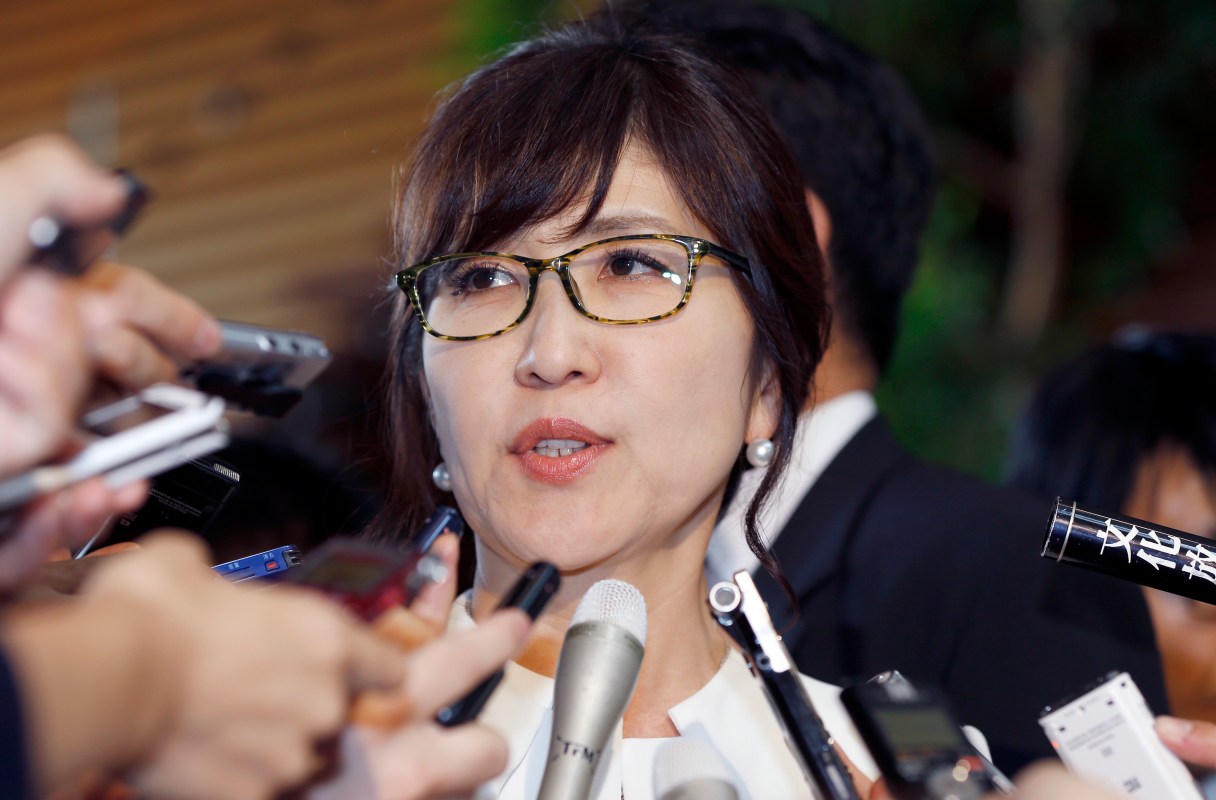
TOKYO (AP) – A woman who has downplayed Japan’s wartime actions and is known to have far-right views was named defense minister in a Cabinet reshuffle on Wednesday, a move that could unsettle relations with Asian neighbors with bitter memories of World War II-era atrocities.
Tomomi Inada, a former reform minister who most recently was policy chief in the ruling Liberal Democratic Party, replaced Gen Nakatani as defense minister. She’s the second female to fill the post.
Prime Minister Shinzo Abe changed more than half of the 19-member Cabinet in a bid to support his economic and security policies, as well as push for revising Japan’s postwar constitution.
While keeping the economy as the top priority, Abe said he would do his “utmost to achieve a (constitutional) revision during my term,” which ends in September 2018.
A lawyer-turned-lawmaker with little experience in defense, Inada is one of Abe’s favorites. She regularly visits the Yasukuni Shrine, which honors war dead including convicted war criminals, a gesture seen as an endorsement of Japan’s militaristic past.
She also has defended Japan’s wartime atrocities, including forcing many Asian women into sexual servitude in military-run brothels, and has led a party committee to re-evaluate the judgment of war tribunals by the Allies.
Her link to a notorious anti-Korea group was acknowledged by a court this year in a defamation case she lost. Inada also was seen posing with the leader of a neo-Nazi group in a 2011 photo that surfaced in the media in 2014.
Inada, 57, is a supporter of Abe’s long-cherished hope to revise Japan’s postwar constitution. She has said parts of the war-renouncing Article 9 should be scrapped, arguing that they could be interpreted as banning the Self-Defense Forces.
Inada said she would try to protect peace and safety under the Japan-U.S. alliance, which is a cornerstone of Japan’s security and diplomacy. On Wednesday, she refused to say if she planned to visit Yasukuni to mark the Aug. 15 anniversary of the end of WWII.
Finance Minister Taro Aso, Foreign Minister Fumio Kishida and Chief Cabinet Secretary Yoshihide Suga were among key Cabinet members who retained their portfolios, while 10 ministers were replaced in the reshuffle. Many are not necessarily experts in their assigned portfolio, prompting opposition lawmakers to criticize Abe for dominating the Cabinet with like-minded supporters of his political views.
Abe, whose key policies include women’s advancement, will have two other female Cabinet members, including one who will serve as Olympic minister after being shifted from environment minister. Tokyo is set to host the 2020 Summer Games.
While campaigning for last month’s upper house elections, Abe promised to focus on economic revitalization in the short term, and to later seek to revise Japan’s pacifist constitution.
Since he took office in late 2012, Abe has sought to boost growth by pumping massive amounts of money into the world’s third-biggest economy. But lavish monetary easing and public works spending so far have failed to reignite growth as much as hoped.
The reshuffle was the third since Abe took office, and the first since October.
___
Follow Mari Yamaguchi at https://www.twitter.com/mariyamaguchi
Find her work at http://bigstory.ap.org/content/mari-yamaguchi