
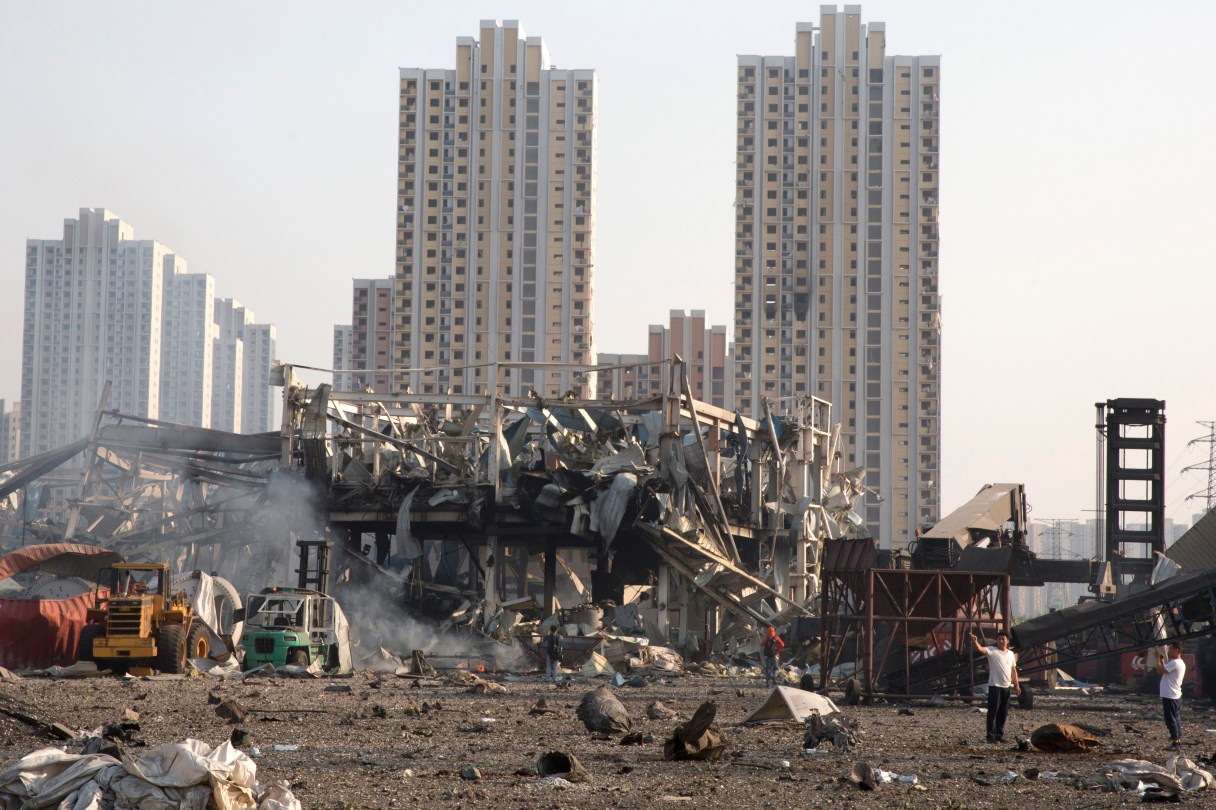
SHANGHAI (AP) – The man unveiled as principal owner of the warehouses at the center of deadly blasts in Tianjin also is on the board of a state-owned company that is ultimately controlled by the same powerful entity investigating the explosions, an Associated Press review of public documents found.
Corporate filings show that Yu Xuewei, the silent majority shareholder of Ruihai International Logistics, sits on the board of directors of a subsidiary of China Sinochem, one of the country’s most influential conglomerates. Like other large state companies, Sinochem is controlled by the State Council, the central authority overseeing the investigation into last week’s explosions at Ruihai’s chemical warehouses that killed at least 114 people and displaced thousands.
Yu’s connections hint at the extent of his political network and showcase the complexity of China’s political system, in which the entity running an investigation can be linked to the company it is investigating. Major state-owned Chinese companies often are accused of ignoring safety and other regulations, especially Cabinet-level enterprises whose chief executives have a higher status in the ruling Communist Party hierarchy than the regulators who are supposed to oversee them.
The subsidiary where Yu serves as a director, Tianjin Port Sinochem Dangerous Goods Logistics Co., also has been accused of violating safety standards at its own hazmat warehouses. The environmental group Greenpeace released an investigation this week saying Tianjin Port Sinochem and its sister company, Sinochem Tianjin Binhai Logistic Corp., operated hazardous chemical warehouses less than 1,000 meters (3,280 feet) from a major highway, schools and residences, in violation of Chinese safety laws.
China Sinochem has tried to distance itself from Ruihai. Two days after the explosions it published a statement acknowledging that former staff members worked at Ruihai, but disavowing any deeper links. Sinochem wrote that Ruihai “has no relationship with Sinochem or its affiliated companies” and that former employees had “all long terminated employment” with Sinochem and its affiliates.