
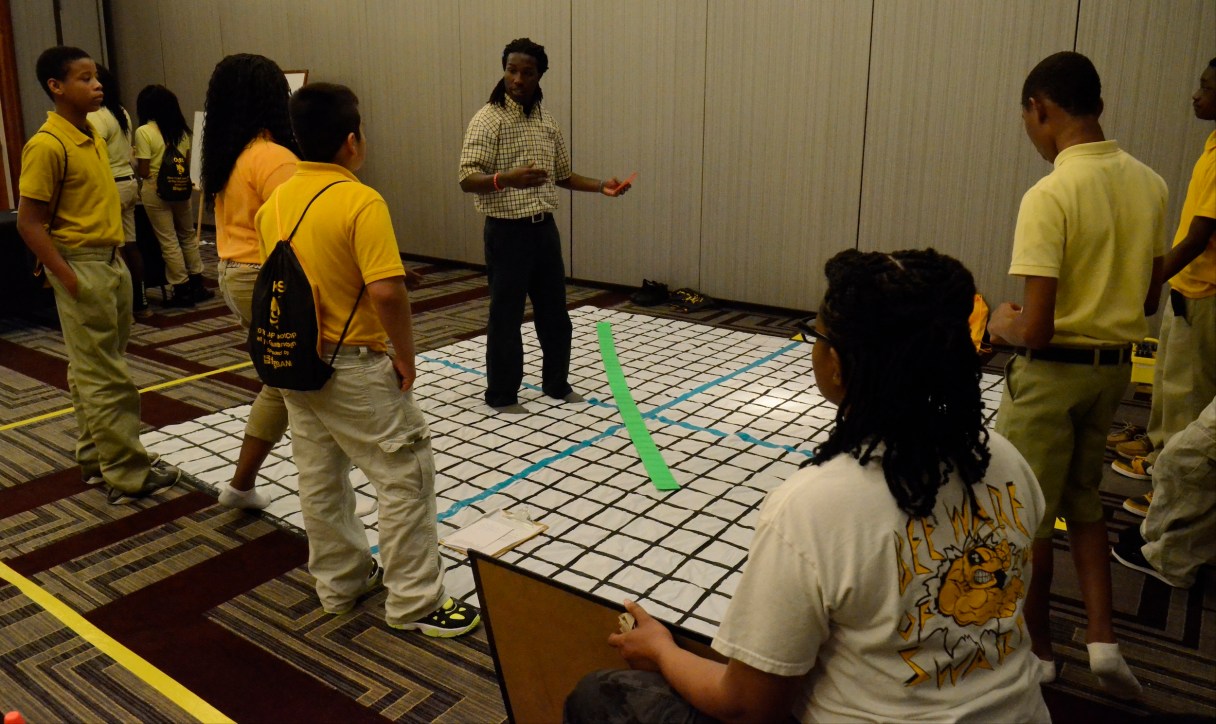
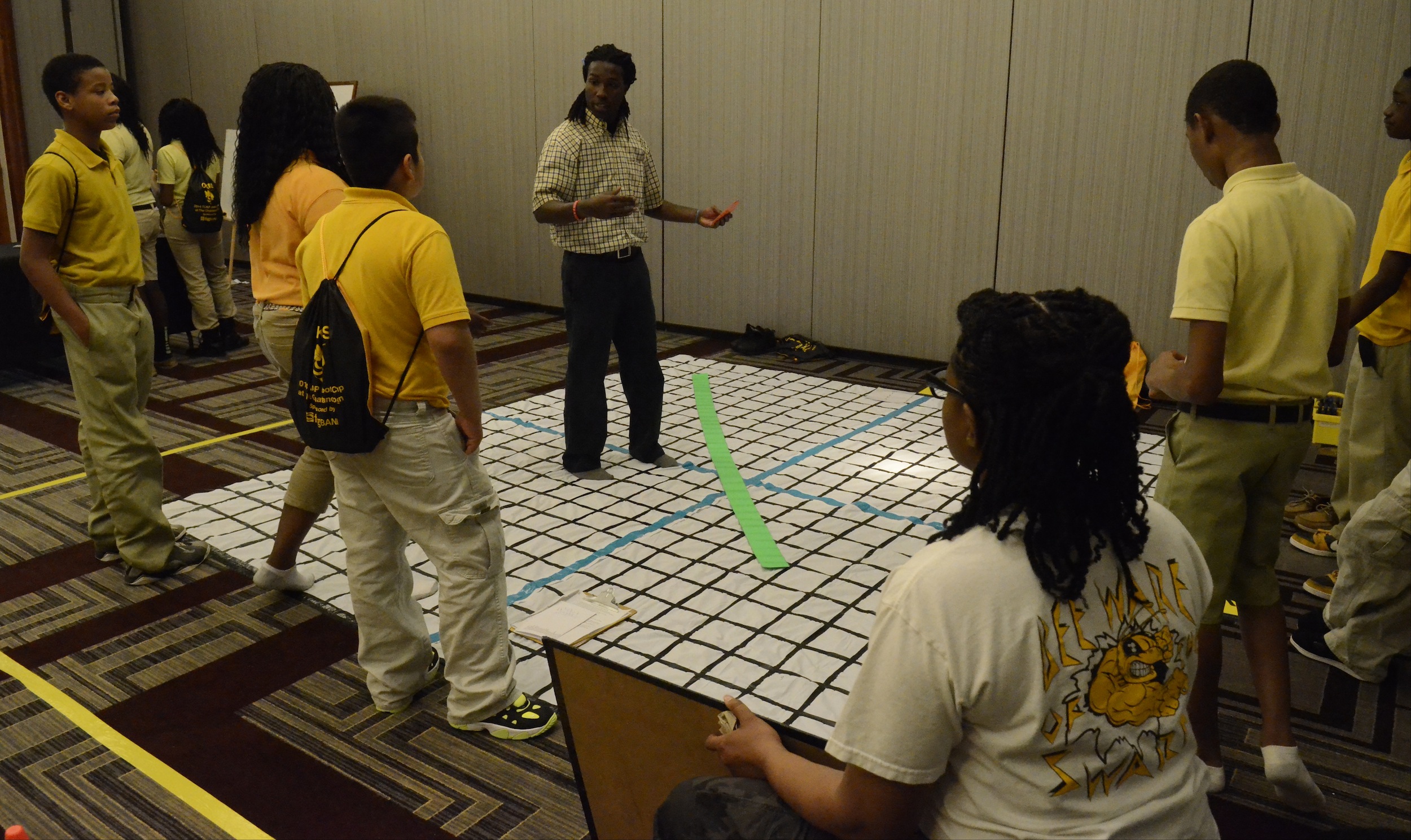
 Seventh-grade math teacher Jamal Lett, center, and assistant teacher Brandy Powell, foreground right, used a giant graph in a 2014 TCAP boot camp to help Orchard Knob Middle School students prepare for tests in math, science, social studies and language skills.
Over the weekend, President Barack Obama said he has heard myriad parents and teachers who are complaining that our schools spend far too much time on standardized testing. Saying that the heavy emphasis on testing creates too much teacher and student pressure, he plans to cap the testing time to 2 percent of the school year by making it easier for states to satisfy federal testing mandates.
In Hamilton County and across Tennessee, students last year spent 2.8 percent of their year in testing – or 36 hours, according to the Tennessee Department of Education website. A state-mandated switch from TCAP tests to the new TNready tests will add one hour to testing, meaning our students will spend 37 hours testing – 2.9 percent of their school-year learning time.
President Obama’s goal is to limit standardized testing to 2 percent of the year. Here, that will mean cutting our students’ testing time from 37 hours down to 25.2 hours.
Hamilton County students are supposed to spend 180 seven-hour days (1,260 hours or 36 weeks) in school this year, according to the Hamilton County Department of Education website. How can anyone really think that spending one of those 36 weeks is too much to assess how well or poorly our students are learning and our teachers are teaching?
We can hear the “but” already: Does that include test prep time?
No. Nor should it.
Here’s why. TCAP tests, TNready tests, or whatever we call them this week, are intended to assess what children have learned based on the standards set by state and federal school officials for a given grade level.
If teachers are having to prepare students to take the test, that means our students have not already learned enough to pass the tests at their grade level. They are already behind, and teachers who are having to teach to the test are playing catch up for teachers in previous grades.
That’s not to say that teaching to the test is all bad. After all, the students are still learning something they need to know. And they are still being educated to the level we deem “proficient.”
It certainly is not wasted time to teach what students need to know in reading, language skills, math and science. Especially if those students don’t already have that knowledge. What was wasting time was not adequately preparing those students to be test ready – without additional prepping time.
The bottom line is if teachers in Hamilton County or any other county in any other state are having to spend weeks preparing students to take and pass these tests, then the tests are not really measuring what students should already know. They are instead becoming the mountain teachers and students have to climb year after year to catch up.
Hamilton County Schools’ Kirk Kelly, director of testing and accountability, in August told the school board that the increase in testing time due to the state’s change to TNready tests would mean seven weeks devoted to testing.
Since the tests take, at most, 37 hours, we have to assume that seven weeks – almost 20 percent of the system’s total educational time – includes prep time. If not, then it’s a fair question to ask if Kelly and Superintendent Rick Smith led the school board into an angry tizzy to avoid talking in depth about Hamilton County students scoring below state average in nine of 10 categories in last year’s TCAP tests.
Smith told the board members: “Really good teachers are going to look at this and say, “I’ve lost 30 or 40 percent of my instructional time.”
Now the president is caving to a teachers’ union myth that standardized testing – which can and should be used to evaluate teachers – is taking too much time from education.
One way to look at the president’s action is that majority Republican states like Tennessee, Georgia and Alabama will now embrace testing as an accountability factor in education. After all, they never like anything that President Obama puts forward.
Teachers like to blame tests, parents and even students. Some of that is fair. But a teacher’s job is to teach – no matter how good or poor the students are. Thankfully, there are many wonderful teachers. But they may not be here – or wonderful for Hamilton County’s lowest performing students who all-too-often are in inner-city schools.
Just last week, the Tennessee Department of Education gave our school system the lowest possible rating on system performance based what gains our students made over the past year.
Something here is not working, and the school board, administrators and educators – not students and families – need to be held accountable. The gains test measures gains, not socio-economic home life.
Tennessee Sen. Todd Gardenhire, R-Chattanooga, last year took on the educational status quo of passing ill-prepared students from grade to grade until they graduated and went, unprepared, to Tennessee’s now-free community colleges needing remedial classes. Gardenhire, looking to bring about education accountability, introduced a bill that would make school systems responsible for the costs of remediation courses taken by students who graduated with less-than-adequate college readiness.
His bill went nowhere, but he’s not giving up.
“I don’t know how else to get accountability without testing,” he said Monday afternoon in response to President Obama’s push to limit testing time.
We don’t either.