
I didn’t anticipate spending the whole morning with Rick Huffines, who took over as executive director of the Tennessee River Gorge Trust earlier this year. In fact, I only put enough change in the parking meter to cover an hour and a half. My interview with Huffines began at 8:30 am at his downtown office and ended almost four hours later on the peak of Snooper’s Rock, 1,500 feet above the Tennessee River.
“I guess just my whole life I wanted to be outside,” Huffines says as we sit in his office. “I remember being about six years old and seeing a bird in the spring. I asked my mother what it was and she said, ‘I don’t know.’ But she said, ‘we’ll find out.'” So they went to the public library and checked out a Peterson Field Guide where Huffines learned about that bird and a handful of others. “I couldn’t really read at the time but I remember not wanting to take it back to the library. I kept asking her if we could check it out again.”
After he received his Wildlife Management degree, Huffines began working for the US Army Corps of Engineers. He was stationed at Martin’s Fork Lake in Eastern Kentucky where he did boundary line and park patrols. But something was missing.
“You’re young and you think, what am I supposed to do for the world? I kept thinking what am I supposed to be doing here? What am I contributing?” It took Huffines nearly ten years to answer that question: It wasn’t what he had gone to Kentucky to do; it was what he had gone there to get.” And it was to be humbled by those people that lived there. The people that lived in the mountains,” he says.
After a 26-year-long conservation career that included multiple roles-park ranger, refuge manager, even law enforcement where he received federal training to become Deputy Chief of the National Wildlife Refuge System of the Southeast-Huffines returned to his home state of Tennessee to help TRGT continue its vision “to preserve the Tennessee River Gorge as a natural sanctuary for our community. Forever.”
Huffines divides his time between the office and the field, making his way between both workspaces in a big gray pickup truck. He researches and writes grant proposals with the help of office manager Hannah Shadrick, a recent Smith College graduate who is also helping Huffines build TRGT’s presence on social media websites such as “the Twitter and the Facebook,” he says. The other half of his time is spent outside. “I was supposed to get out to the Mike Linger Memorial Field today to do some brush clearing,” Huffines says, referring to the butterfly meadow recently dedicated to the TRGT’s late land stewardship director. “But I’m not sure if that will happen now,” he adds while looking at the rain falling outside his office window.
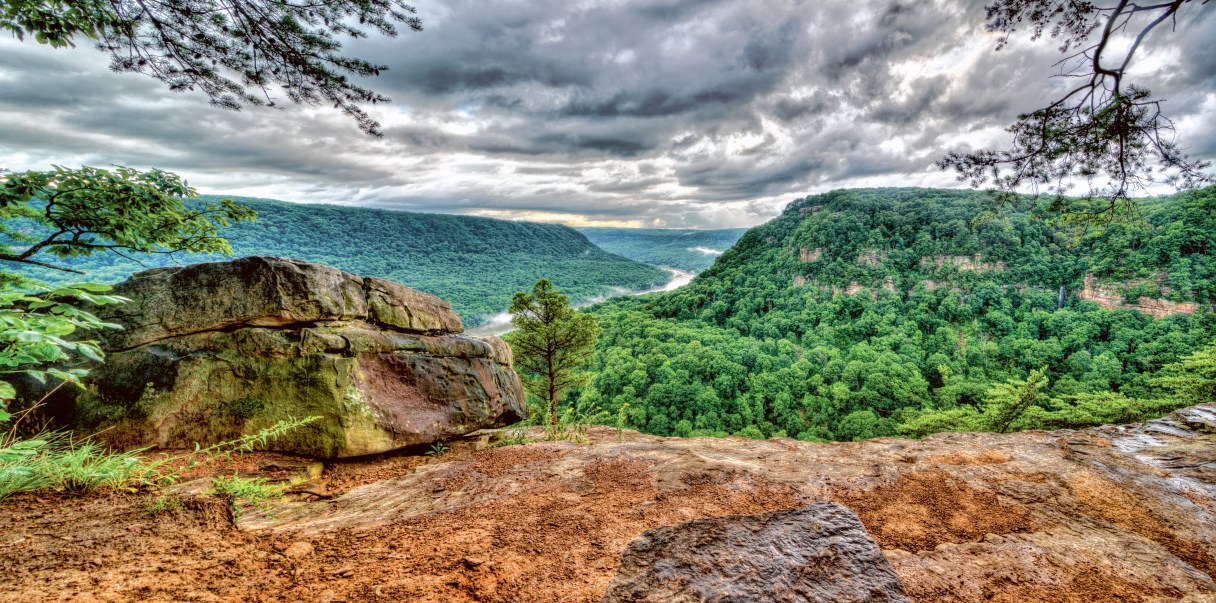
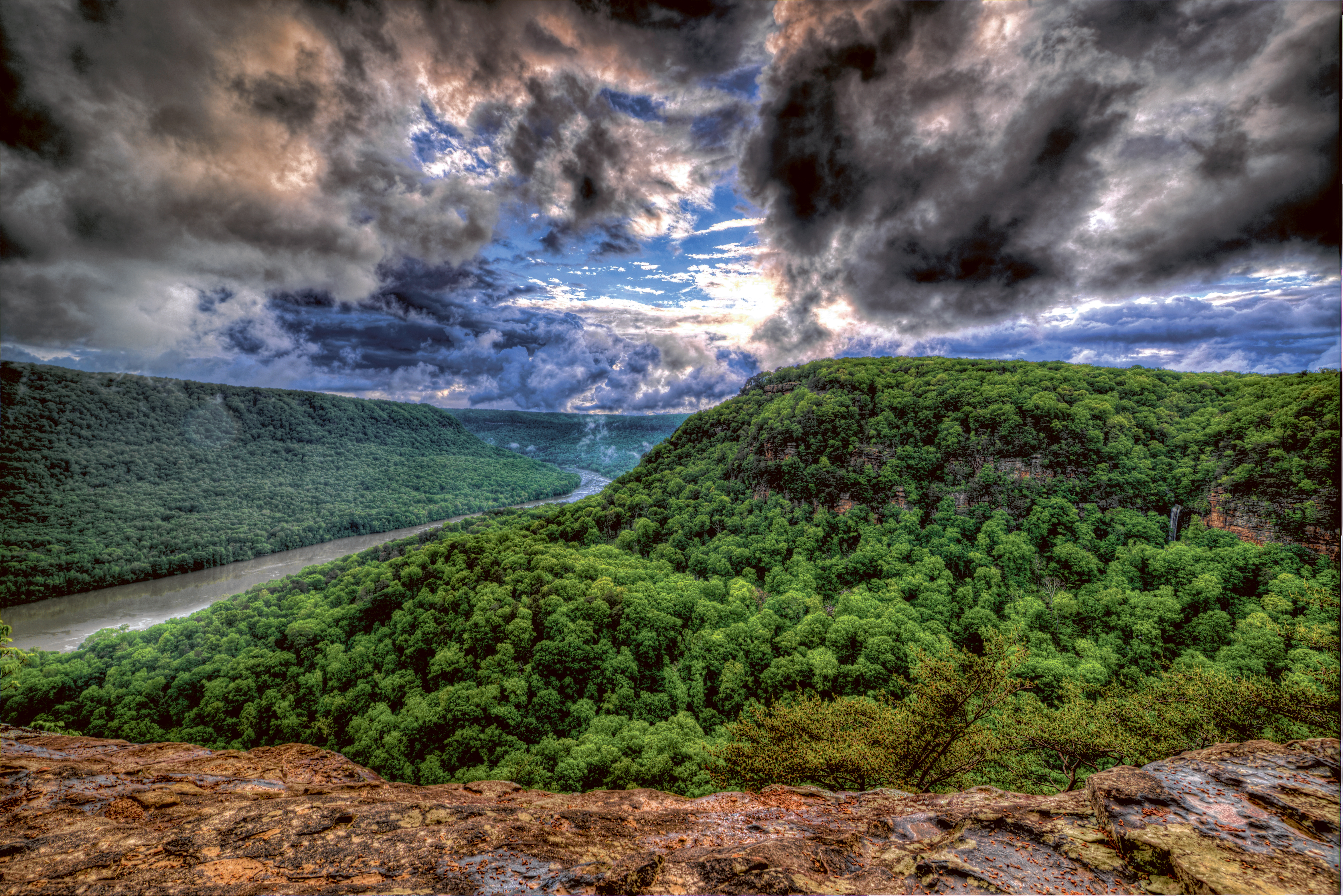
The Tennessee River Gorge is a unique geographical landscape comprised of escarpments, gorges and forest that span 27,000 acres and includes a 27-mile stretch of the Tennessee River carved through the Cumberland Mountains.Over the past 32 years, 17,000 of those acre shave been protected by the community, which is the function of the land trust. This means that the project is sup- ported by the people, not the government.
“It’s unlike any place else I ever worked,” Huffines tells me. That is saying a lot. His professional career has encompassed four million acres, 127 national wildlife refuges, ten different states and the Caribbean. “I’ve been on special details from Alaska to the jungles in Puerto Rico and I’m telling you,” he stresses, “this is unlike anything I’ve ever seen.”
The reason for the Gorge’s uniqueness is twofold. First, it is due to the many natural features and communities, for instance, the waterfall and spray communities, the cliff communities, and the expansive cave and karst systems. “I think the Tennessee River Gorge is an incredibly bio-diverse place and I’ve seen that in the last seven months,” he says. “You can have five natural communities within a half-mile radius of each other whereas in other places you might have to drive 50-100 miles to change from one natural community to another.”
It is these facets that make the gorge an ideal place to conduct studies on adaptation or changes in the climate. “Yet we’re not doing that. You ask why and I don’t really know.
We haven’t put the focus on it. That’s something I’m trying to do,” he explains.
That fact parallels with the second fold of the gorge’s uniqueness: it is generally undiscovered. There is a substantial lack of information about the gorge’s communities and inhabitants. For instance, the current available data lists 11 species in the gorge that are either threatened or endangered. Recently, however, Huffines did a little research and learned that out
of the 100 species listed as threatened or endangered in the state of Tennessee, 31 of those species are believed to be or known to be in the Tennessee River Gorge.
“I’ll show you right here on this biodiver- sity hot map,” he says as he unrolls a mapof the Tennessee River Gorge across his desk. “Where it’s red is where it’s hot,” he explains while pointing to several thick blots of red. “Hot” means there is an unusually high density of biodiversity in that area. The thick blots of red were overwhelm- ingly located on federal lands. “Typically your state agencies and your federal agen- cies have the data,” Huffines explains.
Sections of the Tennessee River Gorge were only tinged with red. “We’re seeking grant funding now to do biodiversity inventories. The next time you look at this map, I firmly believe this whole thing down here,” he says, laying his palm over the areas that are part of the land trust, “will be just as red as this down here.” He points to The Chickamauga Battlefield which is marked with a thick red blot and which is owned and protected by the state.
“How do you manage what you have if you don’t know what you have?” asks Huffines.
First and foremost, his objective with the TRGT is to protect the land. Second, it is to be a good steward of the land. Lastly, his job is to educate. His primary focus is making the land relevant to the youth. This is done through a myriad of educational programs which teach children about land trusts, water quality, air quality and perhaps Huffines’ favorite topic, birds.
“We teach them about migration and how we share these birds with other people in other countries like Central and South America,” Huffines describes. “We have a responsibility to those people just as they have a responsibility to us. We see the birds come in the spring; they see them come in the winter. The hope is that whether they become engineers, architects, whatever they become, that they will remember the importance of the birds and the trees and the habitat.”
Many of these programs are taught at the Pot Point Cabin, which was built by pioneers in 1835, located in the heart of the Tennessee River Gorge. “To show people the relevance, you first have to provide them the opportunity to come out to this place,” Huffines says.