
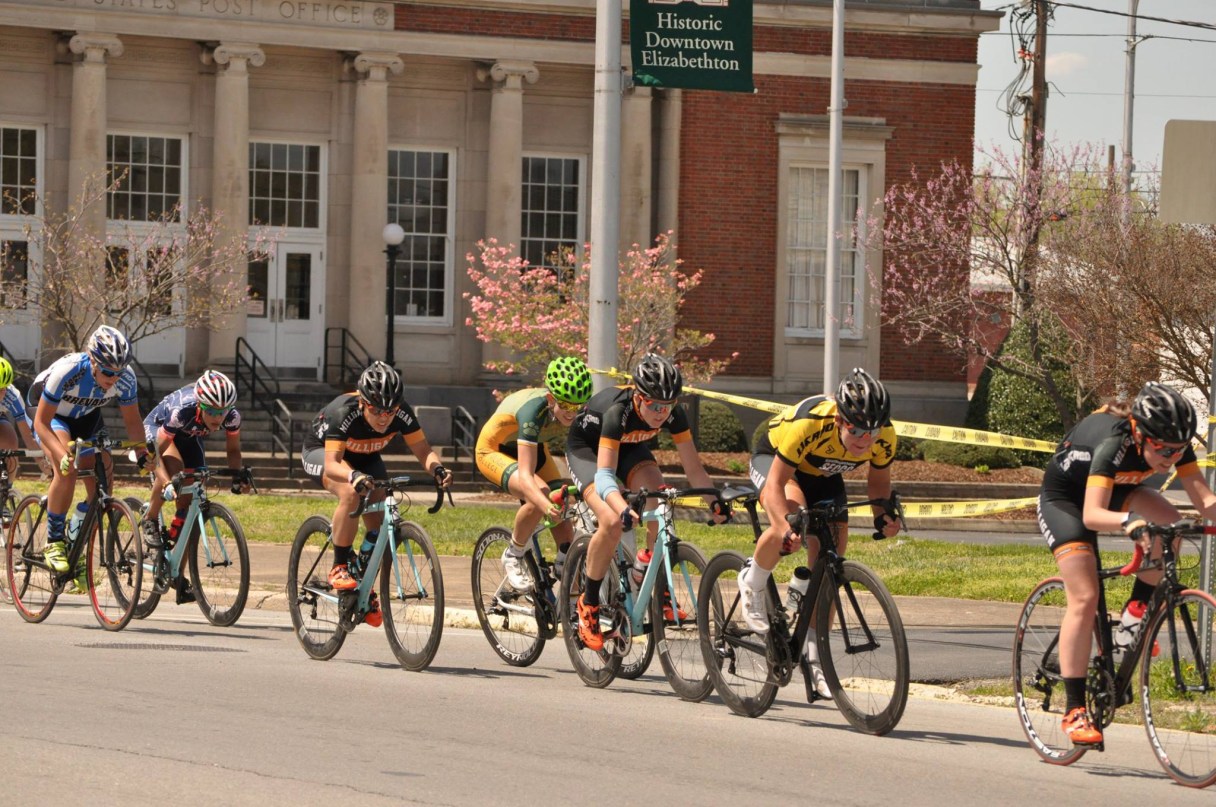
 Milligan College cyclist Morgan Miller races in a cyclocross event.
Tips from the coach
Zack Nave has been the cycling coach at Milligan for nearly five years. His No. 1 piece of advice to prospective student-athletes? Simply call.“The earlier, the better. I’ve got people that are sophomores or freshmen in high school reaching out to talk about the opportunities and challenges,” says Nave. “I’m up for that 100 percent.”
Nationals
Milligan attended the National Championship for cyclocross in early January, placing 8th in a field of 22. The team traveled to Hartford, Connecticut, for the competition, and faced a course for which it was difficult to train.“The mud must have been four inches thick,” head coach Zack Nave says with a laugh. “People were sliding down the mudbank since it was faster than riding down.”The locales of competition pose interesting challenges for the team. Northern mud, Nave says, has a much different consistency than the clay-filled mud of the Southeast, and the coldsnap Connecticut experienced in the days preceding the competition left ruts in the course frozen in place, which take practice to efficiently navigate.“We can only practice what the weather provides, and it’s hard to duplicate those conditions,” says Nave. “It’s just one of the challenges collegiate cyclists have to face — those different conditions.”
Collegiate-level cycling has been gaining traction over the last few years, with more and more schools offering the sport as well as scholarships for cyclists. Milligan College, for example, in the northeast corner of Tennessee, might not be a football powerhouse, but it is packing both a men’s and women’s team that have attended multiple national championships, and has offered thousands of dollars each to “players” in that field.
Morgan Miller is a junior at Milligan and one of the 10 women on the school’s female cycling team. Growing up in Bradley County, she got experience in high school with the Velo Vixens, a women’s-only multi-sport club team based in Chattanooga. Though already accustomed to the trials of competitive cycling, Miller says collegiate cycling offers much different challenges come race day.
“Our main goal is to get one of us to win,” she says, emphasis on “one of us.” Whereas most club teammates compete on a solo level, collegiate cycling is a true team sport.
The technical aspects of team road racing and the new challenges of cyclocross posed a steep learning curve when Miller joined Milligan’s team as a freshman.
“We have to work together to get our person across first,” she says. “While some girls’ results might look poor on the sheet, it was a team effort.”
That team effort is growing every single year, says Jack Nave, Milligan’s head coach. When Morgan joined the team three years ago, she was one of three women. Now, the women’s team is 11 strong, and Nave says several promising prospects have signed on for next year.
“We’re one of the bigger women’s teams in the U.S., and we’re excited about the growth on both sides. We’re seeing other college teams popping up and schools offering scholarships,” he says.
Many of those prospects have a story similar to Morgan’s. Her fitness level and skill in road cycling were excellent, but she wasn’t grounded in team strategy or the technical skills related to mountain biking or cyclocross.
“There’s a smaller women’s field in Tennessee, and although numbers are growing, a lot of my recruits have raced on teams of just a handful or solo,” Nave says. “Even though the men’s teams are more diverse, I’d say most of my cyclists have road cycling backgrounds.”
As cyclocross and competitive mountain biking become more widespread in the Southeast, Nave expects more high school programs to pop up to support the desire of young cyclists.
“I wish I had dates to give, but we’re working on organizing camps over the summer to introduce some of these concepts to kids,” he says. “We’re very excited at what the future can bring.”