
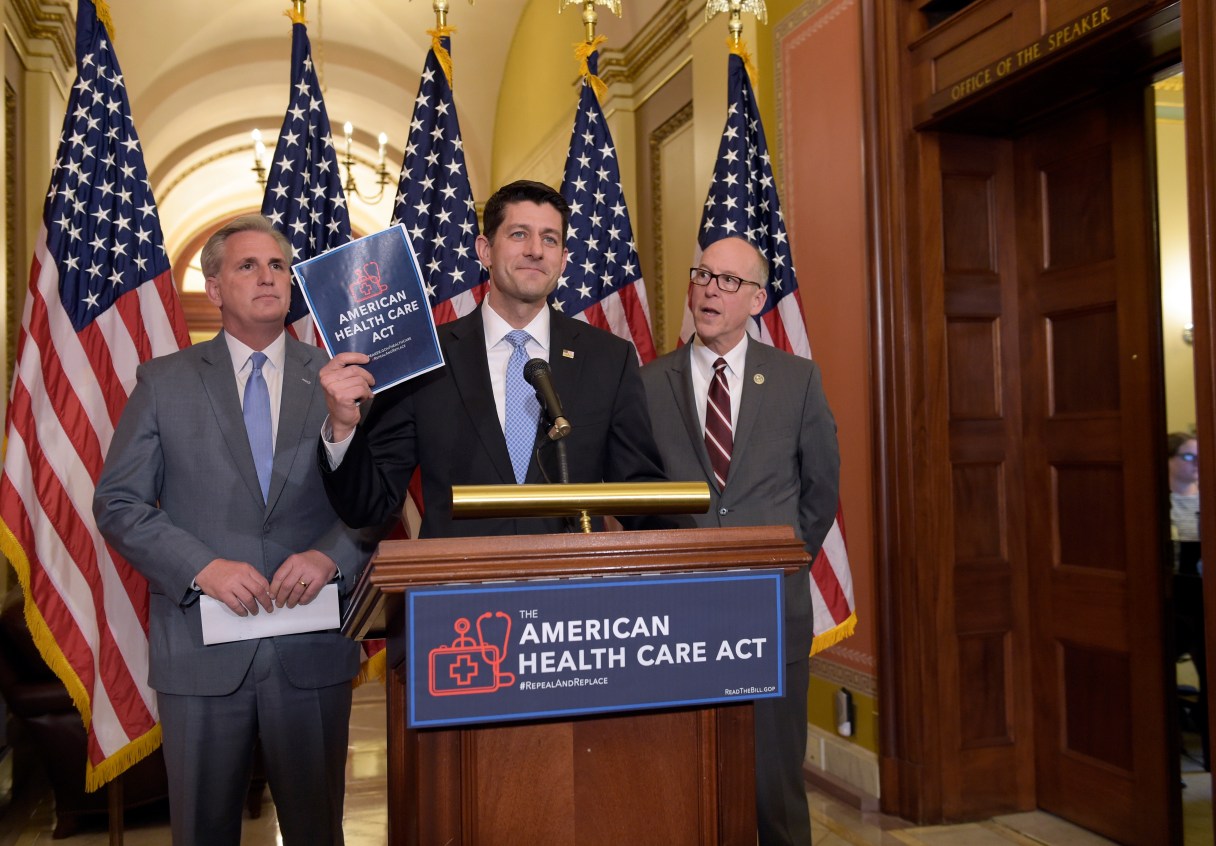
Health insurance changes proposed in American Health Care Act
* Purchasing insurance no longer required, but people who let coverage lapse could face 30 percent surcharge.* Subsidies for low-income buyers replaced by tax credits based on age and income.* Insurers could charge older people up to five times more than younger customers, instead of ACA’s three times more.* Contributions to health savings accounts rise from $3,400 for individuals and $6,750 for families, to $6,550 and $13,100.* $100 billion goes to states over 10 years for “high-risk pools” for sickest residents.* Medicaid changes from open-ended entitlement program to block grants.* States that expanded Medicaid under Obamacare would keep enhanced federal funding and 90 percent coverage for current enrollees, but those enrolled after 2020 would receive less funding.No changes: Kids can stay on parents’ plan til age 26; pre-existing conditions are covered; no annual or lifetime coverage caps; certain Obamacare benefits retained.Source: The Washington Post
Some Tennessee health care providers say they don’t see a good outcome from the GOP’s radical surgery on Obamacare.
Republican leaders in Washington, D.C., say the plan to reform the Affordable Care Act will make health care less costly and give consumers more choices.
But hospitals, patient advocates and insurers in Tennessee say the proposal to replace premium subsidies with tax credits and to shrink Medicaid funding could cost tens of thousands of state residents their health insurance and slash funding for struggling rural hospitals.
“These things they are proposing will absolutely transform rural Tennessee,” said Gordon Bonnyman with the Tennessee Justice Center, a nonprofit advocate for health care for the poor. Justice Center figures show 70-80 percent of revenue at rural hospitals comes from Medicare and Medicaid. The center says more than half the state’s births and more than 60 percent of its nursing home care is paid for by TennCare, the state’s Medicaid program.
Bonnyman isn’t sure Congress knows what the plan will do to the very people who voted for a Republican majority in Congress and Republican President Donald Trump.
“They don’t understand they’re going to carpet-bomb their own constituents,” he said.
At least some of Tennessee’s congressional delegation don’t see it that way. Sixth District Rep. Diane Black, chairman of the House Budget Committee that will take up the bill next week, said on her website she met with President Donald Trump at the White House on Friday to talk about it.
“Obamacare is collapsing and we have a responsibility to protect the American people from its damaging effects. Working with the Trump administration, we’ve delivered a conservative bill to do exactly that,” Black said in a statement.
***
The American Health Care Act was introduced in the House on Monday and pushed through two key committees this week. GOP leaders are driving a floor vote on it next week, though the sponsors don’t know how much the plan will cost.
But Democrats and some Republicans in states across the country are pushing back, saying the plan would wreck lives and budgets.
Various analysts have estimated anywhere from 10 million to 20 million people nationwide could lose their health insurance. Figures from the Tennessee Justice Center say the plan includes $600 billion in tax cuts that will shift costs to low- and middle-income people nationally, plus $370 billion in cuts to Medicaid across the U.S. and much higher costs for people who buy insurance through the federal marketplace.
Tennessee Hospital Association president Craig Becker said Friday “a significant number of the roughly 230,000 Tennesseans now covered” could be in that group who can no longer afford insurance.
And those sick people then would show up at hospital emergency rooms, he said. The cost of uncompensated care in Tennessee hospitals, now $2 billion a year, will skyrocket, Becker said.

“This presents a dark forecast for the future of hospitals in Tennessee, especially our rural and safety net facilities,” Becker said in a statement. “Federal lawmakers must find ways to provide health care coverage to Americans while ensuring such a solution supports the viability of hospitals and other providers, especially those in rural areas.”
Rep. Chuck Fleischmann, who represents Chattanooga and the 3rd District, called Obamacare a failure in a statement Thursday.
“I’m glad to see the American Health Care Act was released, and I look forward to working on specific legislative details with my colleagues so we can finally fix our broken health care system,” he said.
But opponents said the new act won’t do that for those who most need help: low- and middle-income people who don’t have employer-sponsored insurance and who either are enrolled in Medicaid or buy individual plans on the federal exchanges.
***
The Affordable Care Act provided subsidies to help pay for insurance premiums. Those amounts were determined by the buyer’s income, age, and the cost of coverage where he or she lived.
The American Health Care Act – what some have dubbed Ryancare, after its chief architect, Rep. Paul Ryan of Wisconsin, or Trumpcare – does away with those subsidies and replaces them with tax credits ranging from $2,000 a year to $4,000, based on the buyer’s age. Older folks get larger credits.
But Andrew Hetzler with the American Exchange, a Chattanooga company providing enrollment services for health insurance, said that doesn’t begin to cover premium costs. And even though older people would get larger tax credits, the GOP reform plan would allow insurers to charge them up to five times as much as younger people for coverage. The ceiling was three times as much under Obamacare.
“Some Tennesseans this year are getting $1,900, $2,000, $2,100 a month to help pay their premiums,” Hetzler said. “If you talk about putting someone on a credit of $4,000 a year, you’re going to see a huge amount of disenrollment. You’re looking at plans being completely unaffordable for low-income people – they’re going to be right back where they were in 2013.”
The New York Times, working with numbers from the Kaiser Family Foundation, reported that in Tennessee, people of all ages earning less than $50,000 a year would get less benefit from the tax credits than ACA subsidies. Only people earning more than $70,000 a year would come out ahead, The Times reported.
Hospitals, insurers and patient advocates also say the Medicaid reform in the GOP plan will hurt the poor.
Obamacare allowed states to put more low-income people on Medicaid and have the federal government pick up 90 percent of the tab, but some 19 states, including Tennessee, didn’t do so.
The Ryan bill would change Medicaid from an open-ended program that pays most of the cost for however many people are enrolled to a block grant. States would get a certain sum of money and would have more flexibility to decide how many people to enroll and what kind of benefits to pay for. Those that expanded Medicaid programs would continue to get 90 percent federal funding for those already enrolled, but less money for new people coming in.
Becker said giving the state greater control of its Medicaid program is a “potentially positive move,” but the Justice Center and others have said the GOP bill would cut funding by $1 trillion over nine years. States would get less money even as health care costs and enrollment could keep rising.
“We must ensure Medicaid enrollees continue to receive comprehensive and adequate benefits with fair reimbursement to providers for health care services,” Becker said. “The current proposal stands to make achieving those goals a major obstacle.”
Contact staff writer Judy Walton at jwalton@timesfreepress.com or 423-757-6416.