
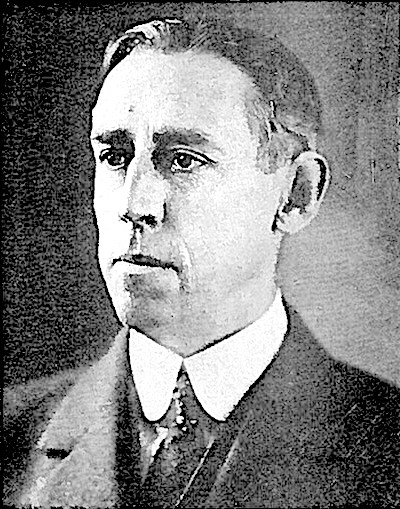
William “Bill” Emerson Brock III’s defeat of favored Democrat Wilkes T. Thrasher Jr. in 1962 started the transformation of Tennessee’s 3rd Congressional District into a Republican stronghold. Except for Marilyn Lloyd’s upset victory over incumbent Lamar Baker in 1974, the 3rd District seat has been held by a Republican. Zach Wamp and Chuck Fleischmann have represented the 3rd District in recent years.
Bill Brock was not the first member of his family to represent Chattanooga in Washington. His grandfather, William E. Brock Sr., served as a senator from 1929 to 1931 and was a Democrat. Brock Sr. was appointed by Tennessee Gov. Henry Horton to fill the vacancy in the Senate caused by the death of Sen. Lawrence D. Tyson in September 1929. Although re-elected in November 1930, Brock Sr. chose to retire and left office in March 1931.
William E. Brock Sr. was born in Mocksville, N.C., in March 1872. His father, Richard E. Brock, a former Confederate soldier, ran a small tobacco farm. When his father died, William, at age 14 and the oldest of five children, quit school and took over the farm. At age 22, he rode into Winston-Salem, N.C., on a neighbor’s wagon. Stopping at the first store he reached, he asked the owner for a job and was hired.
Three years later, he had worked up from $30 to $50 per month but resigned to take a position with the R.J. Reynolds Tobacco Co. as its first salesman at $30 per month.
After three years, he was made sales manager for Southern states. During his 11 years on the road, he studied opportunities throughout the South.
He settled in Chattanooga in 1909 and went to work in candy manufacturing.
“I knew I could sell the candy if I would get someone to make it for me,” he admitted.
Brock Candy grew into one of the largest candy manufacturers in the country.
Brock soon learned that a person with a gift for selling also could succeed in politics. In 1911, he was elected president of the Chamber of Commerce and encouraged the organization to become active in politics, a suggestion that shocked many people.
The next fall, he successfully managed the congressional campaign of Judge John Moon. In 1929, he was appointed U.S. senator. During his short time in Washington, he characterized himself as a Woodrow Wilson Democrat.
One of his main accomplishments was facilitating the passage of the Rivers and Harbors Act, which provided for nine dams on the Tennessee River for navigation and flood control, the forerunner of the TVA.
In January 1903, he married Miriam Acree, the daughter of Baptist minister from Lynchburg, Va. Thirty minutes after meeting her, “I proposed and she accepted. But it was six and a half years before I was making enough money for us to marry.” She was described at her alma mater, Cox College, College Park, Ga., as “queen of the student body. In personal charm, in mental force, in sympathy, and healthfulness and tact, and energy, she speedily became the idol of the classes.”
Sen. Brock once characterized himself: “Born and reared to go to church and Sunday school.” He and Miriam became deeply involved in the religious life of Chattanooga. They help create a number of churches, including several in the African-American community. A devout Methodist, he for many years taught at Trinity Methodist Church and was active in the Holston Conference. He worked with Dr. J.P. McCallie to introduce Bible teaching in the Chattanooga public school system.
Despite lacking a college education, he served as a trustee for Emory University, Emory and Henry College and the University of Chattanooga, where he led its postwar building program. Brock Hall was dedicated in his honor in November 1949. He also had served as general chairman of the Confederate reunion in 1913 and helped found the Community Chest.
Sen. Brock maintained an active life from his residence on Missionary Ridge until his death at age 78 in 1950. Miriam died at age 77 in 1969. They were survived by two sons, W.E. Brock Jr., and Richard Brock.
A News Free Press editorial termed him “a towering figure in community life, in business, in church work, in philanthropy, in friendship, in all around good citizenship … his character truly matched the mountains which rise above this city in which the great works of his fruitful life were centered.”
Jerry Summers is an attorney with Summers, Rufolo & Rodgers. For more, visit Chattahistoricalassoc.org or call LaVonne Jolley 423-886-2090.