
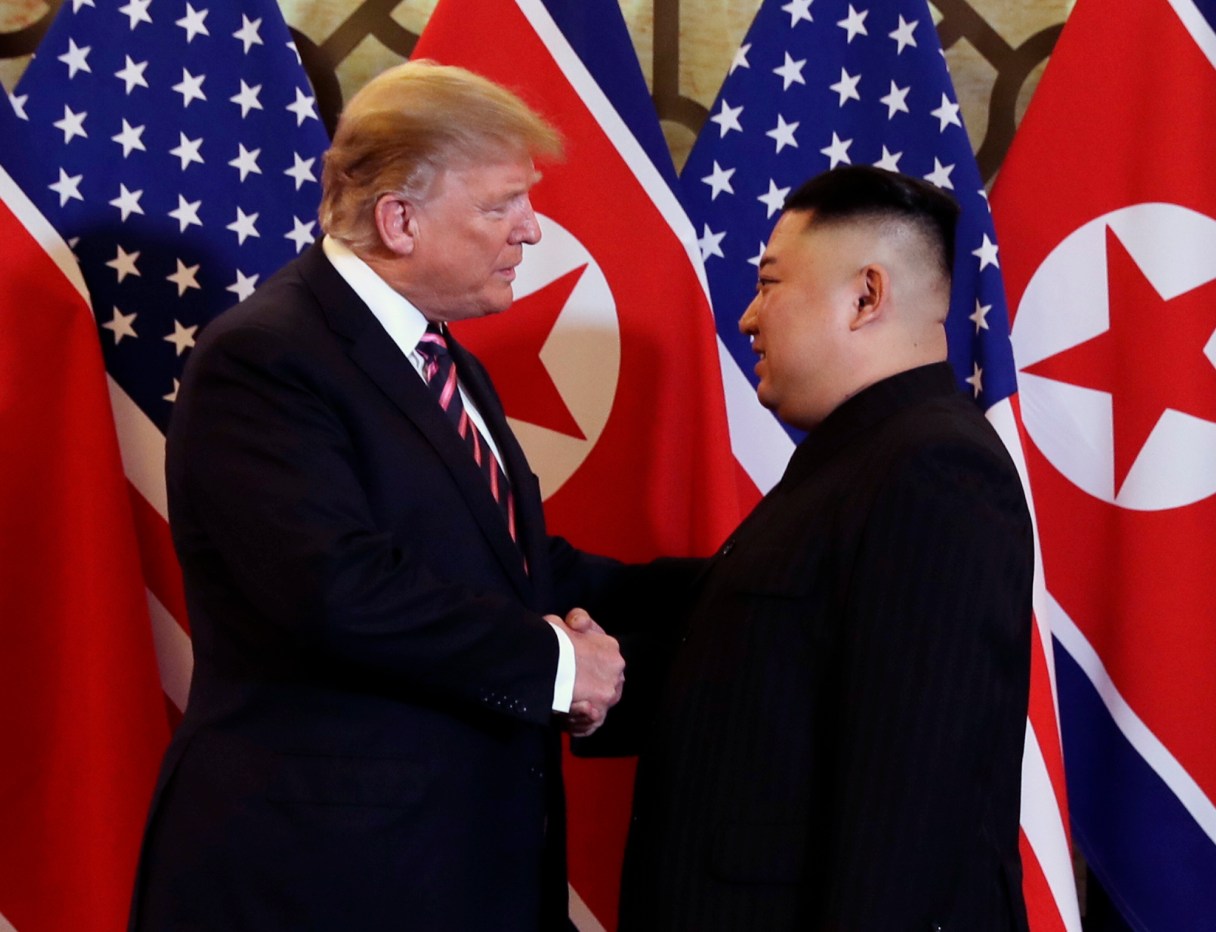

When President Donald Trump left the Hanoi summit with North Korean leader Kim Jong Un Wednesday, it wouldn’t have mattered if he had left Vietnam with or without a nuclear weapons agreement.
He would have been wrong in the eyes of his political opponents and the national media.
Had Trump signed an agreement, which he later said he was close to doing, it would have been characterized as having little substance or, alternatively, as giving away the store. And opponents already had readied the excuse that an agreement would be signed to take the focus off the Capitol Hill testimony by the president’s former lawyer, Michael Cohen.
As it is, he is being criticized for not signing an agreement, for assuming he is a master negotiator and for eschewing the staff-level work said to be required before two leaders meet face to face.
“The president staked a lot of his presidency on something that is just much more difficult than reality TV,” snarked CNN’s Jim Acosta, a persistent critic. “This is not something that could be wrapped up in a season of ‘The Apprentice.'”
Trump’s demeanor has confused them, too, because they assumed he would leave the summit angry, would be ready to return to calling Kim “Little Rocket Man” and would thunder that there would be no more negotiations with North Korea.
Instead, he said relations between the countries remain warm, that flexibility is necessary for his talks and that the U.S. even could open a liaison office in the country.
Whether or not the national media and Trump’s opponents like it, it’s a fact the region has been more peaceful since Trump engaged with Kim. No test missiles have flown out of the communist country, and no one is estimating how far into the United States one might reach.
Indeed, he had the temerity to do what no president in the last 25 years – Bill Clinton, George W. Bush and Barack Obama, whose administrations attempted to negotiate with North Korea – had done. He said he would sit across from and talk to the country’s leader.
However, Trump said he would demand Kim give up his nuclear weapons program, and he did. But no one expected Kim would do so at Trump’s mere request, and he didn’t. That doesn’t mean the summits have been a failure – after all, the leaders of the two Koreas are talking to each other for the first time since World War II – just that they haven’t achieved the desired end yet.
“Sometimes you have to walk,” the president said.
We recall a summit 33 years ago in which another president did virtually the same thing.
In 1986, President Ronald Reagan left an arms control summit in Reykjavik, Iceland, with the USSR’s Mikhail Gorbachev when the Soviet leader demanded the U.S. give up not only all its bilateral nuclear weapons but also its missile-defense Strategic Defense Initiative (SDI).
Until that time, the two leaders had made more progress than anyone had expected, in spite of the fact the national media – just as they do with Trump – referred to the president as a dunce, an amateur, a saber rattler and clearly out of his league.
A discussion had ensued on the possibility of eliminating nuclear weapons forever. And Gorbachev had agreed to discuss human rights issues, something no previous USSR leader had done.
Reagan even described to Gorbachev about returning to Reykjavik in 10 years, both older and retired, and witnessing the dismantling of the world’s last remaining nuclear warhead.
The USSR leader, though, continued to balk at SDI – ridiculed by the president’s critics as “Star Wars” – even when the president offered to share the technology with him. In the end, he couldn’t accept the U.S. development of a missile defense shield.
Although Reagan left the summit, he later described, as the angriest in his career, the two leaders came back a year later and negotiated the Intermediate Range Nuclear Forces Treaty, which for the first time eliminated an entire class of nuclear weapons.
We don’t know what may happen in the future with Trump and Kim. But we feel grateful that relations are better between the two Koreas, that no missiles are flying over Japan into the Pacific Ocean, and that nothing stands in the way of future negotiations over nuclear weapons.
An agreement may be a bridge too far, but we wish the president’s opponents and the media shared the optimism that something good still could come out of two leaders meeting face to face.
All we are saying, after all, is to give peace a chance.