
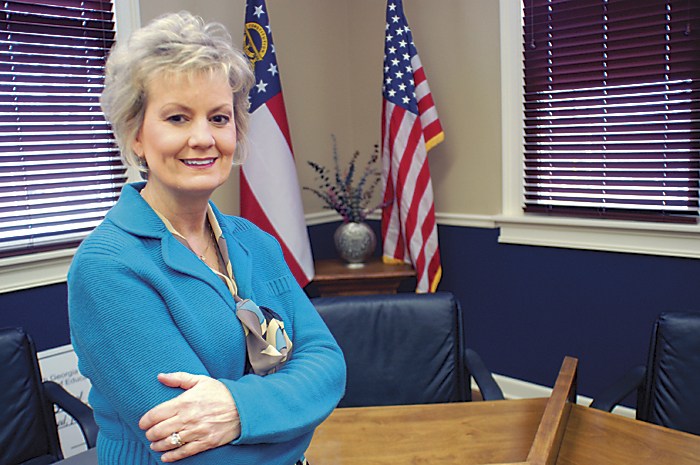

CHICKAMAUGA, Ga. – Melody Day says this year is one of the toughest yet of her 11 years as Chickamauga City School superintendent.
Ms. Day, who first came to the system as a teacher in 1978, says the tight-knit, three-school system has battled state funding cuts since 2003, building reserves that would soften the blow of state cuts and an economic downward spiral.
Chickamauga, like every system in the nation, will struggle with funding in the coming year, she says.
Q: What are Chickamauga officials doing to prepare for an increasingly tighter budget year?
A: We have a strategic plan that looks at least three years into the future, and it covers all operations. Primarily, we have two overarching goals that actually everything we do fits under those two goals: One is higher student achievement, because academics will always be our primary focus, and the other is efficient and effective operations, whether that be in food service, maintenance, custodial, in the classrooms, organizational effectively of our administrators, our central office, our board.
We have had an aggressive facilities improvement program over the last 10 years. I became superintendent in 2000, and in 2001 the Yates Building was completed on the high school campus and it was a state-of-the-art science and math building. Those facilities, which were in dire need of upgrade (and) hadn’t had an upgrade since the 1930s when the high school was built, we were in great shape there for science and math (and) our labs; everything that we needed.
We’ve also made additions to both the elementary and the middle schools. I, along with some of the staff members, wrote a comprehensive school reform grant and that along with our (Special Purpose Local Option Sales Tax) enabled us to completely redo the technology infrastructure in every school. We have state-of-the-art, 21st Century technology classrooms. Every teacher has SMARTBoards, student response systems, projectors.
I say all these things about our improvements to say that we were in excellent shape, facility-wise, going into these cuts. That has been a tremendous asset to us.
Definitely, we have maintenance issues. But as far as overall facilities, we are in good shape there.
Q: Will you have to make cuts?
A: We’re building next year’s budget now. All prices tend to increase and our budget decreases, so therein lies a tremendous hurdle. Then when you take your budget and you know that 85 percent of it is for salary and benefits for your people, that doesn’t leave a lot to work with to absorb these cuts.
We have been saving every penny we could for the last 10 years and I had built our reserve for us up to a tremendous amount – three times what it typically is. Our “typical” reserve was right at $250,000 to $300,000, so we were right at $1 million in reserves.
We had to utilize those funds when the cuts came and kept coming, and now we’re dangerously close to that initial reserve.
That is very worrisome to me because we also receive equalization funds. And the purpose behinds those (funds) are to equal the opportunity for the children in the smaller, poorer systems to that of systems that have more system wealth, more opportunity, more urban activities and cultural events in their areas. The equalization funds are to help us to bring those things to our students.They have taken tremendous cuts. This year at the initial onset of the school year we had a three-percent cut. Now, there’s another call for another cut to equalization in the mid-term and that is very, very worrisome to us because that has tremendously hurt us on top of the austerity reductions that everyone else is receiving.
It’s almost like if you’re one of the low wealth systems … it’s been more of a hit. We’ve received some (American Recovery and Reinvestment Act) funds, but it in no way offsets what we’ve lost.
In preparing for our budget, we have not raised our millage rate since 2003. Our millage rate is 10.25 mils. We have not raised our school tuition in two years. We won’t pass anything on to our citizens that we don’t have to.
We have been able to hold onto our entire staff. That doesn’t mean we haven’t cut programs and we haven’t had retirees, but we’ve been able to move people to different positions to keep (them). Going forward, if there’s not some relief in the very near future, we will have to look at all those options as possibilities to have a budget that we can operate on.
Q: Are Georgia lawmakers making moves this session that help or hurt schools?
A: There is a bill that has been dropped in the legislature at this point – no action has been taken – to do away with equalization funding for mills 6, 7 and 8. The first five mills are the local fair share that every school system pays toward education. If mills 6, 7, and 8 were not eligible for equalization funding, then we would only have mills 9, 10 and 10.25 that would receive that funding. So that would be a tremendous blow to our budget if that were to occur. That is a great concern to me.
I think there is a lot of decision-making going on about whether to allow more flexibility in class size and I think that is something that would help every system. There are very strict counts as to how many students can be in a classroom and it varies depending on the level of the student, the grade level and things of that nature.
I definitely think if you’re looking at whether to lose teaching staff or to put a few more children in the classroom, that would be a wise decision to make because there are a lot of measures in place to make sure children are achieving as well as end of course tests and state testing. I do not think we would see a great decrease in that.
If a teacher’s doing a quality job, two or three more students in that classroom won’t detract from that.
I do think that the House of Representatives are looking to give more local flexibility. They know what dire straits we are in.
The bill by (Rep.) Jay Neal (R-LaFayette) asking for an allowance from April 15 to May 15 before we extend (teacher) contracts would be excellent because at this point we won’t know the outcome of many of these legislative bills before April 15 and it could definitely affect our funding. If we don’t have the funding to pay our teachers we certainly wouldn’t want to issue a contract and then not be able to pay them. We’d be obligated and where would we get the funds?
I do think the bills that are being considered now are aimed at trying to help us with our flexibility. At one point, I know we had funds that were earned by site, so what each school earned had also to be spent in that school program alone. They were earned by program and by site. We’ve already been given some flexibility there, for instance, if I earned gifted funds in the high school and had some extra moneys that would help the gifted program in the middle school. At one time that was not allowable because the funds must have been spent where they were earned. They’ve already given us some flexibility there. They (now) must be spent in the same program but that in itself has been very helpful to us as a small system and, I would think, to every superintendent.
I do think the mindset is, “We are in tough times. We know it’s bad. We’re trying to help you as much as we can but at the same time there just isn’t enough money to go around. Even though it’s going to hurt, we’re trying to help you much as we can.”
Q: Can the federal Race to the Top competition help in any way?
A: We were not one of those systems (that signed memorandums of understanding to apply). The superintendents that were able to look at it in depth and see what was involved, they declined to apply at that time. I don’t all the reasoning behind that, but again I do know … it takes a tremendous amount of time. I also think they were very concerned about some of the repercussions from the Race to the Top. I do think that from officials at (Georgia’s Department of Education) that I’ve spoke with that they feel that Georgia has a very good chance of obtaining a great deal of those funds. I can only hope that if that occurred it would be able to help.
But I think many of the funds are going to be targeted at lower-performing schools that might be even in the needs improvement area. Not totally that, but I think they would be the priority. So there again, I don’t know what opportunity we will have.
When I became superintendent in 2000, out of 180 school systems, Chickamauga City Schools ranked number 179. We were the next-to-the-poorest system in the entire state. Now, we have had growth in our economy, businesses that have located in the city and have increased our tax base. We have moved from 179 to 170 out of 180. So, our system wealth has increased. That is another thing that has helped us through these hard times. But that still is a relatively poor system when you look at 180 systems.
Q: How has student achievement fared under the pressure of funding cuts?
A: Usually, you would think that we would get all sorts of assistance. But since we are not a low-performing school system – all our schools have made (adequate yearly progress) every opportunity, also the system has made AYP every year. Our performance on state testing is tremendous. We’ve gotten, two years in a row, the Governor’s Cup for the three-year highest average on the high school graduation test. Now that’s not the big trophy for the Governor’s Cup. The school that gets that is the school that makes the greatest improvement.
We’re not a needs-improvement school so we can’t get a lot of the funds that are available to school systems to assist because we don’t qualify. So, we’re in a difficult spot, but I’m proud of our performance because that’s our primary focus. We want our children leaving here with the best education possible.
We feel we are meeting our mission but at the same time it does get a little frustrating sometimes when it seems that all of the assistance isn’t going to these schools that are high-performing.
Our staff and our leadership in this school system are tremendous and they work extremely hard and they all deserve such a pat on the back because even with being furloughed six days this year, their primary concern are these children and what they provide to them. They just don’t get the recognition and praise that they deserve.
Q: The system was recently recognized for its technology; what was the recognition and how was it achieved?
A: This is the third year in a row that the Digital School Survey was administered. It’s a national survey. Three years ago we were fifth in the country in the small school system category. They recognize 10 (systems) in the small, medium and large school districts. Last year, we had dropped to No. 7, and so were concerned this year if we would even make the top 10. We were so pleased when we got the results and we had scored fourth in the country.
It is a nod to school systems that are making strides in technology. We do utilize technology in every unit of study that we provide. Our school board last year was named a Distinguished School Board in the state of Georgia. They are continually learning and setting the example for our students. They have become a digital school board. We do our board meetings electronically, they have laptop computers, we’re able to send the agendas early to the board. We do the meetings completely paperless.
We have a long and great history here but we also want to be very progressive for our students. We want our students to be able to compete with any student any where, and to be competitive in a global economy.
Q: Does the burden in maintaining so much technology worry you?
A: It definitely does. We have a replacement plan in place. A big cost are just the bulbs for the projectors and little things of that nature when you have as many as we do. We have had to work very hard with our technology director to look at maintaining and rotating computers and changing them out so that all the costs don’t come at one time.
NEWSMAKERName: Melody DayAge: 54Occupation: Chickamauga City Schools superintendentHometown: Chattanooga