
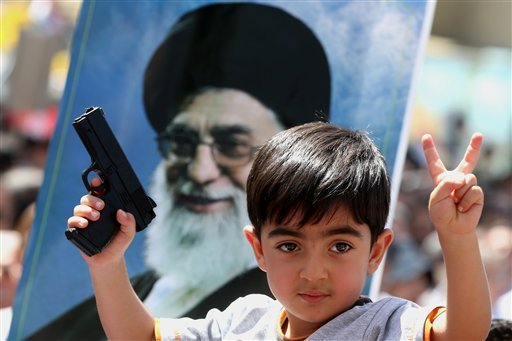
 An Iraqi boy living in Iran holds a toy gun and flashes a victory sign in front of a poster of the Iranian Supreme leader Ayatollah Ali Khamenei in a demonstration against Sunni militants of the al-Qaida-inspired Islamic State of Iraq and the Levant, or ISIL, and to support the Grand Ayatollah Ali al-Sistani, Iraq’s top Shiite cleric, in Tehran, Iran, Friday, June 20, 2014.
WASHINGTON – For years, the U.S. has been clear about its intent to step back from Iraq. The restrained American military aid now being offered to defend Baghdad against a ferocious Sunni insurgency reaffirms the Obama administration’s mantra that Iraq is still largely on its own.
What hundreds of thousands of U.S. troops, during more than eight years of war, apparently could not achieve in training Iraqi forces to defend the nation’s vast deserts and dusty towns is now being tasked to a few dozen teams of Green Berets and other special forces and stepped-up surveillance.
On Thursday, President Barack Obama ordered 300 special forces soldiers to advise joint operations in and near Baghdad, marking the first return of a U.S. fighting force since the military left Iraq in 2011 after a war that killed nearly 4,500 American troops and more than 100,000 Iraqis.
The White House is not ruling out potential airstrikes against Sunni insurgents as well, but no time soon, and is deeply reluctant to do so.
And Obama, who has little desire to return to the battleground of what he once termed as a “dumb war,” is holding fast to his pledge that American forces will not be sent into combat.