
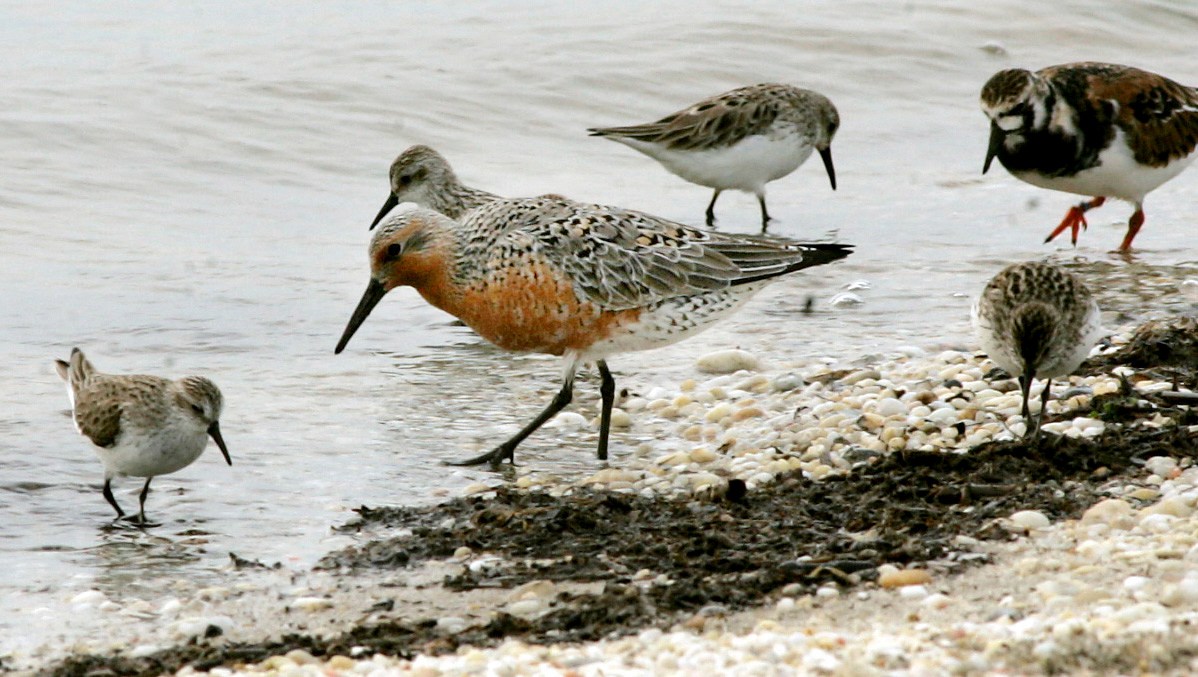
Environmentalists and coastal researchers say New Jersey’s efforts to establish commercial oyster farms in shallow coastal waters may be jeopardizing a threatened shorebird.
They are asking the state to delay expansion of the Delaware Bay shellfish farming industry until more studies can be done on its impact on the red knot, thousands of which rely on the bay’s beaches as a rest and feeding stop on its annual 10,000-mile journey from South America to the Arctic.
The American Littoral Society and New Jersey Audubon, along with several scientific researchers, tell The Associated Press there is growing evidence that the oyster farms are interfering with red knots during their crucial fattening-up period each spring. They say workers who tend the shellfish farms before and after low tide can scare the birds away, and that sometimes people don’t even need to be there to interfere with the birds; the elevated racks and bags used to grow the oysters can deter birds from landing and feeding.
Their effort sets up a clash between two worthwhile environmental initiatives. One is raising shellfish, which help remove pollutants from the water, and stabilize shorelines against destructive storms. The other is the effort to protect thousands of red knots, whose survival would be in doubt without the southern New Jersey beaches where they gorge themselves on horseshoe crab eggs.
An advisory committee recently sent a report to the state Department of Environmental Protection recommending that expansion of near-shore aquaculture projects not be expanded until further research can be done on potential harm to the red knots. And a study led by a Rutgers University professor found that increased human activity associated with near-shore aquaculture resulted in some shorebirds abandoning affected areas.