
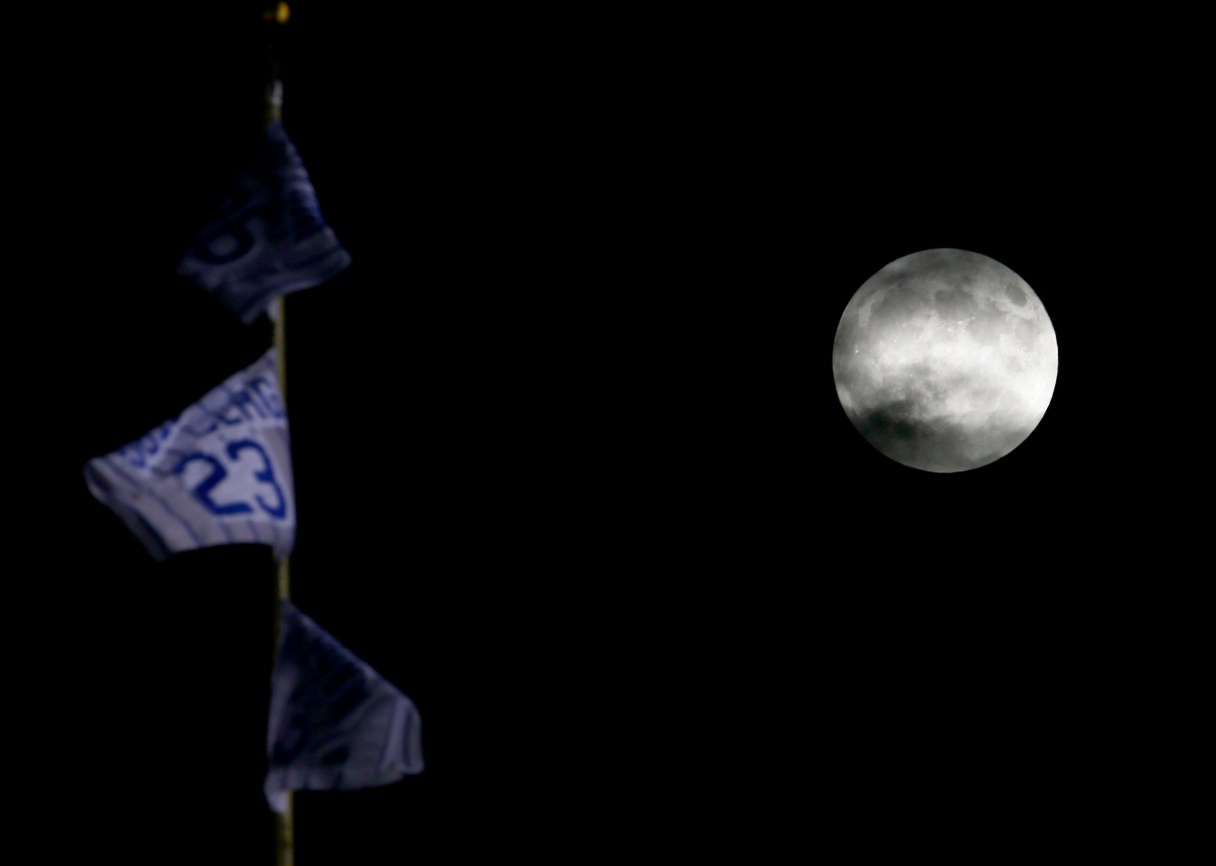
LOS ANGELES – Stargazers are getting a double celestial treat when a total lunar eclipse combines with a so-called supermoon.
Those in the United States, Europe, Africa and western Asia can view the rare coupling, weather permitting, Sunday night or early Monday.
It’s the first time the events have made a twin appearance since 1982, and they won’t again until 2033.
When a full moon makes its closest approach to Earth, it appears bigger and brighter than usual and is known as a supermoon.
That will coincide with a full lunar eclipse where the moon, Earth and sun will be lined up, with Earth’s shadow totally obscuring the moon.
The event will occur on the U.S. East Coast at 10:11 p.m. EDT (0211 GMT) and last about an hour.
In Europe, the action will unfold before dawn Monday.
In Los Angeles, a large crowd filled the lawn of Griffith Observatory while many others staked tripods with telescopes around the hilltop landmark in anticipation of the rare celestial sight. They will be treated to live piano music by 14-year-old prodigy Ray Ushikubo, who’ll be performing Beethoven’s “Moonlight Sonata.”
The possibility of clouds obscuring the view is adding a little drama in the air, said astronomer Edwin Krupp, the director of Griffith Observatory.
“You always want to see the eclipse because they’re always very different,” Krupp said, adding that the additional component of the earth’s atmosphere adds “all kinds of twists and turns to the experience.”
“What we see tonight will be different from the last event: how dark it is, how red it is. It’s always interesting to see,” he said.