
When religious leaders, threatened by Jesus’ increasing popularity, tried to trap him by asking if it was appropriate for Jews to pay taxes to the occupying Roman government, Jesus replied, “Give back to Caesar what is Caesar’s and to God what is God’s.” Everyone was amazed by his clarity, but for modern Americans the lines between government and God are seldom so clear.
Two recent incidents highlight the issue. First, Rev. Robert Grant, senior pastor of The Father’s Way Church of Warrenton, Virginia, was asked to give the invocation to begin the Virginia State Assembly on Feb. 11. His prayer led to many Democrats leaving the chamber in protest, others yelling insulting remarks, and eventually, the Democratic house speaker, ending the minister’s prayer.
Dr. Grant, an African American, prayed for concerns over racial inequality in criminal punishments, prison reform and the need to help keep families together. Then, he prayed, “The unborn [have] rights and those rights need to be protected. The word of God has given us a warning: Woe to anyone who harms an innocent child.”
Grant continued asking God to “uphold the Virginia family” with legislation that “will always protect the biblical traditional marriage as God instructed the first man and the first woman in the Bible. We should never re-write what God has declared. Marriage is to join a biological male and a biological female in holy matrimony, not to provoke the almighty God.”
Dr. Grant told reporters afterward, “I think that the statehouse belongs to all the citizens. And all the citizens have a voice,” he said. “If it’s my turn to have a voice, and I am a pastor, what do you expect from me? If you don’t want to hear what a pastor has to say, then don’t invite one.”
The upset delegates wanted a pastor to bestow pleasant platitudes of God’s blessings on their meeting. Instead, they heard God’s word calling them into accountability, and they rebelled. Dr. Grant’s actions should inspire all Christians.
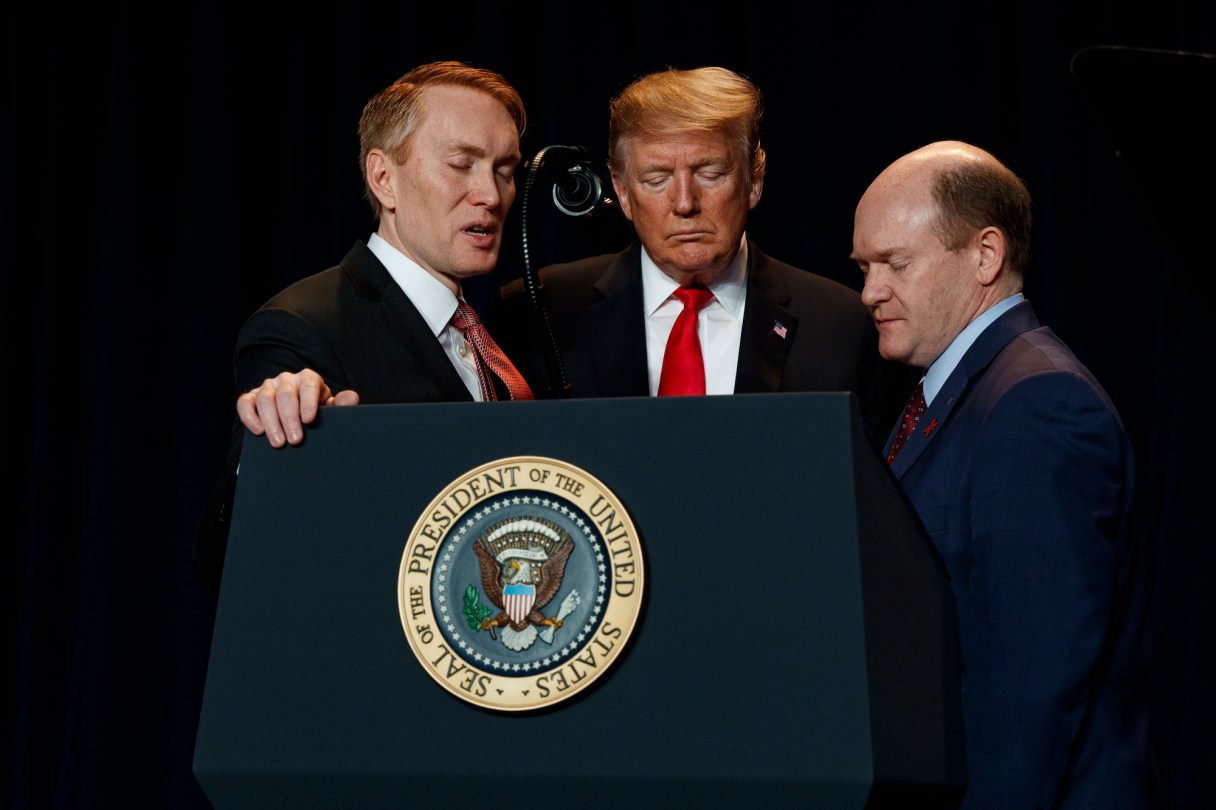
The second incident happened during the National Prayer Breakfast. The keynote speaker was Arthur Brooks, a Harvard business professor and Washington Post columnist, and his text was Jesus’ admonition to love our enemies. His words were especially pertinent coming on the heels of the divisive impeachment hearing that ended two days earlier.
However, when the president spoke after Brooks, he took exception. He said he didn’t “like” people who used their religion as a pretense for political reprisal – an obvious dig at Sen. Mitt Romney and House Speaker Nancy Pelosi. Romney stated that his religious beliefs were instrumental in his decision to vote guilty during the impeachment hearing. Similarly, Pelosi told reporters, “I pray very hard for him, because he’s so off the track.” That’s like the Southern lady self-righteously declaring, “That girl is so ugly … bless her heart!”
The president’s political enemies point out that if he chose the higher road, as Jesus directed, he might bridge the political chasm in Washington. Really? I’m skeptical. Reconciliation in D.C. requires more than quoting the Bible.
More significantly, the president concluded, going off script saying, “I’m sorry, I apologize. I’m trying to learn,” apparently returning to Jesus’ directive to love one’s enemies. “When they impeach you for nothing, you’re supposed to like them? It’s not easy, folks. I’m doing my best.”
The president is not a humble man, but those are humble words from the most powerful man on earth.
I can identify with his dilemma, as do millions of other Americans who continually ask for God’s blessing and guidance in determining what is Caesar’s and what is God’s.
Roger Smith, a local author, is a frequent contributor to the Times Free Press.
 Roger Smith