
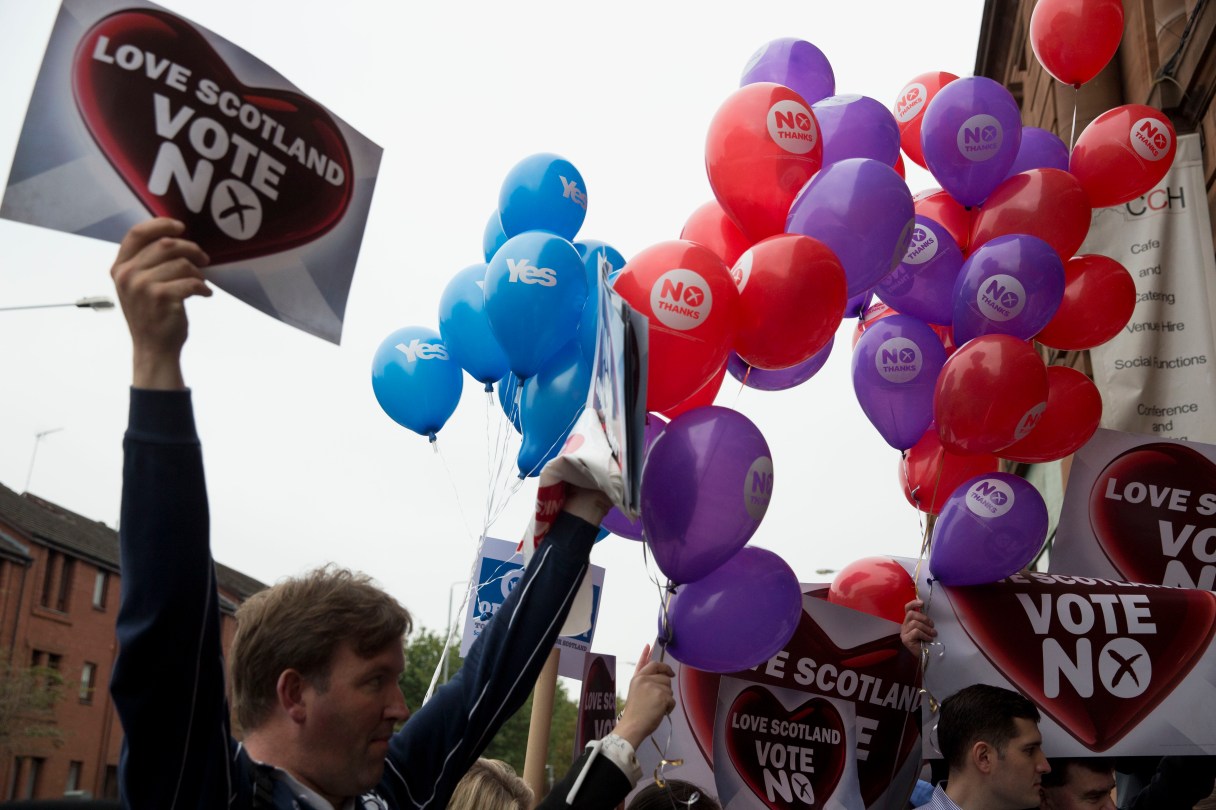
LONDON (AP) – Breaking up is hard to do, especially after 307 years. The entire United Kingdom will find out just how hard if Scotland chooses independence in Thursday’s vote.
WHAT’S AT STAKE
A Yes vote will trigger 18 months of negotiations between Scottish leaders and London-based politicians on how the two countries will separate their institutions ahead of Scotland’s planned Independence Day of March 24, 2016. The issues range from whether Scotland will use the pound as its currency to how much U.K. debt it should take on to how the military will be split up – and the results will affect all of the U.K.’s 64 million people, not just the 5.3 million in Scotland. A Yes vote will also ripple across the 28-nation European Union and NATO and boost independence movements around the world, including in Spain’s Catalonia region or Flanders in Belgium.
CENTURIES OF UNION
The parliaments of Scotland and England passed the Acts of Union that led to the creation of Great Britain in 1707 after centuries of conflict, which saw the rise of Scottish heroes like William “Braveheart” Wallace and Robert the Bruce. The union grew to become a great empire in which Scots took a leading role as inventors, artists, doctors, missionaries, engineers and intellectuals – producing luminaires such as economist Adam Smith, author Sir Walter Scott and poet Robert Burns. The global empire thrived on shipbuilding and manufacturing but fell apart after World War II as nations outside the British Isles demanded independence. Scotland has had its own parliament since 1999, although the U.K. government retains control of issues such as foreign policy, defense, immigration, trade and industry.