
By the numbers
› 13.1 million: Number of Americans 55 years of age or older looking for work› 330,00: Number of seniors 55 and older looking for work who have been without a job for more than six months› 182,000: Number of seniors 55 and older looking for work who have been without a job for three to six months› 40.3 percent: Labor force participation rate for people 55 and older, or less than two thirds the 63.2 percent labor force participation rate for all adults.› 1,079 persons: Number of persons 55 and older currently seeking employment while receiving jobless benefits in Southeast Tennessee, or 14 percent of all jobless benefit recipients.Sources: The American Association of Retired Persons (AARP) Public Policy Institute using U.S. Department of Labor data for January 2019, Tennessee Department of Labor and Workforce Development
Kimberly Crider has a master’s degree in social work and two decades of experience working in her chosen field. Sitting in a conference room deep inside the maze-like facility of Goodwill on Dodds Avenue, the native of Cleveland, Ohio, remembers the point in time when she decided that social work was her life’s calling.
“My parents were both teachers, and they instilled in me the importance of learning but also for compassion, for helping others,” Crider says. “(Mother) would tell me a story – I think I was in the 4th or 5th grade – about an immigrant family with a boy who was being bullied. The teacher was actually taking part in the bullying, and my mother confronted the teacher and told her to stop it. There wasn’t any hallelujah moment or anything, but I knew what I wanted to do.”
Today, Crider is helping citizens 55 years of age or older find work in Hamilton and Tennessee counties surrounding Hamilton County. Crider is the director of the Senior Community Service Employment Program (SCSEP), a federally funded program administered through Goodwill. Nationwide, SCSEP is a $300 million-a-year, job-training program providing part-time, minimum-wage jobs to seniors.
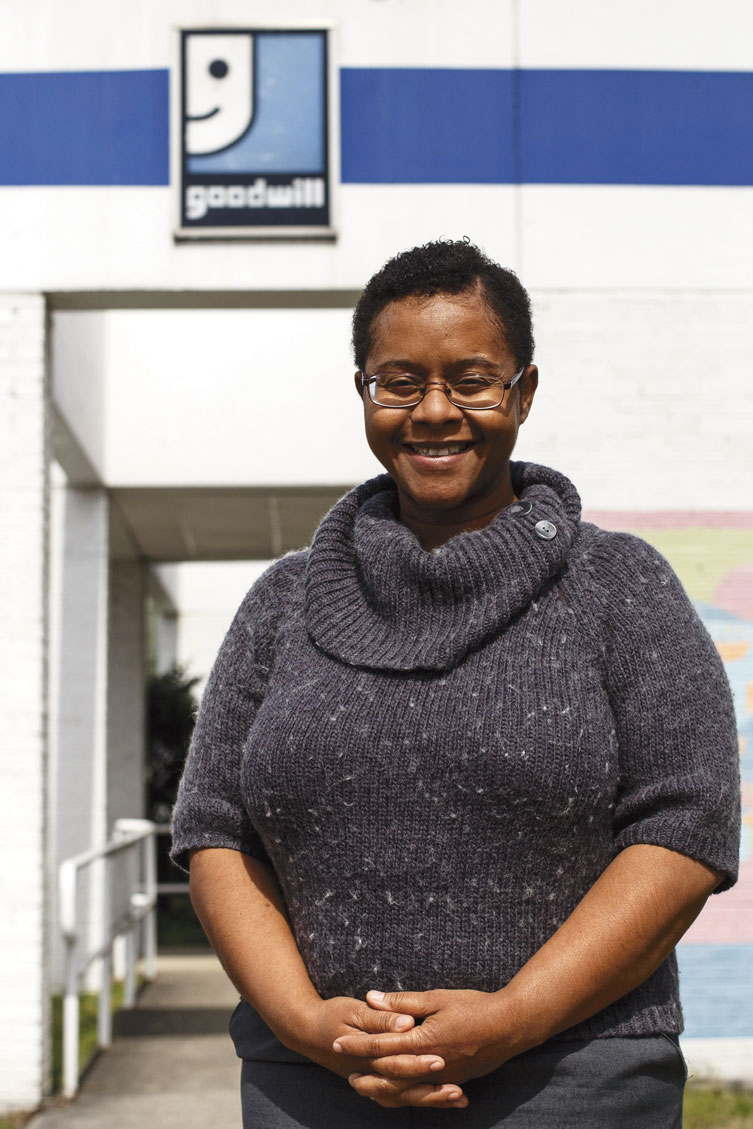 Senior Community Service Employment Program Director Kimberly Crider is shown at the Goodwill Chattanooga offices in the Whitehead-Luttrell Building on Wednesday, March 13, 2019, in Chattanooga, Tenn.
Crider and her staff of one are authorized to serve 71 new individuals a year, and an individual can be part of the program for four years. Currently, Crider has 120 people in the program.
Crider works to place clients into non-profit or government entities. Among those organizations partnering with SCSEP to employ and train older workers are Habitat for Humanity, Erlanger Health System, the Urban League, the United Way of Greater Chattanooga, the Cleveland-Bradley County Library, WTCI and the Tennessee Department of Homeland Security offices in Chattanooga and Athens.
SCSEP is one of a loosely knit group of agencies with a focus on helping seniors find work. For example, the Southeast Tennessee Development District works with seniors looking for work and partners with agencies such as the American Job Center Tennessee.
The U.S. Bureau of Labor Statistics projects that over the next decade seniors age 65 and older are expected to have the fastest labor force growth of any other age group. From 2014 to 2024, BLS predicts the number of workers age 65 to 74 years old will jump by 55 percent and those 75 years old and older will increase by 86 percent as Americans both live and work longer. The overall workforce is projected to grow only 5 percent in the same period.
Crider’s program enrollment mirrors the state profile of unemployed seniors looking for work. Crider says she has worked with one woman who had four college degrees but couldn’t find work without learning computer applications. The loss of her husband created the need to re-enter the workforce.
“It doesn’t really matter whether someone is a white-collar or blue-collar worker, people need to find work because the bills keep coming in,” says Crider. “There’s not a lot of people dedicated to seniors out there. We see ourselves as a foot in the door.”
Sandra Madry is one of those people. Madry, 65, is a lifetime resident of Chattanooga and a grandmother to five children. In 2009, Madry decided to retire early from Blue Cross Blue Shield due to a combination of personal reasons, and what she feared were changes to her pension program that would diminish the benefit.
“It was a confusing time,” says Madry, who has college experience at Middle Tennessee State University and Chattanooga State. “I had just lost my mother and didn’t really understand the changes that were coming. I was afraid and didn’t have anyone to talk to about what to do.”
Madry spent two years “taking it slow for a bit” before realizing that she needed to go back to work. She perused the newspaper for job openings and landed a part-time job at a church but realized she needed additional training.
“I needed to build up my relationship skills,” says Madry, “and I needed encouragement. I know I have five good years left in me to do good work.”
Madry is currently working at other part-time positions but said the job market may require her to take a full-time position.
Both Crider and Madry speak openly about the reality that age discrimination exists, but neither see it as a true impediment to getting a job if someone is committed to finding work.
“The economy is creating demand for more people, and that will open up opportunities for older workers,” says Crider. “I talk with people all the time who say they get a ‘sense’ that they are being discriminated against, but there is nothing overt because employers are cautious. It’s a perception they get, and that makes sense and it’s a normal feeling. Some of what we are seeing right now is that there is so much employment out there that people who in the past may have been willing to discriminate are now willing to let more people come in.”
“You just believe (age discrimination) is real, and it happens when people meet you face-to-face,” says Madry. “You can just feel that some judgment comes in when they see you. You can just tell that someone thinks you are too old, or that you can’t keep up. No one says it, but you can feel it. I just wish that people were able to just be truthful up front, but they can’t because of the laws.”