
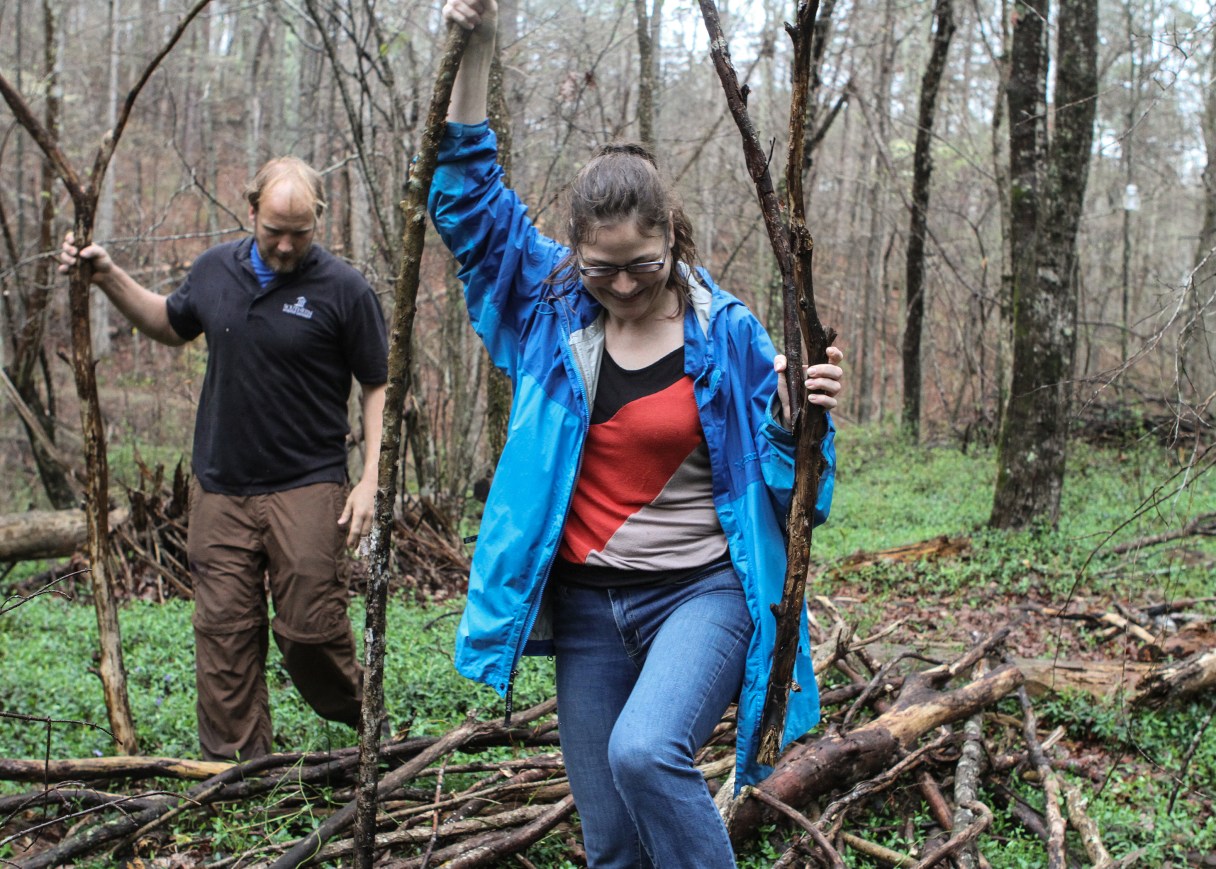
I live in a cozy-but small-duplex near the edge of downtown. But this downtown girl inadvertently brought a more uptown mentality to building a shelter in the woods, my final assignment in this survivalist series. “That’s great … if you have a large group. Or if you want to have a party,” Southern Adventist University Outdoor Adventure Program Coordinator Mike Harris interjects, as I fan branches taller than me from the crook of a tree to the ground in an attempt to build a crude teepee. “You don’t need a cathedral ceiling. Think about a bivy sack.” I didn’t know what a bivy sack is…
Much like the simple shelter provided by a bivy sack, which has evolved into essentially the smallest pup tent you can imagine, you want the top of your emergency shelter to be low to the ground. “The smaller, the better,” Harris says as he directs me away from my partly constructed penthouse teepee and guides me over to a large fallen tree. That’s because small shelters take less energy to construct, and to heat.
There was just enough room to shimmy under the tree trunk once the branches had been cleared. While you don’t want to be under a tree that’s about to fall-something most people don’t take into account, says Harris-being under one that’s already fallen can be ideal. It’s likely to already have a strong main support (the trunk) and, like a tree that’s about to fall, is a treasure chest of branches, which you’ll need to build your shelter. Just remember to test it, while looking up if the tree’s still standing, and to look down. Though you’ll want to create a bed of leaves to protect your body heat from the cold, hard ground, you should always check for black widows, brown recluses and snake holes. Maybe the fallen tree is too decomposed or not elevated enough? A stump sticking out of the ground is a great base for building a low teepee or lean-to, provided it’s sturdy. You can also use a forked tree to elevate your support beam, but remember: It must be sturdy, and the smaller, the better.
Whichever type of shelter you opt for, the construction is essentially the same. Before beginning, determine which way the wind is blowing. You’ll want to keep this in mind so you can shelter yourself from it, and so you don’t smoke yourself out if you build a fire. You’ll also want to consider the sun in regards to warmth-“where the sun sets and falls. You’re usually supposed to be on the south-facing side. It keeps the most heat,” Harris says. A lean-to will actually reflect the heat of a well-placed fire back into the shelter. But while smoke rises, it also settles, he warns. Again, the wind is crucial to consider when determining placement.
Create a wall of sticks by angling them from the ground up to your support piece, starting with the bigger sticks and working your way down in size as you build other layers. The angle of your sticks should be wide, says Harris, as the steeper the angle, the easier the structure will be brought down by rain. You can crisscross some of the smaller sticks for a thatched effect if you’d like. Be sure to angle the sticks from the ground up as you layer them; otherwise, you’ll create a rain spout right into your shelter. It’s OK if some of the outer sticks don’t reach all the way to the top. Then, cover your shelter with layers of leaves, perhaps even “weaving” them into the structure using the same thatching method.
Just don’t forget to leave a door, which you can cover with more sticks and leaves, a rock, or potentially just leave open. After all, I might want to come over for a party.
Words to the wise, from the wise (Mike Harris)
If lost, don’t move. You’ll waste energy and could reduce your chances of being found.Try to conserve energy in everything you do-part of why fallen trees and stumps are so great for shelter building.An evergreen tree is one of your best resources. In addition to kindle for fire and needles for bedding or shelter insulation, you could easily turn one with low-hanging branches into a shelter by anchoring them to the ground or a support. And, “They’ve got their own waterproofing system.”Privet, rhododendron, bamboo, river cane, young saplings and honeysuckle can easily be used as cordage, or rope.While water is essential for survival, building shelter in a flood-prone area, such as hollows/ditches, downhill or near a body of water that’s likely to rise (due to tides or rain), can mean death.Stay away from the valley, not necessarily because of water, but because “animals usually cut through valleys.”The Internet is a great resource for skills.You can use rocks or water heated in a fire as a heating pad, though you may need to put something between you and the rock or bottle of heated water.