
Monday, November 16, 2026Nov 16

Hungary buries remains of Holocaust victims found in Danube

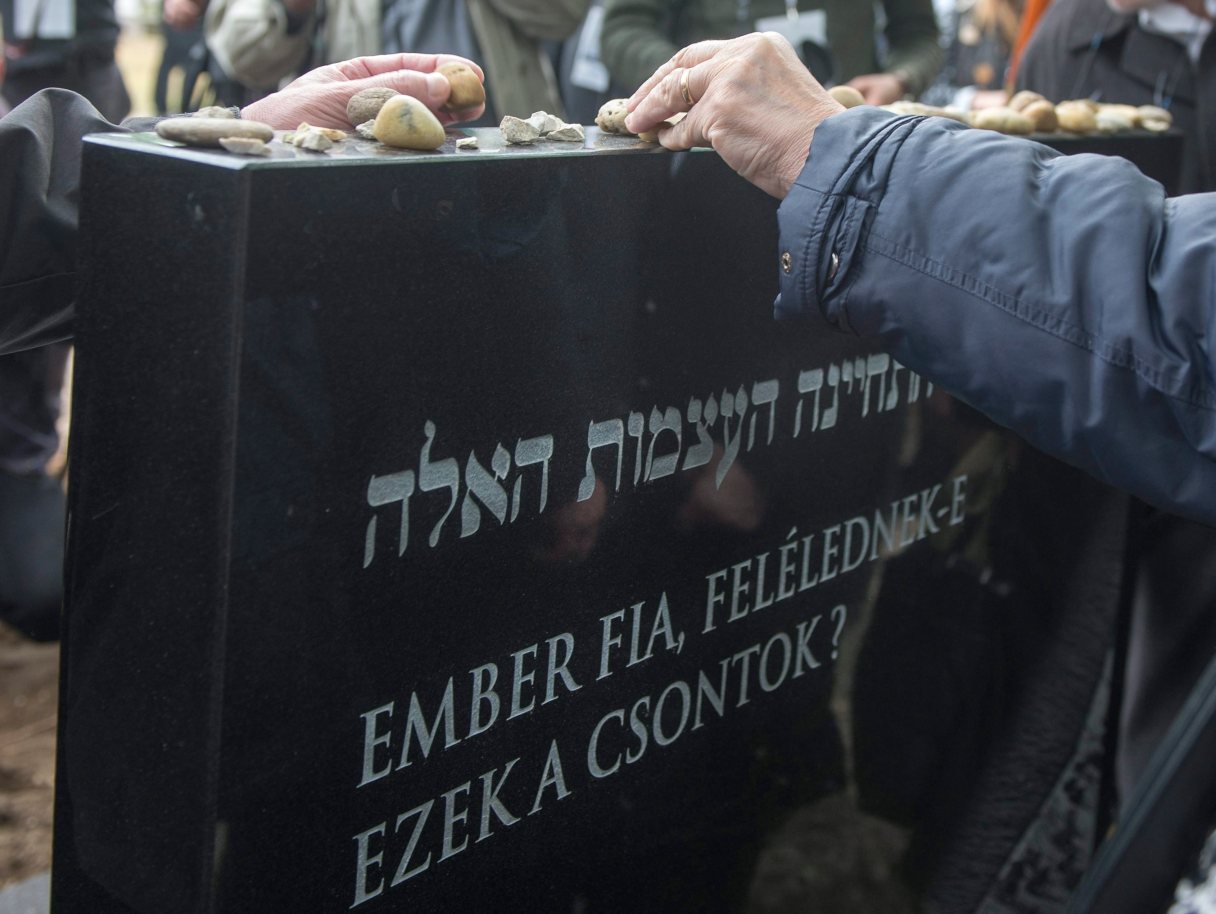
Attendees place pebbles atop a memorial tomb with the words 'Son of Man, shall these bones revive?' engraved on it during the burial service of the remains of Jewish people found in River Danube in the Kozma Street Jewish Cemetery in Budapest, Hungary, Friday, April 15, 2016. Human remains found in 2011, including many believed to be of Jews shot on the banks of the Danube River near the end of World War II, were buried Friday in a Jewish cemetery in Budapest. Two wooden caskets containing hundreds of bone fragments were laid to rest according to Jewish customs in a ceremony attended by Christian clergy and government officials.  (Tibor Illyes/MTI via AP)
Attendees place pebbles atop a memorial tomb with the words 'Son of Man, shall these bones revive?' engraved on it during the burial service of the remains of Jewish people found in River Danube in the Kozma Street Jewish Cemetery in Budapest, Hungary, Friday, April 15, 2016. Human remains found in 2011, including many believed to be of Jews shot on the banks of the Danube River near the end of World War II, were buried Friday in a Jewish cemetery in Budapest. Two wooden caskets containing hundreds of bone fragments were laid to rest according to Jewish customs in a ceremony attended by Christian clergy and government officials. (Tibor Illyes/MTI via AP)

BUDAPEST, Hungary (AP) – Human remains found in 2011, including many believed to be of Jews shot on the banks of the Danube River near the end of World War II, were buried Friday in a Jewish cemetery in Budapest.

Two wooden caskets containing hundreds of bone fragments were laid to rest according to Jewish customs in a ceremony attended by Christian clergy and government officials.

The remains were found during the renovation of Margit Bridge, which is located in an area of downtown Budapest where an estimated 3,600 mostly Hungarian Jews were executed by henchmen and allies of Hungary’s Arrow Cross, a pro-Nazi group that governed Hungary for a few months from late 1944.

“No similar series of murders took place in other large European cities. It is truly unique,” said historian Gabor Tabajdi. “Mass murders were taking place daily in the center of the city.”

Friday’s burial took place on the eve of Hungary’s Holocaust memorial day, which commemorates when Jews began to be placed in ghettos and camps ahead of their deportation to Nazi death camps. More than 420,000 Hungarian Jews were deported in less than 10 weeks and some 550,000 Hungarian Jews perished in the Holocaust.