
Friday, October 30, 2026Oct 30

This story is free to read.

NASA Mars test called success despite torn chute

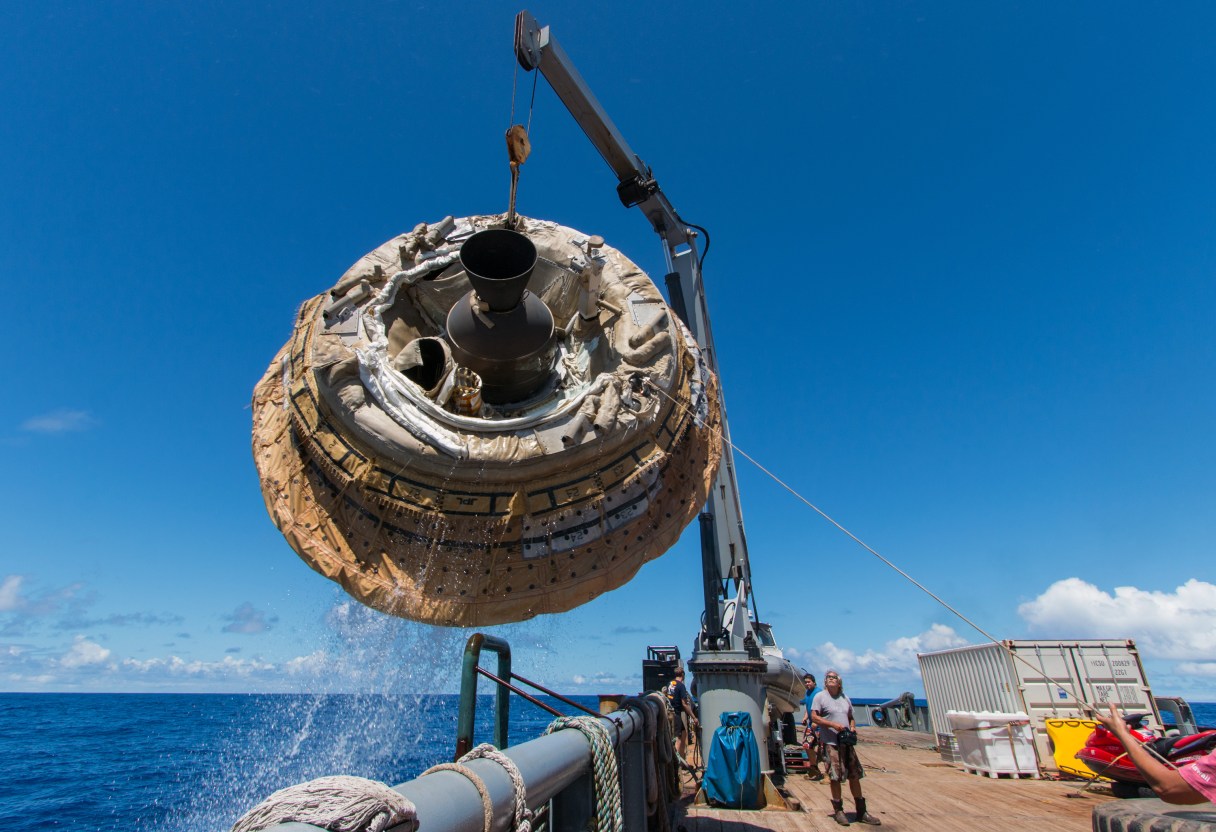
In this June 28, 2014 photo provided by NASA, NASA's Low-Density Supersonic Decelerator (LDSD) is lifted aboard the Kahana recovery vessel off the coast of the U.S. Navy's Pacific Missile Range Facility in Kauai, Hawaii. NASA engineers insist that a test of technology they hope to one day use above Mars achieved most of its objectives and taught them essential lessons for their next try despite a parachute that virtually disintegrated the moment it deployed. (AP Photo/NASA)
In this June 28, 2014 photo provided by NASA, NASA's Low-Density Supersonic Decelerator (LDSD) is lifted aboard the Kahana recovery vessel off the coast of the U.S. Navy's Pacific Missile Range Facility in Kauai, Hawaii. NASA engineers insist that a test of technology they hope to one day use above Mars achieved most of its objectives and taught them essential lessons for their next try despite a parachute that virtually disintegrated the moment it deployed. (AP Photo/NASA) In this June 28, 2014 photo provided by NASA, NASA's Low-Density Supersonic Decelerator (LDSD) is lifted aboard the Kahana recovery vessel off the coast of the U.S. Navy's Pacific Missile Range Facility in Kauai, Hawaii. NASA engineers insist that a test of technology they hope to one day use above Mars achieved most of its objectives and taught them essential lessons for their next try despite a parachute that virtually disintegrated the moment it deployed. (AP Photo/NASA)

LOS ANGELES (AP) – NASA engineers insisted Friday that a test of a vehicle they hope to one day use on Mars achieved most of its objectives, despite a parachute that virtually disintegrated the moment it deployed.

The engineers laid out at a news conference what they’ve learned in the six weeks since the $150 million high-altitude test of a vehicle that’s designed to bring spacecraft – and eventually astronauts – safely to Mars.

Engineers said they achieved the main objective: getting a flying saucer-shaped craft to 190,000 feet above the Earth at more than four times the speed of sound under test conditions that matched the Martian atmosphere.

“The vehicle did an amazing job of getting to the right speed and altitude,” said Ian Clark, principal investigator at NASA’s Jet Propulsion Laboratory.

As the craft prepared to fall back to Earth, a doughnut-shaped tube around it expanded like a Hawaiian puffer fish, creating atmospheric drag to dramatically slow it down from Mach 4.3, a task that weeks of analysis have shown it performed beautifully, NASA said.