
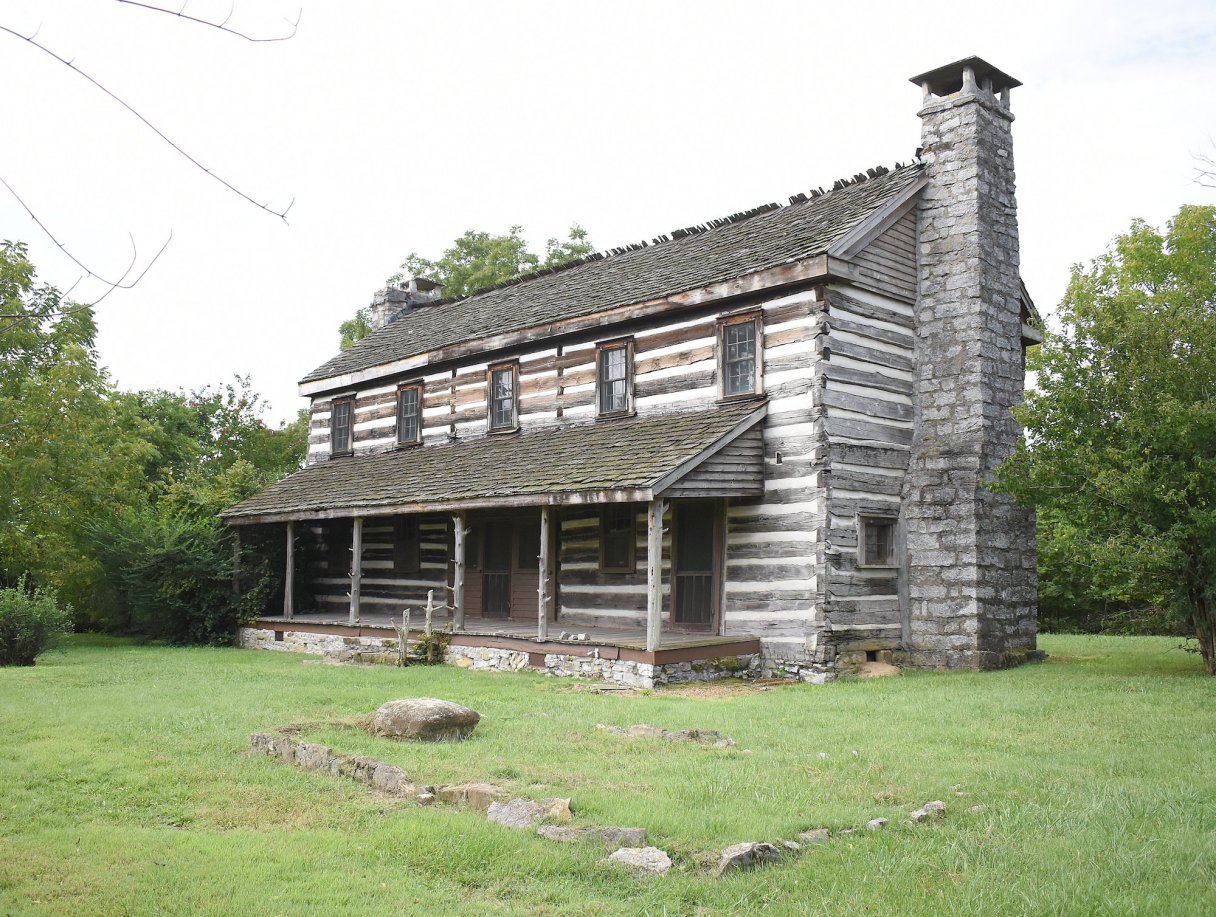
Brown’s Tavern, erected for John Brown in 1803 by carpenter Casper Vaught, is the oldest structure on its original foundation in Chattanooga. Brown’s father, Richard Brown, owned 640 acres on Moccasin Bend and across the Tennessee River, where his son operated the tavern and nearby ferry.
In 1805, Col. Return J. Meigs negotiated a treaty with the Cherokees providing for construction of the first wagon road through the Cherokee Nation. One fork of the road passed the tavern of John Brown and crossed the Tennessee River at Brown’s Ferry.
The Browns were mixed-blood Cherokees. Col. Richard Brown’s father, Chief John Lucien Brown, was half Cherokee and half white; his mother, Dolly Dean Brown, was a full blood. Selu Corn Woman, Richard Brown’s first wife, was the mother of his son, John Brown (sometimes referred to as John Brown Jr. after his grandfather), who built the tavern and was himself a chief. John Brown’s wife, Nancy, born about 1792, was a full-blooded Sioux adopted and raised as a Cherokee. Both Richard and John Brown fought under Andrew Jackson at the Battle of Horseshoe Bend during the Creek War of 1814.
John Brown maintained a farming operation and a mill on his land. In addition to the two-story tavern with fireplaces at both ends, there was a smokehouse, barn, hen house and an orchard. When his widow Elizabeth Brown, apparently his second wife and administrator of Brown’s estate, sold the property in 1847, it included the tavern, outbuildings and slightly more than 300 acres.
Brown moved to Walker County, Georgia, in 1830 when the Hixson family took over his ferry, but he moved back across the state line in 1835. He was living in his house during the Trail of Tears, when the Drane and Bell detachments crossed the river at Brown’s Ferry and the Whitely detachment camped nearby for three nights in June 1838.