
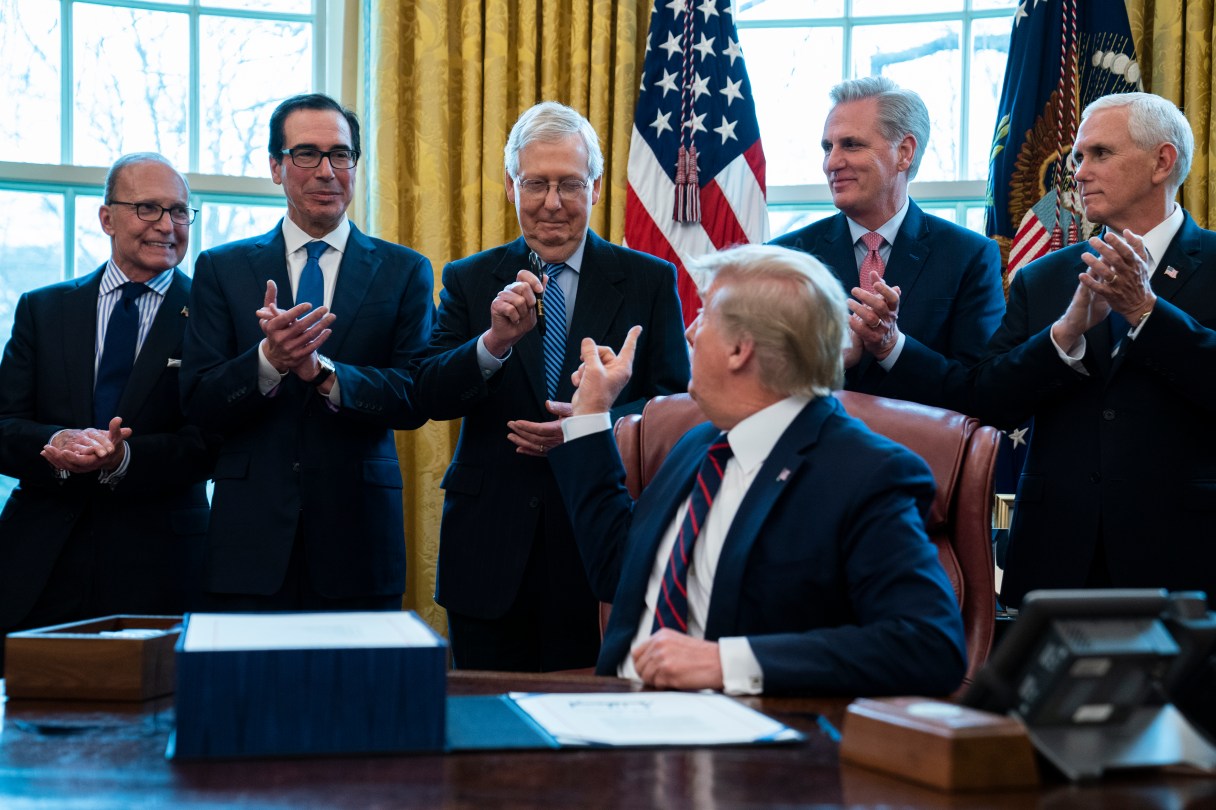
President Donald Trump aims to shovel $2.2 trillion into the U.S. economy over the next few weeks to try to cushion its free fall. But that means putting his fate in the hands of banks, profit-minded businesses and government bureaucrats he has frequently derided, along with a man who has emerged as arguably the biggest power broker to business in Washington: Treasury Secretary Steven Mnuchin.
The massive bailout package, which includes direct cash payments, $349 billion in loans for small businesses and a $500 billion corporate rescue fund, is the biggest ever in U.S. history. It’s an attempt to keep the economy afloat as Trump warns Americans to brace for a “hell of a bad two weeks,” with 100,000 to 240,000 coronavirus deaths now projected in the U.S. even if current social distancing guidelines are followed. At the same time, the country is hemorrhaging more than 3 million jobs a week, with economic forecasters warning of a deep recession that could compromise the Republican president’s reelection chances.
At the center is Mnuchin, a former hedge fund manager and movie producer who helped to write the package and shepherd it through Congress and now has enormous discretion over which industries are most in need and how to dole cash out accordingly.
And then there is the matter of the president – and questions about whether he’ll want to meddle.
Trump has already made clear he is more inclined to work with those who earn his favor, including returning the calls of governors who praise him and prioritizing requests for equipment and vital supplies in states that will be crucial to his reelection, like Florida.