
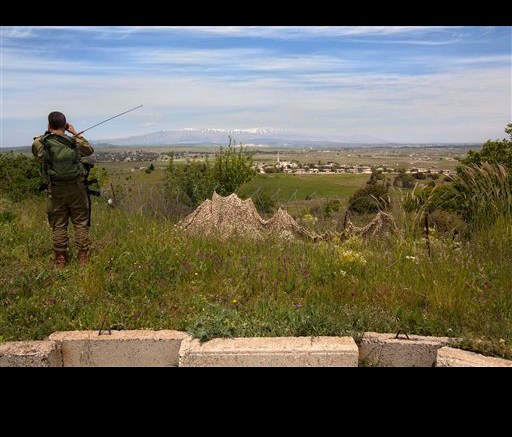
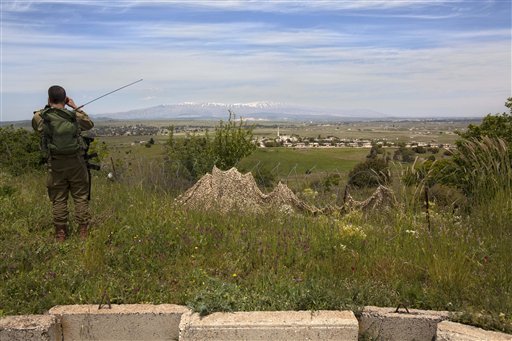
 In this photo taken Wednesday, April 24, 2013, an Israeli soldier looks through binoculars at a Syrian village from an army post on the border between Israel and Syrian on the Golan Heights. Against a breathtaking vista of green fields and a snowcapped mountain range, all is silent but for a strong gust of wind whipping across the landscape. The tranquility is suddenly interrupted by a burst of gunfire from beyond a newly built fortified fence: Jihadi rebels are battling with Bashar Assad’s battered troops in a nearby Syrian village. Watching it all unfold are Israeli soldiers atop tanks – a sight unseen here in a generation – and the sounds of explosions from a large-scale Israeli drill are distinctly heard in the background.
ALONEI HABASHAN, Golan Heights – Against a vista of green fields and snowcapped mountains, all is silent but for a gusting wind. Then comes a burst of gunfire from the Syrian civil war raging next door, where jihadist rebels are battling Bashar Assad’s troops in a village.
Watching it all unfold from a few kilometers (miles) away are Israeli soldiers atop tanks behind a newly fortified fence, while a large-scale Israeli drill sends off its own explosions in the background.
This is the new reality on the Israeli-occupied Golan Heights, for 40 years the quietest of Israel’s front lines, a place of hiking trails, bird-watching, skiing and winery tour. The military predicts all that will soon change as it prepares for the worst – a power vacuum in Syria in which rogue groups could get their hands of the country’s large stockpile of chemical weapons.
In many ways, a new era has already begun. The Syrian villages along the border change hands between military and rebel strongholds in daily battles. Their mortar shells and bullets frequently land on the Israeli side, including in some cases narrowly missing soldiers and civilians. A Syrian army tank shell landed in the border community of Alonei Habashan in February.
Though Israel believes these have mostly been cases of errant fire, it has responded with firepower of its own on several occasions in the first round of hostilities since a long-term armistice took hold after the 1973 Mideast war.