
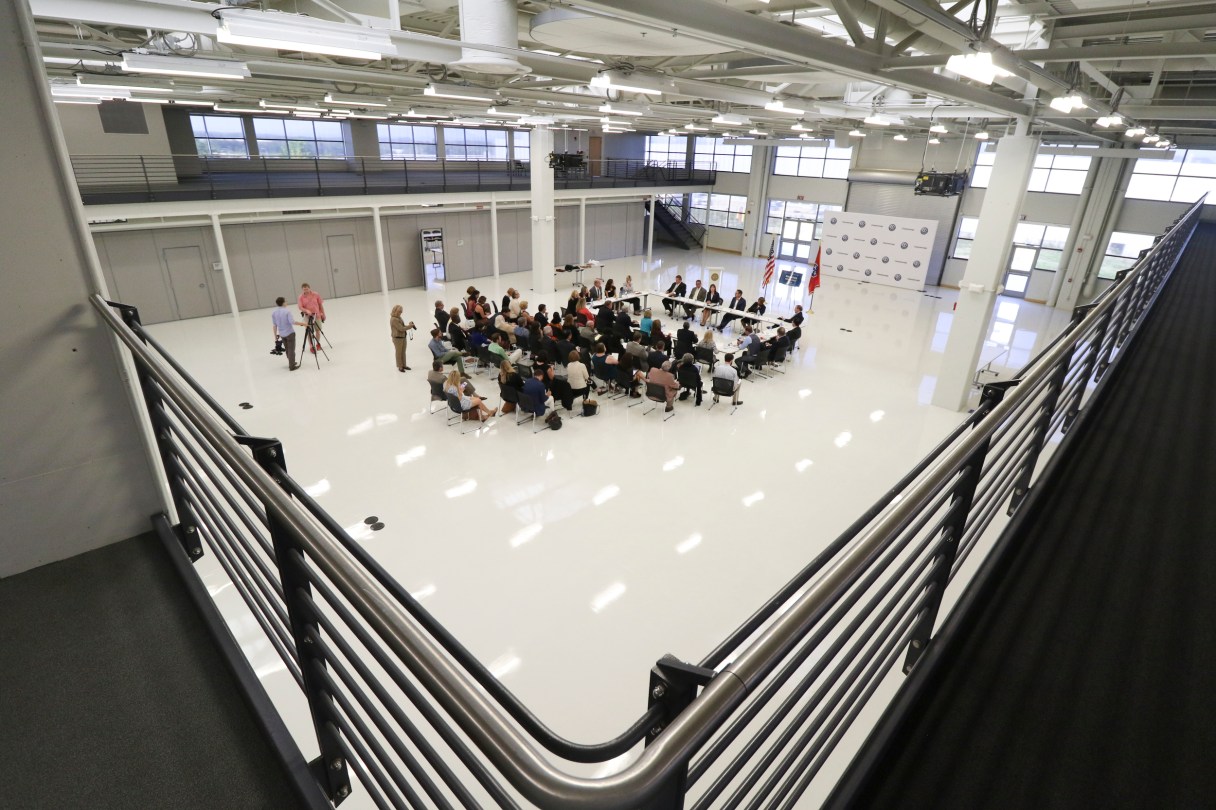
Tennessee Education Commissioner Candice McQueen told Hamilton County school administrators this week that they must must find “urgency” to improve schools – especially the county’s failing schools.
McQueen, in fact, made the point with so much of her own urgency that she repeated the word five times in her quiet but firm advice to school officials during a 90-minute education summit Tuesday convened at Volkswagen by Hamilton County’s legislative delegation, which invited itself into the overall community conversation about our struggling school district.
“You do need to feel some urgency around your priority schools,” she said.
Moments later she said it again and again: “You should feel incredible urgency. You have to have a plan. Create your plan around the right vision, have some metrics and align to the right goals and make sure your human capital is attached to that but urgency [is needed.] Capitalize on the moment You need action based on the right plan, and you have to have urgency.”
Five Hamilton County schools are in the bottom 5 percent of schools statewide, meaning those schools are designated as “priority” schools. If those schools, which have received $13 million in federal school improvement grants since 2013, don’t improve, they can be removed from the system and taken over by the state.
Yet despite the extra money, scores did not improve in those priority schools. Some 20 other priority schools across the state that also received extra federal money did improve. State officials in March provided Hamilton County educators with an autopsy of Hamilton County’s failure to improve teaching and student learning in our five priority schools – also referred to as our iZone schools.
That report states the county’s plan for using that extra money and the implementation of that plan were inferior, and the report faulted the school district’s leadership, lack of planning and lack of focus.
“The plan suggests schools are working in silos as opposed to working toward a clear vision A cohesive approach is essential and the review team was left with questions about the structure and capacity of district iZone leadership,” the report states.
State officials said the school district failed to equip and empower principals to lead and build culture, retained less effective teachers at higher rates than other iZones in the state, maintained chronic absenteeism far above state average and even failed to spend all the grant money during the years the funds were awarded.
Meanwhile, hundreds of children who should have been learning actually lost ground in our schools.
Here we are six months later. Following the report and other equally egregious school problems, the superintendent has retired and members of his administration have been promoted. But at the end of Tuesday’s education summit with McQueen and state lawmakers, our school officials still don’t really seem to have gotten the message McQueen was offering.
Chief Academic Officer Jill Levine told Times Free Press editors, “We do have a plan. A five-point plan.” And Interim Superintendent Kirk Kelly told Times Free Press reporter Kendi Rainwater that he thinks the district is “right on track,” and that an urgency already exists around improving priority schools.
Even to us, the new five-point plan seems a bit anemic.
It calls for improving “student engagement” by retaining more effective teachers (about 1 in 3 teachers in our schools are considered least-effective by state measures, and many are concentrated in the district’s predominantly poor and minority schools). The plan also calls for improved communication, climate and culture; improved literacy using “guided reading” (reading in small groups with a teacher); preparing students for college or jobs by increasing technical classes and working to increase the average ACT score from 19.1 to 21 in three years, and improving the district’s 16 lowest-performing schools. Some 20 percent of our schools are ranked in the bottom 10 percent of schools statewide, based on standardized testing.
Everything on this five point plan is something we parents might look at and say, duh. You mean teachers weren’t already sitting with students to teach reading? You mean you were not already supposed to be preparing students for college or jobs? Have our school leaders thought they were running a 12-year daycare system?
It’s good that Hamilton County’s legislative delegation arranged Tuesday’s summit. But perhaps they also need to draw our school leaders a picture. Or maybe they just need to let the state take over our priority schools – or our whole system. After all, 60 percent of our third graders cannot read at their grade level.
In horrifying and practical terms, our school system has failed an entire generation of children – Hamilton County youngsters who likely now will carry for their whole lives the educational foundation – or dearth of one – that we provided with school leadership that has seemed incapable of charting its way beyond a wish list to a solid plan.
The Hamilton County Board of Education should move immediately to begin a national search for a new schools superintendent – one not from here, one not blinded with tunnel-vision, one who does not shy from change, and one not afraid to rearrange the house. Our children don’t have another moment to lose.