
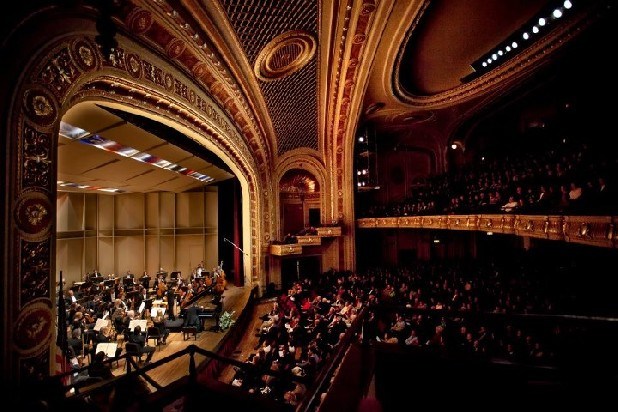
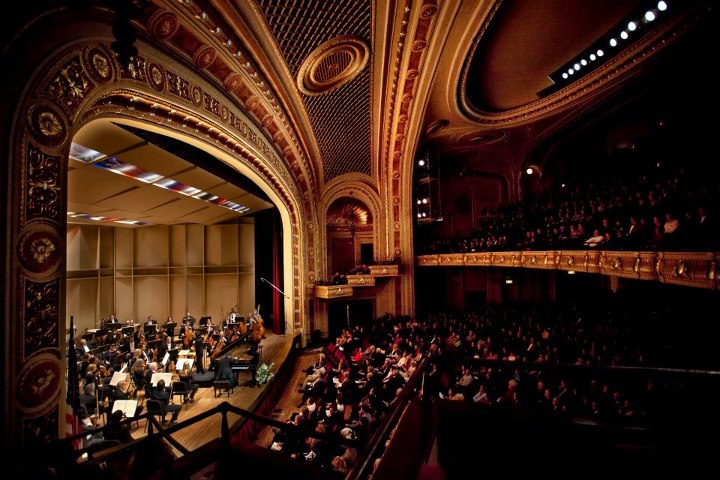
 The Chattanooga Symphony performs in the Tivoli.
Love was definitely in the air at the Tivoli Theatre last night as the Chattanooga Symphony Orchestra, led by Maestro Kayoko Dan, celebrated the Bard of Avon’s 450th musical tribute to affection–both blissful and unrequited.
The trip down Lover’s Lane began with Tchaikovsky’s emotionally wrenching “Romeo and Juliet Fantasy Overture,” (1870). Try as we might, it is nearly impossible to connect this composition with any romantic events in the composer’s life at the time. While it’s true that he wept openly at his rejection by the singer Desiree Artot, he seems to have suffered nothing as profound as the protagonists in his music. One is free to connect the events of Shakespeare’s tragic drama with certain aspects of the overture, but it may be most fulfilling just to revel in the range of emotions-from swirling ecstasy to
suffocating despair-all set to the lushest of melodies.
The CSO performed this familiar work very musically and with excellent control, but it seemed a little tame, never descending to the dark side or exulting in the magic of two hearts become one. Perhaps the passage of time has eased the intense feelings a bit.
On a less tragic note was the performance of Felix Mendelssohn’s “Midsummer Night’s Dream Suite” (1827 & 1843). While a black cloud seemed to follow Tchaikovsky around, Mendelssohn lived in the sunlight, and his music emanates a radiance that balances his Russian counterpart well. This suite (multiple independent movements) saw its beginnings in the composer’s 17th year as he spun out the “Overture” to accompany a production of “Ein Sommernachtstraum,” the German version of Shakespeare’s comedy. This composition is often referred to as “incidental music” because it wasn’t designed as the focus of audience attention. More like film music or an overture to an opera, it set the mood and described some of the action in the play.
Nearly two decades later, the composer was asked to furnish additional material for the same play, and he complied with music to entertain between scenes, under dialogue, for dancing and marching, or just a single held note to produce the right atmosphere. Today all that music has been collected into five separate movements.
The Overture suggests fairies that began as a bit disorganized lot but soon gave us a sparkling show and musical “donkey calls,” recalling the character Bottom from the play. It’s really hard to imagine that a lad of 17 (Mendelssohn) could capture such depth and maturity at that age. The following Intermezzo – originally designed to connect Acts 2 and 3 of the play – was most engaging with a focused intensity that was new for the evening. Then came one of the most haunting horn calls in all orchestral literature as principal horn Gordon James floated aloft the tender theme from the movement Nocturne.
The third section, Scherzo, produced a bevy of fairies again, with impressive nimbleness from the strings and woodwinds, especially flutists Kristen Holritz and Nora Kile.
The finale, Wedding March, is familiar to anyone who has witnessed a traditional ceremony. In America, the work – filled with layer on layer of fanfares plus a noble middle section-is known as the Recessional (the bride and groom’s march out of the church after the wedding), but in England, it is often associated with the bride’s entry down the aisle as popularized by Victoria Adelaide, the Princess Royal and daughter of Queen Victoria in 1858. It has remained a wedding staple ever since and kept birthday, “Shakespeare in Love,” with a year as he spun out Mendelssohn’s music in the public ear. The CSO offered a fine performance of this orchestral standard.
Much as Mendelssohn’s suite morphed from originally-fragmented materials meant to accompany a drama, so too did Leonard Bernstein’s “Symphonic Dances from West Side Story” ripen into a concert work from his earlier Broadway masterpiece. Because this music was composed to dramatize the events of the story-the star-crossed Romeo and Juliet become the ill-fated Tony and Maria in the musical-the story itself is quite evident in the music.
However, as often happens in music composed to support a story – as in Wagner’s operas – the music takes over and becomes an end in itself. This is certainly the case here where it’s not necessary to know or care about the plot, as Bernstein’s creation rises to the level of a masterpiece, standing on its own musical feet.
This work, in nine movements, is a killer for orchestra. It plumbs the emotional depths as much as Tchaikovsky’s work but changes musical styles on a dime and is insanely fragmented-with bits and pieces of music flying from one part of the orchestra to another. By the time the performers got to movement four – Mambo – Kayoko Dan was driving them on all musical cylinders and the ensemble was really cooking. It continued to sustain that energy through the eighth-movement Rumble and ended with a gorgeous, prayerful Finale.
It is little short of amazing that a work of rather popular music, composed over fifty years ago (1961), could still seem so fresh and fascinating after countless performances. But that was the genius of Bernstein-and Mendelssohn and Tchaikovsky, for that matter.
“Shakespeare in Love” was a creative thematic programming idea that worked well and allowed listeners to enjoy some beloved classics. The first two selections were introduced with short scenes by costumed players from Shakespeare Chattanooga that gave the musical selections a needed connection to the theme.
A great evening for those in love – with great music.