
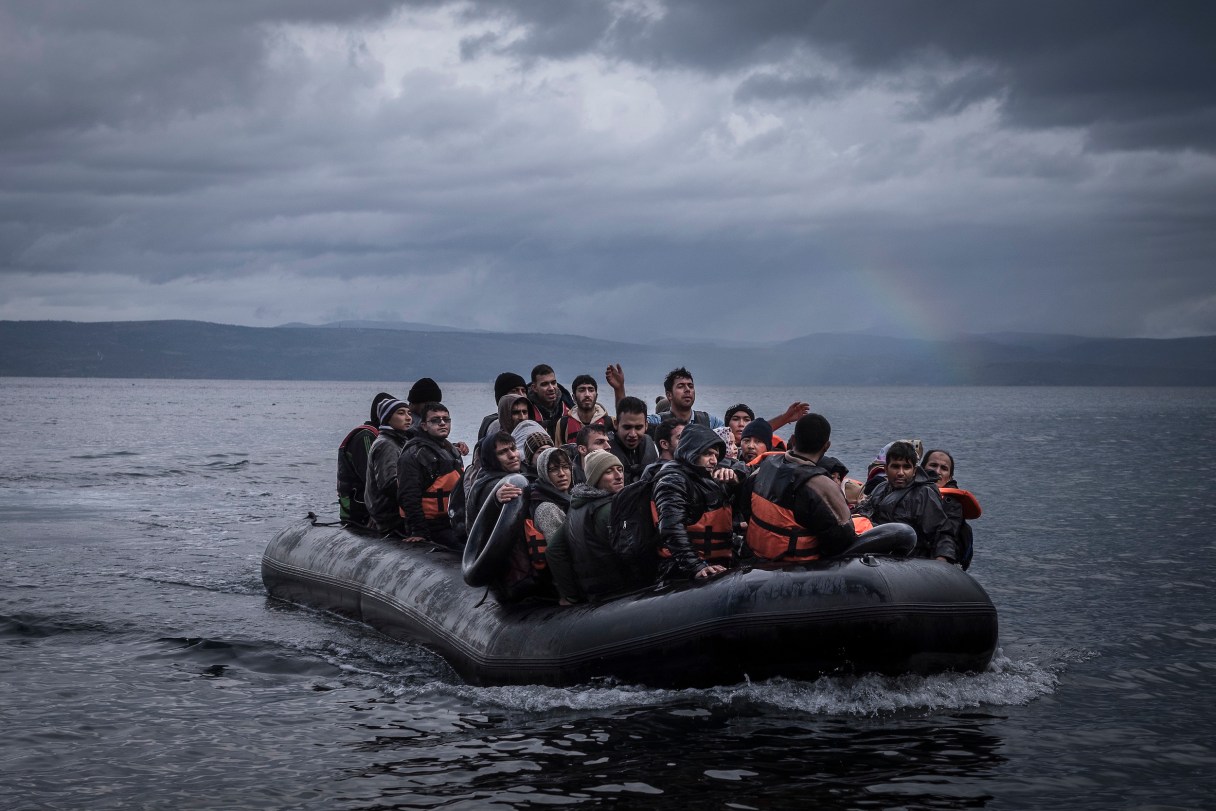
STOCKHOLM – Now in his last year in office, President Barack Obama is in legacy mode. He has much to be proud of. But if he doesn’t want his achievements muddied by foreign policy, he’ll spend his last year redoubling his efforts to contain the Middle East refugee crisis before it goes from a giant humanitarian problem to a giant geostrategic problem that shatters America’s most important ally: the European Union.
I know – putting “European Union” into the lead of a column published in America is like a “Do Not Read” sign. Maybe I should call it “Trump’s European Union.” That would go viral. But for the two of you still reading, this is really important.
The meltdowns of Syria, Somalia, Eritrea, Mali, Chad and Yemen and our takedowns of Libya, Iraq and Afghanistan – without proper follow-up on our part, NATO’s part or by local elites – has uncorked the worst refugee crisis since World War II. This tidal wave of migrants and refugees is a human tragedy, and their outflow from Syria and Libya in particular is destabilizing all the neighboring islands of decency: Tunisia, Jordan, Lebanon, Kurdistan and Turkey. And now it is eating away at the fabric of the EU as well.
Why should Americans care? Because the EU is the United States of Europe – the world’s other great center of democracy and economic opportunity. It has its military shortcomings, but with its wealth and liberal values, the EU has become America’s primary partner in addressing climate change, managing Iran and Russia and containing disorder in the Middle East and Africa.
At a seminar in Davos, Switzerland, sponsored by the Wilson Center, I interviewed David Miliband, president of the International Rescue Committee, which oversees relief operations in more than 30 war-affected countries. He made several key points.
First, one in every 122 people on the planet today is “fleeing a conflict” at a time when wars between nations “are at a record low,” said Miliband, a former British foreign secretary. Why? Because we now have nearly 30 civil wars underway in weak states that are “unable to meet the basic needs of citizens or contain civil war.”
Second, he said, last year the rescue committee assisted 23 million refugees and internally displaced individuals. Some 50 percent of those going to Europe come directly out of Syria and most of the rest come from Iraq, Afghanistan, Somalia and Eritrea – and the international humanitarian relief system “is now being overwhelmed by the numbers.”
More and more countries are now sealing their borders, and anti-immigrant parties are rising everywhere. Sweden has imposed border controls, and its ultranationalist Sweden Democrats party has grown from the fringe to one of the largest. Many in Germany, Sweden and Austria, which have accepted the lion’s share of refugees so far, want to seal off Greece from the EU’s passport-free internal travel zone if Greece – the first port of entry of many refugees – is unable or unwilling to hold them.
Chancellor Angela Merkel of Germany was well intentioned when she opened her country to 1.1 million Arab, African and Afghan migrants last year, but it was also reckless of her to think that so many immigrants, primarily Muslims, could be properly absorbed so quickly into society in Germany – a country that took two decades and billions of dollars to absorb East Germans.
“This refugee crisis is a real arrow pointed at the heart of the European Union,” said Miliband. “There is no solution that confines itself within the borders of Europe.”
Obama did not cause this Syria problem, and he can’t fix it alone – but it’s not going to get fixed without U.S. leadership. I have shared the president’s caution about getting involved on the ground in Syria. But I now believe we need to take another look at establishing some kind of U.S./EU/NATO safe zone inside Syria and Libya to create space for refugees to remain in these countries. It’s not a panacea or cost-free, but letting this refugee disaster fracture the EU will be a lot more expensive.
The New York Times